← All network guests
Colby Wagner
Mornings in the Lab · Center Stage

Colby Wagner

Founder, Autonomy Agency

Sustainable agency growth frameworksWork-life balance for entrepreneurs
Watch the conversation
Watch on YouTube ↗

Questions this episode answers

How does Colby Wagner recognize burnout warning signs?

Colby says he now pays attention when he senses he needs a break instead of ignoring the signal. He describes recovery as a continuing process of small decisions rather than a problem he has permanently solved.

Read this moment in the transcript →

How did Colby Wagner become more open about burnout?

Colby describes telling his wife when he notices an early warning sign. He contrasts that with previously bottling things up because he felt he had to look okay on the outside.

Read this moment in the transcript →

How does Colby Wagner choose what to work on first?

Colby writes down the three things he hopes to do each day and marks the one he believes will have the greatest impact. He starts there and says he is learning to avoid overplanning, even if the other two items remain unfinished.

Read this moment in the transcript →

Summary

Colby Wagner describes burnout recovery as an ongoing process of noticing warning signs and making small changes. He reflects on speaking more openly with his wife and leaving his agency after questioning where he could fulfill his potential. For work, he favors managing energy and starting with the most consequential item on a short daily list.

Key takeaways

  • Wagner links his burnout to repeatedly ignoring signals that he needed a break or a better food choice; he now pays attention to those smaller decisions.
  • He describes telling his wife when he notices a warning sign instead of concealing his struggles to look okay.
  • He writes down three daily priorities, marks the activity with the greatest potential impact and starts there, even if the other two remain unfinished.
Read the transcript →

Jump into the conversation

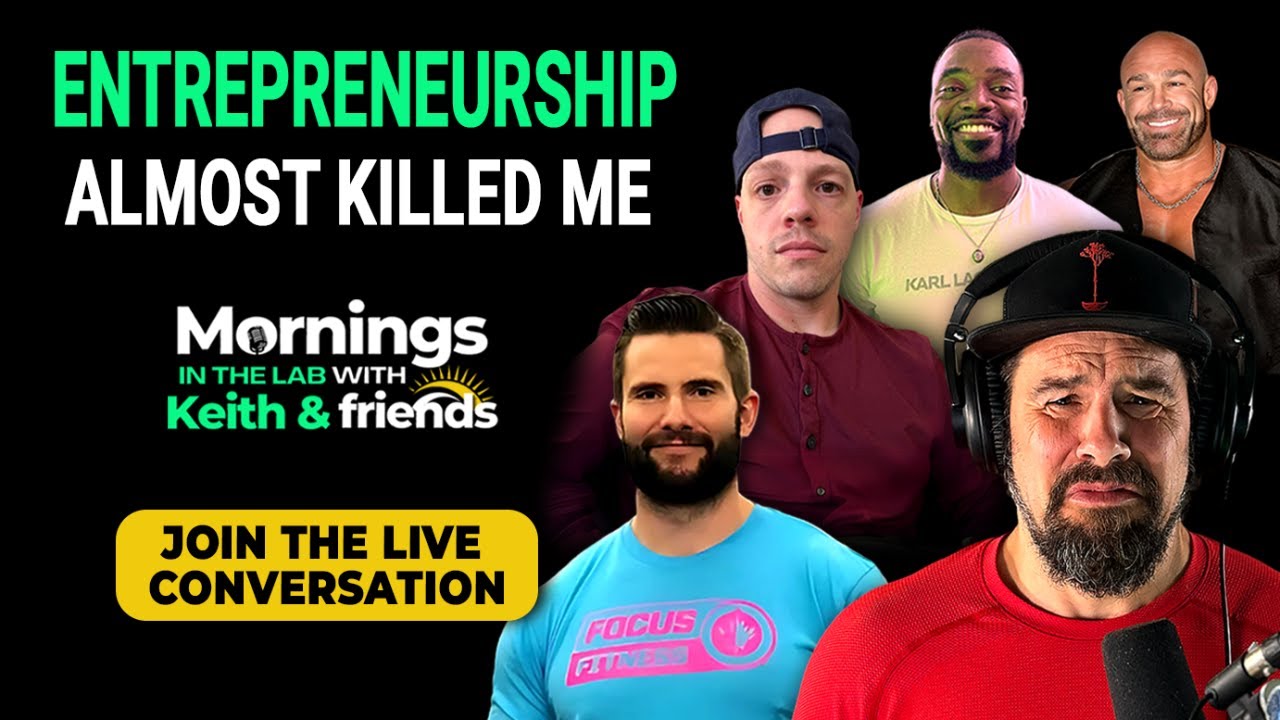
Surviving Burnout: Colby Wagner's Journey to Purpose and Balance
  1. 00:00Introduction and Welcoming Colby Wagner
  2. 00:18Colby's Background and Milwaukee Discussion
  3. 01:01Founding the Autonomy Agency
  4. 01:51Colby's Journey Through Burnout
  5. 03:21Transition from Teaching to Marketing
  6. 05:47Colby's Early Marketing Career
  7. 07:24Morning Show Wrap-Up and New Guest Introduction
He Almost Died From Being an Entrepreneur: Burnout Will Kill You
  1. 00:00Introduction and Today's Agenda
  2. 02:11Celebrating Kristina's Birthday
  3. 02:29The Importance of Mental Health
  4. 03:01Upcoming Segments and Guests
  5. 04:19Community Engagement and Show Growth
  6. 09:30Mental Health Awareness Discussion
  7. 29:09Fitness Tips with CMartyFit
  8. 35:09Colby's Daily Struggles and Routine
  9. 36:15Burnout and Micro Decisions
  10. 37:48Marty's Approach to Burnout
  11. 39:31Community Interaction and Advice
  12. 43:10Setting Limits Without Limiting Yourself
  13. 50:10The Importance of Resilience
  14. 52:34Balancing Self-Care and Responsibilities
  15. 56:31The Role of Resilience in Success
  16. 01:07:40The Future of Technology and Privacy Concerns
  17. 01:15:46Functional Training Insights
  18. 01:16:08The Importance of Squats
  19. 01:19:02Mastering the Deadlift
  20. 01:22:13Stretch Therapy and Functional Movements
  21. 01:24:52Daily Functional Tips
  22. 01:29:05Community Corner and Show Wrap-Up

Their story

Colby Wegter did not plan to build a coaching empire. He planned to run a marketing agency. What happened instead — burning out twice in the same year, watching his health deteriorate, navigating the near-collapse of everything he had built — turned out to be the most important education of his professional life. Today, as the founder of Autonomy Agency, he teaches other marketing agency owners how to do what he could not: build a business that does not require their constant presence to survive.

Read the full guest story

Colby Wegter did not plan to build a coaching empire. He planned to run a marketing agency. What happened instead — burning out twice in the same year, watching his health deteriorate, navigating the near-collapse of everything he had built — turned out to be the most important education of his professional life. Today, as the founder of Autonomy Agency, he teaches other marketing agency owners how to do what he could not: build a business that does not require their constant presence to survive. Colby grew up as the youngest of four kids — by his own description, an accidental leader from the beginning. He was never the student council president at his small school of 36 students, never the one people pointed to as the natural authority. But something happened in his late twenties when he and his team began scaling their marketing agency: he realized that being responsible for other people's livelihoods demanded a different version of himself. He became, as he puts it, obsessed with the trade of leadership. The agency grew. And then it broke him — twice. Colby burned out not once but twice in the same year. The first time, it showed up quietly: his wife hit her limit before he acknowledged his own. The second time came with greater physical and psychological urgency. Both times, he had created the problem himself. He had said yes to everything. He wrote every word on the company website, managed 50 clients simultaneously, led five direct reports, and spent years running on raw willpower and the mistaken belief that the business needed him everywhere at once. What followed those two burnouts was a period of ruthless self-study — Warren Buffett on the power of saying no, Brené Brown on daring leadership, Simon Sinek on why, Adam Grant on work and identity. Colby began to dismantle the founder overdependence that had nearly destroyed his health, and to build in its place a set of systems that meant the business could run — and thrive — without him physically present for every decision. The proof came when he took a three-month sabbatical. He returned to find his team stronger and more organized than when he had left. Six months of preparation had made that possible. It was, for him, the confirmation: the right systems don't just free the founder — they make the organization more durable. Autonomy Agency was born from that realization. Colby's community and coaching practice now works with marketing agency owners — one of the most isolated, burned-out, and underserved populations in entrepreneurship — helping them 2x, 3x, or 4x client retention, extend the lifetime value of every client relationship, and build the kind of sustainable growth that does not require sacrificing their families, sleep, or health. In an industry where the average client relationship lasts eight months, Colby's own agency kept clients for five to six years. Recognized as a top 1% globally ranked digital marketer, Colby brings 12 years of agency experience and thousands of clients' worth of hard-won knowledge to the mission he has defined for the second chapter of his career: helping others find time and financial freedom through their agency — with as little stress as possible. He lives in Milwaukee, Wisconsin — a city he has come to love despite the cold — and joins Mornings in the Lab's Center Stage as a voice for purposeful, system-driven entrepreneurship.

In their own words

Burning out twice and rebuilding with purpose

After burning out twice while running a multi-million dollar agency, Colby shifted gears to focus on balance, purpose and sustainable growth.

The detail that this happened twice — not once — is critical. The first burnout is often dismissed as a fluke. The second demands a reckoning. Colby's willingness to burn out twice and then build a coaching practice entirely around what he learned is what gives his message credibility.

Radical ownership of burnout and founder overdependence

I burnt out because of me. I said yes to everything. I wrote every word on our website. I had I was managing 50 clients at a time. I managed five other people. I said yes to everything.

This is an unusual admission in entrepreneurship culture, where burnout is often blamed on external pressures. Colby's radical ownership of his own burnout is the foundation of everything he now teaches: the problem isn't the agency model, it's founder overdependence.

Sabbatical as proof: systems outlast the founder

I took a three-month sabbatical last year and when I came back the team, the organization was stronger and better than it was before I left.

This is the living proof of concept for Colby's entire philosophy. Six months of system-building preparation made a three-month absence not just survivable but generative. It is the outcome every agency owner reading his content is trying to achieve.

The power of no: Warren Buffett's lesson applied

Warren Buffett said the most successful people say no to almost everything — I learned that after burning out twice.

The delayed application of Buffett's most famous productivity insight gives this quote its weight. Colby didn't read this and act on it immediately — he learned it through two failures. The lesson cost him, which is exactly why it now defines how he teaches.

Leverage thinking: multiplying impact through coaching

I thought if I could help other marketing agency owners in particular, that expands that impact so much further — because one marketing owner could have 20, 30 clients. Now we're talking a thousand at a time.

This is Colby's leverage insight: transitioning from serving agency clients directly to coaching agency owners multiplies his impact exponentially. It is the thinking behind every great coaching practice — working at the level of the multiplier, not the individual.

12 years and 1,100 clients: the credibility foundation

I've had 1,100 marketing clients in my career but I thought if I could help other marketing agency owners that just expands that impact.

1,100 clients over a career is a data point that establishes serious credibility. Colby is not a coach who has read about agency life — he lived it at scale, across multiple cities (New York, Chicago, Milwaukee), and built the systems under real pressure.

Client retention: 5-6 years vs. industry average of 8 months

In the agency world, we keep clients for five to six years when the industry averages like eight months.

An industry average of eight months compared to five to six years is not a marginal improvement — it is a categorical difference. This is the metric that makes Colby's methodology not just philosophically appealing but financially transformative.

Presence and engagement: showing up fully wherever you are

I lived in New York, Chicago, Milwaukee — I thought it would be more boring than it is. Milwaukee's got plenty to offer.

A small moment that reveals something important about Colby's character: he engages fully wherever he is. The same spirit of showing up present — in a city, in a client relationship, in a coaching conversation — runs through everything he does.

Appearances & videos

Original interview details

Journey to Purpose and Balance

Episode #CS-004

Center Stage

  • Mornings in the Lab · Center StageAugust 1, 2025Watch →

From the interview

I burnt out because of me. I said yes to everything. I was managing 50 clients at a time. I said yes to everything.
I took a three-month sabbatical last year and when I came back, the team, the organization was stronger and better than it was before I left.
I thought if I could help other marketing agency owners, that expands that impact so much further — now we're talking a thousand at a time.

The guest conversation

The original excerpt is preserved below, followed by an additional guest conversation. Timestamps refer to each recording.

Original published excerpt Colby wgar joining us here in the live what a shaking Colby wgar hey how's it going guys thr how are you how are you how are you I got to do I got to do something here because I missed my button and it's this button right here boom there he is yay we're bringing Kobe on stage I'm honored thanks for having me yeah so where do you join us from today Kobe physically geographically where are you joining us from today on the planet Colby I'm sitting in Chile Milwaukee Wisconsin right now oh there you go so I read a story this sworn that Milwaukee Wisconsin the Green Bay Packers they did a poll of NFL players Marty they did a poll of NFL players the two worst places to go play football was Buffalo and Milwaukee because Green Bay kby was that's boring there it's too cold there nothing to do there and I'm like wait a minute that's like Winnipeg all the hockey players …

Read the full transcript →
Conversation topics

Introduction from Milwaukee: breaking the boring myth · ~2 minutes · Colby joins from Milwaukee, Wisconsin. Light banter about the city's reputation establishes his grounded, self-aware personality before the conversation turns substantive. · From multi-million dollar agency to burnout: the story · ~5 minutes · Colby recounts the arc of his marketing agency — building it from scratch, scaling to multi-million dollar revenue, managing 50+ clients and multiple staff, and the cumulative weight that led to two burnouts in the same year. · Burnout one: the first warning that was ignored · ~3 minutes · The first burnout — his wife's breaking point as the signal he wasn't reading about himself. Why the first one wasn't enough to change his behavior and what that says about founder psychology. · Burnout two: the reckoning · ~4 minutes · The second burnout, more physical and psychological, and why it forced the change the first one didn't. Colby's radical ownership of the cause: he said yes to everything, he was the bottleneck, he built the conditions for collapse. · The rebuild: systems, leadership literature, and letting go · ~4 minutes · How Colby rebuilt — Warren Buffett on saying no, Brené Brown on leadership, systematic delegation, and the six months of preparation that made a three-month sabbatical possible. · The sabbatical test: returning to a stronger organization · ~3 minutes · Colby's three-month sabbatical as the ultimate proof of concept — and what it meant to return and find the organization not just intact but improved. The goal every agency owner is working toward. · Building Autonomy Agency: the multiplier insight · ~4 minutes · The decision to pivot from running an agency to coaching agency owners — the leverage insight that helping 20-30 agency owners impacts a thousand clients at a time, rather than serving clients one by one. · Client retention: 5-6 years vs. the industry's 8-month average · ~3 minutes · Colby's data point that separates his methodology from the competition: keeping clients for five to six years in an industry where eight months is the norm. The business case for retention-first thinking. · Practical advice for agency owners in the audience · ~3 minutes · Concrete takeaways for agency owners feeling the early signs of burnout or founder overdependence — where to start, what to prioritize, and how to begin the transition from doing everything to building systems.

Appeared in