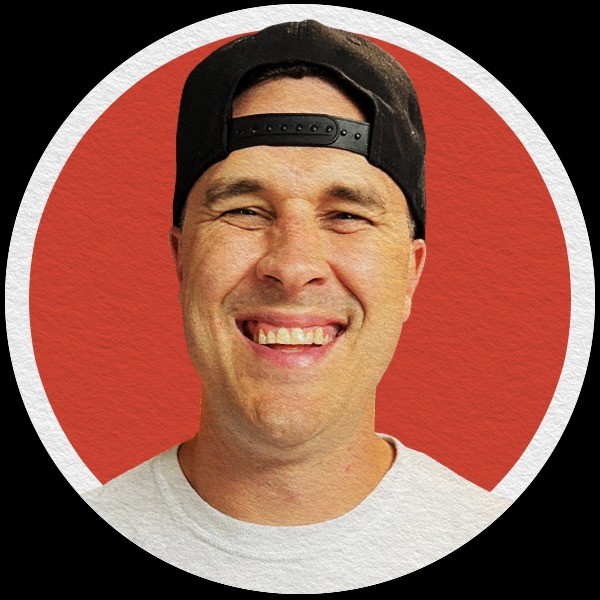
Daniel Brenneman spent years being the person everyone called when something needed to get done — and never the person anyone could easily describe. He worked as a graphic designer. Then a strategist. Then an email marketer. He served on church staff, filled fractional roles, took on whatever needed taking on. Each time a project called for a different skill, Daniel was the one who figured it out. 'Hey, Daniel can figure that out' — it became his informal title. And for a long time, that versatility felt like a limitation: he always moved sideways, never up, because he was too useful in too many directions to be promoted in any single one.
Read the full guest story
Daniel Brenneman spent years being the person everyone called when something needed to get done — and never the person anyone could easily describe. He worked as a graphic designer. Then a strategist. Then an email marketer. He served on church staff, filled fractional roles, took on whatever needed taking on. Each time a project called for a different skill, Daniel was the one who figured it out. 'Hey, Daniel can figure that out' — it became his informal title. And for a long time, that versatility felt like a limitation: he always moved sideways, never up, because he was too useful in too many directions to be promoted in any single one.
That changed when the people around him started naming what they were seeing before Daniel could name it himself. Colleagues and collaborators, one after another, began pointing to something they'd noticed: a rare ability to take complex concepts and reduce them to their essential clarity. A storytelling instinct in the brand work he created. A way of relating to and leading people that felt unlike anything they'd encountered in someone performing a similar function. 'What you do is really unique,' they told him. And for the first time, Daniel stopped dismissing that as flattery and started treating it as data.
What he discovered, through that process of excavation rather than fabrication, was that his identity — his real brand — had always been there. It lived at the intersection of every role he'd cycled through: the designer's eye, the strategist's framework, the marketer's understanding of what moves people, the empathic communicator's ability to make others feel genuinely seen. None of those were separate. They were concentric circles. And at the point where they all overlapped was something no competitor could replicate, because no competitor had walked the same winding road to get there.
Based in Charlotte, North Carolina, Daniel Brenneman is the founder of his own personal brand practice and co-founder of Empathy Marketing Co. His current work focuses on helping pro athletes, high-performing professionals, and purpose-driven entrepreneurs excavate their own remarkably unique brand identities — the ones built from lived experience, not manufactured positioning. He teaches that personal brands are not fabricated; they are discovered. And his methodology, rooted in the intersection of origin story, skills, values, and the patterns in one's own history, is the kind of framework that produces depth rather than surface.
His morning routine tells you everything about how he's wired: coffee, Bible reading, LinkedIn brain games to activate his thinking, time with his kids before school, and then — first thing, every weekday — a LinkedIn post. Not because the algorithm demands it, but because talking about what he is trying to bring into the world every day keeps him accountable to the mission. Daniel appeared on the Center Stage segment of Mornings in the Lab to share the blueprint behind his approach — and to make a case that feeling trapped in someone else's box is always, ultimately, a signal that you haven't found your own yet.