I have notified the authorities. He is questioning the coffee machine. Nation, tag someone who treats caffeine like a constitutional right. I met someone recently who paused when I asked what they did. They'd just left a job they'd had for years. That's a hard question. The answer you've given for years suddenly doesn't fit. Right. When the job title goes away, are you figuring out what to say or figuring out who you are without it? Maybe start with what you miss. The work, the people, or feeling needed? Those aren't the same loss. Keith and Jon, here's the question: How do you honor a role that mattered without letting it be the only way you see yourself? All right. Are you a title person? Yeah, I lo- So, let's get into this conversation with titles. Who are you without the title? Because some folk, without the title, they lose themselves. And, uh, today the conversation is gonna go exactly about that. If you don't have the title, who are you? Yes. Are you, uh, are you absent? Are you lost? Are you somebody that is identified by the title on your name? Because it can also be a, a, a thing that holds somebody back. Now, listen, I don't, I don't want to sit here and tell somebody how, uh, how that person should feel, you know, liberated by the title they do or don't have. Um, Jon, let's talk about the titles a little bit. When you see somebody with a title, does that mean anything more to you? And I believe I know your answer, but does it, does that give you credibility? Uh, does it, does it, does it, does it, does that title, those letters before the name or after the name, uh, give you more questions to ask, or does it walk you into a conversation with that person knowing that they're coming into this with maybe some knowledge that you don't have? A doctor or a physicist or somebody like that. Mm-hmm. You're like, "Okay, they're smart. They're a smart motherfucker," or they just put the time in. Do you follow me? I think it depends on, you know, what arena or what industry we're speaking of. Oh, I like that. Yes. Like, they're… A perfect example. I'll make a, I'll, like, make two extremes. Yeah, yeah. You're not gonna go… We, we couldn't have you go sign up for a series of, of courses this afternoon that you could complete probably in a 24-hour period that would give you a PhD behind your name. Right. But we could do that for all sorts of other fucking letters behind your name. That's fair. Yeah, that's fair So those, the, the ones that can be achieved in an afternoon, those titles don't mean much. Do you think titles are changing as knowledge is becoming much more of a commodity? So let's, let's go yesterday. We met with our agent yesterday. She sat down with you and I. We had a great meeting. She had all this knowledge that, that, if you think about it, Anderson, that knowledge that we got yesterday, we, we would have been knowledge typically we would have got from a lawyer, right? Like seriously, we would have paid money, we would have had that knowledge. But yet we had this knowledge accessible to us that does… Like, with knowledge becoming that commodity, Anderson, do you find letters become of less value? S- And serious question, right? So a human comes to the table, you know they've put the time in. Does it mean- Well, if you ask, if you, if you ask Elon Musk- Yes … he says that, you know, fuck, by I think it was 2035- Yeah that, you know, that these, these diff- what are they called? Humanoids, I think he calls them. Yeah. Yeah, yeah, yeah. Yeah, yeah. They're gonna be doing fucking better surgeries than, than the fucking people who, who went through all of the channels and have all the experience- Precisely … to get it done. So- Yes … at a certain point, you know, I guess, uh, we're coming into a new time. This wasn't even a thought process before. But, you know, again, I think that, that it all depends on the title, the industry, the person, I mean, the, the application. It's, it's, it's… You can't really just say yes or no to that. I- Well, well, maybe Anderson, related even to our kids and how we parent, right? Like for example, you know, we know that if you go to school for a certain period of time, when you get out of school, you're gonna end with some letters or a title. Well, to Elon's comment or the knowledge that I'm accumulating on a daily basis or what you're learning or I'm teaching you and the things you're learning, that in the mi- You know, we, we both have kids. I, I, I'm openly questioning today the value of education. And don't misunderstand this, Nation. Education is not bad. I'm just tak- I'm talking about the institution of education. It's a g- Well, I think, uh, if, if we're talking about taking the institution of education- Yes, yes … and trying to make money with it, I think there's a big question there. I think education is extremely valuable, but what is the purpose of you getting educated? Ah, okay. Okay. Yes You're really good at making headlines. I'm really good at fucking breaking, breaking the things into so we have- Yeah, yeah, yeah. Yeah, yeah, yeah. Yeah, yeah. I, um, because as we go, as w- as, as society continues to move forward into this new world with AI everywhere, and AI everywhere, frankly, um, I, I, I, I tend to wonder if, if the, the institution of education is more for a social human aspect, Johnny. You know, I saw a wonderful clip yesterday that, uh, our very own Cheryl Whitaker sent to us, uh, which was, uh, um, David Usher. Like, like could you be- Did you say social? Yeah. Yes. Yeah, yeah. Yeah. Like, like, like when I mean social, Johnny, like, like the human aspect of it. Like being more human than ever. Like I almost wonder if- But, but i- if you… I agree. I- Yeah … I, if, agree with that prior to- Yes … everybody being fucking stuck in their phones, because you could be highly educated and completely socially inept. Yes. Okay. Yeah, I hear what you're saying. Does that make sense? Yeah, it does. Yeah, because, uh, you ha- 'cause one might not have any social skills because their head's buried in their technology all the time. Yeah, I mean, they, let's just say they spend half their time learning and reading, right, really good solid education, and then the half of the, the other half their time fucking doom scrolling and they have no fucking social skills. Yeah. What, then the … So I think that, that, I mean, I agree with what you're saying, I'm just pointing out all these fucking extreme ideas.
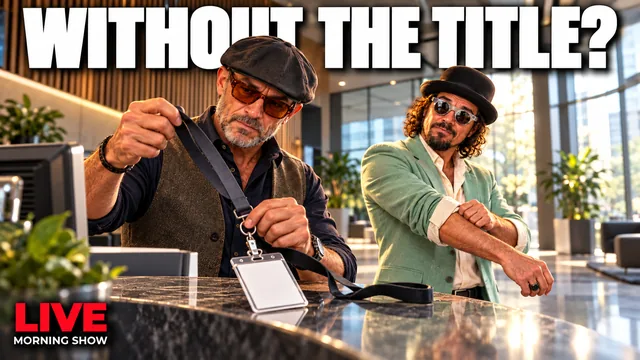
A title can explain what you do. Keith and Jon ask what it proves—and who remains when the role changes.
Read story +
The cover question becomes a discussion about what titles actually prove. Keith asks whether letters before or after someone’s name create credibility; Jon answers that the industry, the qualification and the application all matter.
They distinguish an earned professional qualification from a credential that can be obtained quickly, then ask how access to AI changes the value of knowledge. Jon keeps bringing the question back to purpose: what is the education for, and how will it be used?
Their conversation also considers the human side of learning. Developing a mind and developing social skills are related ambitions, but one does not automatically deliver the other. The title is a starting point for questions, not the whole person.
How would you introduce yourself if you could not name your job?
Inside the issue.
24 stories · 6 highlights
The friends who outlast a job. The words that help us belong. Keith and Jon ask what remains when a title changes, with Salikoko S. Mufwene on language and community.
Johnny, at 16 this guy was kicked out of his seminary for asking too many questions. Years later, his own daughter corrected his English. Now he's hanging out with you and me, live on- Church, so school and seminary. We didn't have that portion in the first part. That's it. Silico, good morning. Hello. How are you today? I'm doing fine. We're- You guys are having a lively conversation for me. Yes, we are. Where are you joining us from today, my brother? Okay. I'm joining you from Chicago. Oh, yes. Oh, I love Chicago. I love Chicago. Uh, so, um, uh, you study what happens in the world that people speak. You're a language guy. We love, uh, we, Keith and Johnny talk on this show, language is a big part of what we do every single day. Let's get into it. Um, you kicked out of school for asking too many questions. Yes things that didn't make much sense to me. What kind of questions were they? Well, usually it was why do we do things this way and not another way? Things that- It seems like- … made more sense to me. That's a very logical question. They just, they just, uh, too many of those and they said, "This guy, we can't help this guy." What was the, what was their reason for kicking you out? Because, well, they wrote in the certificate of dismissal, uh, insubordinate. Uh, that's how they characterize me. Uh, you are supposed to be obedient in a seminary. It's a religious thing, so things have been stipulated and you follow the orders. You are- Oh, because you were, you were ste- basically stepping out of line, right? Right. You were asking questions they didn't want you to be asking, right? Right. Challenging. So what was, what was one of the questions? W- like, give me an example. You know- Well, I- … you're saying to do it this way, but I think we should try it this way. What would be an example? Well, I, I… Well, it, that's too far away. You know, it's 60 years back. I, I cannot remember those things, so I apologize for not giving any ex- exact example. Okay. But what about conceptually? Can you… W- was it, what was it about? Was it about prayer? Was it about how we live our lives? What category were these questions, or were they, were they all categories? Well, I just remember one thing. I, uh, was giggling when in the middle of a prayer, the priest started, um, crying, and I couldn't connect to his emotions. So I thought it was ridiculous for a, an older guy in, uh, his 30s or so, uh, to cry because he was, uh, praying. Um, I didn't- Okay. So let, is- … understand where both of them went together. So did you ask a question after you got done laughing, or was that just- No … w- was one of the examples of insubordination? No. No, I probably… In that case, I was just a regular teenager, and I embarrassing, so, uh, especially because I was commenting about that after the service and- So, so the- … he asked me- … so the plot thickens a little bit here. I, I did. The plot thickens a little bit. It's not just asking questions. It's, it's like giggling at people trying to do their thing. That's true. That's true. But also, uh, like- It was very hot where I was, and, uh, we often had to work outdoors in the heat. And I would ask, "Why don't we wait until it's cooler in the evening?" Uh, so that was not good. Because, oh, interesting, because you were the guy who was ask- So you, you, you were in… I'm just, I'm, I'm, I'm bringing this all together, Johnny. This young man was in an environment where it was, sounds very controlled, very much it was this way, this way, this way. Yeah. And anybody asking those kind of questions outside the boxes were… You know what, and I, and I also this- Well, sometimes, 'cause there was no question about the- Yeah … about the priest that was crying. He just found- Yes … the best painting. Yeah. Here's, here, here's the, here's the que- here's the big question, though, brother. Did you go to this seminary willingly or were you forced to go there? Well, my father made the arrangements, uh, sending the letter- Okay, so this is all making a lot more sense now. You went to a school you had no interest in, so of course- why would you follow the fucking grooves that you don't believe? I get it. That's right. Seminaries were among the schools that provided the best formal education. And so my father came one day, I was, uh, playing with my friends, and he said, "Sam, come here. I just talked to the parishioner, and they are developing this seminary in Calonda. And, uh, you know that's where the elite are trained. So I have made arrangements for you to attend the seminary." And so in two months I was leaving home. I was 11 years old, and went to the boarding school at the seminary, uh, about, uh, 100, uh, kilometers away from home. And, uh… So there my training started in religious ma- uh, religious matters. Uh, I didn't know what it would take to become a priest, and my- I don't know whether my father made those arrangements simply because I was going to get better quality education or whether he really intended for me to become a priest. But in any case, it worked out differently, and, uh, I was kicked out. My father didn't seem very upset about it, so I think, uh, he understood that he couldn't force me, uh, in the direction that he had in mind, so. Interesting. Well, this, this makes a lot of sense, though. Yeah, yeah. I mean, you, you sense, you send a kid to a boarding school he has no interest in, you know, your behavior sounds pretty logical to me. Yeah. Yeah. Hey, Silico, you told our booking team as we booked you on the show here that we under- so we understand our societies better when we know their histories. Silico, what is one language argument that Americans cannot really understand without confronting colonial history? Right. Well, uh, this is not a problem of Americans. It's a problem of scholars, uh, in the West, that since the late 19th century, uh, in the context of Africa- Yeah … uh, things have been described from the perspective of Europeans. And, uh, the education was set up, I- we just spoke of the elite kind of education. It was set up to prepare colonial auxiliaries, people that would work in the interest of colonization and not really in, in the interest of their own people. So much so that after African countries became independent, guess what? The new leaders stepped in the shoes of the colonizers and are doing things like the colonizers did, and they are still exploiting their populations like the colonizers did. So that's the wrong form of education, so… But, you know, uh, this has little to do with, uh, language endangerment and loss. What happens with language endangerment and loss is that people saw that Native American languages, you know, are disappearing quite fast, and, uh, they thought that everywhere there was colonization, the indigenous languages would disappear very fast. But this isn't the case. So I just pointed out that in Africa it was proceeding the same way. Yeah. Oh, interesting. Interesting. Siligo, when, when people hear linguist, uh, they assume you speak every language, but you don't. No. So what's the strangest translation request you've been asked to handle when people are talking with you? Well, they ask me how many languages I speak. Yeah. How many do you speak? How many do you speak? Yeah. Well, five, but not all of them fluently. Oh. I speak French, I speak English, and I speak Twi Bantu languages, and English is the one that I learned the last. Uh, the… But you know, I'm managing my way, thanks to my daughter, as you said when you were introducing me. English is certainly one of the most complex languages to learn, isn't it? No. Oh, it's not? Okay. I th- so th- I, I thought it was. My, my perception was it was because we have less rules than other languages. Teach me. Well, that's one of the prejudices that I've been fighting against, that- Oh … uh, people thought that, uh, at least in the, uh, uh, 19th century, f- people thought that Africans, or Blacks in particular, were mentally inferior and incapable of learning European languages. Well, I'm a, a contradiction to that claim, uh, if I speak English well enough. So, uh, they thought that European languages were too complicated for Africans to learn. And in some cases in Africa, they concocted, uh, an artificial variety called French des Tirailleurs, so the French of the infantry. This was during the World Wars when they recruited Africans to fight a war that Europeans wanted to fight. So, uh, and they, Africans of course didn't learn English natively, um, I mean French in that particular case. In Senegal es- especially, they didn't learn, uh, French, uh, fluently. Uh, but a number of people that lived closely with Europeans learned to speak French very well. Still, that didn't change the prejudice that, you know, in order to communicate with Africans, with Black Africans, they had to speak a broken language. It's funny because the language never took off. Nobody really spoke it. It's a myth that is circulated in the literature. And if you have read Tintin in the Congo, okay, uh, in that book, Africans are ridiculous, speaking, you know, this, uh, in a bizarre way, and, uh, the cartoons really makes a mockery of Africans. So, um- I can see why people may, may claim that, uh, English is a very complicated language. I would say Chinese is complicated too, and, uh, uh, Native American languages are complicated, and my language is complicated, my ethnic language. So every language is as difficult for another person coming from a different background to learn, unless the, what, mother tongue, uh, o- or the vernacular and the target language that they are learning are very similar, so.
When a young person abandons a family's language for the language of school or work, is that a free choice, a survival strategy, or both? Well, it's a survival strategy in a way because the child wants to fit in the, uh, uh, language, in the c- culture of the larger community. The child wants to feel like they fit in that particular culture, and that's why they invest so much time and energy in learning that particular language. It's not necessarily because they hate their parents' language. Uh, it's that for practical reasons they are going to spend a lot more time outside home with the larger population than with their parents, so they… It's an adaptive process. And if they happen to speak that language more frequently than what is spoken at home, they may just find it more, well, convenient to use the language of the larger population if the parents understand it, and then forget about the language of the home. I think that's a great strategy to help someone, especially a child, learn- Oh, yeah … multiple languages. Because if the, you can speak, if in the home you can speak one and outside the home there's another one being spoken, then just by just learning to adapt to survive, that child is gonna become fluent in two different languages, which I think is a really easy way to… I mean, there's, uh, you know, so much easier than having to learn a language when you're 25. Well, it's interesting, John, because Slikeo's daughter, Slikeo, I'm saying to you that, uh, your daughter told you that essentially maybe that's how you say it in Africa, but not here. And, uh, do you ever ca- do you ever catch yourself saying something about, about a young person's slang and that, that makes you laugh? Uh, no. That's something I never tried. I think one time that I, I was teaching here the University of Chicago, and I tried to imitate, uh, something that I heard my students say quite often, and they laugh at me. It didn't come out right. So that discouraged me right away. I guess that would be the case, eh? Yeah, I guess that would absolutely be the case. John, we're gonna wrap with our guest here in a quick minute. Any closing comments for Slikeo, John? It was pleasure speaking with you. You know? Yeah. I, I liked, I like getting down to the boiling down the, the getting kicked out of school because I, I've, honestly, brother, if I was in your position, I probably would've behaved the same way Well, I, yes, I, I think it's natural for children to, uh, question certain things. Uh, what was bad about it- Especially if you don't wanna do it That's right. But yeah. But the seminary was just too repressive for me. So Coco- Uh, what I didn't say, I was an altar boy, and every evening I had to go and prepare the altar. And then when I came back to the dorm, everybody was sleeping already, and I couldn't turn on the lights to see where I was going to sleep. So… And one time I asked, "Why don't I prepare the altar early in the morning rather than doing it in the evening? That way I can just go to bed like everybody else." So And they probably, they probably said, "As soon as you stop laughing at the father when he's praying, we'll let you do that." Hey, so Coco, one of the, uh, one of the things we often talk about on this show is, uh, is healthy lifestyle, healthy choices, and, and making, uh, productive, positive decisions. Please take a moment to share how you start your day. Do you, uh, and I, and I say this with love, but also jest, uh, do you start your day laying on the couch and doing nothing? Do you get up? Do you, do you pray? Do you have, uh… Like what, what, what's your, what's your morning routine, Sir Coco? Well, uh, f- first I feed my cats. Yeah. And second, I check my emails to see if there is anything urgent that I have to attend to. Oh, okay. And then after that I go and do my workout. Oh, yeah? What do you do for workout? Well, I, uh, walk on the treadmill. Yeah. And I, uh, lift weights. Good for you. Yeah, yeah, y- yeah. And I do relaxation exercises, just lie on the floor and, uh, breathe- Yeah in the yoga style. Yeah. And so little by little my w- uh, body wakes, uh, wakes up, and then I can eat my breakfast and then I get to work. There you go. Has this been a big part of your life since a young man, or did, d- was, was there, was there a moment you needed to figure this routine out? Well, uh, I had to figure it out. It was gradual. So when I was, um- completing high school, um, I realized that I had to be more fit one way or another. I was a very nervous guy. So I thought, thought to myself, uh, yoga, relaxation, meditation yoga. Yeah. And, uh, I found it so useful that I really started to control my body and appear to be less nervous and so forth, and that changed my personality. And then when I went to college, uh, that became my routine, starting the day with some, uh, 30 minutes of yoga. Uh, yeah, you know, lying on the floor, curving my body, stretching muscles and so forth. And then, uh, much later when I taught at the University of Georgia, I used to go to the gym with a colleague of mine, an anthropologist, and that's where we started doing weights. And we realized, both of us, that we didn't really belong there. Everybody was so muscular . And, and they spoke a different way. And I teased my fr- my colleague, a native speaker of India. I said, "I think this is one place where you don't have a linguistic advantage over me. You don't speak the dialect." So, but incidentally, one time after we were leaving, uh, the exercise room, we saw, uh, uh, what, a student of ours in the department who was practicing, uh, karate, karate do, do. And, uh, so we asked him if we could join him, and he would teach us karate. And then I really fell in love with that because the exercises of en- uh, endurance and self-discipline were so, uh, strong that we just, you know, enjoyed having this kind of discipline. After an hour of doing karate do, I could go to my office and work for two hours and accomplish what it would take me four or five hours, uh, to do. So I, you know, learned the benefit of exercising. I never went for the belt. I just did, did it for the fun of it, and so did my colleague. And so after that, when I came to the University of Chicago, things had to work differently. So I developed a different kind of routine, mixing different things that I had learned, uh, earlier in life. That's awesome. That's awesome. So Koko Mufwene hanging out with myself and Johnny. Uh, so Koko, thanks for hanging out this morning and bringing your story to the live with us today. Thank you for inviting me. By the way, my, the last name is pronounced Mufwene. Mufwene. Thank you very much. Yeah. And I'm sure I was not pronouncing your first name proper, so I apologize for that. I was doing the best that I could. But the first name was easier, Salikoko. That's it. Salikoko. So you're leaving the show now. Are you gonna go teach? You're a professor, right? You have, you have, you have- This is the Thanksgiving break, so I have to work. Oh. Yeah. I have to ca- have to catch up with my writing. Oh, nice. Okay. Well, there you go. Well, my brother, thanks for hanging out with us and spending some time. Uh, where can folks find you, connect with you, or if they wanted to work with you or learn from you, how could they do that? I'm sorry, I didn't understand you Yeah, if folks wanted to connect with you or find you or even engage with you, how could they find you and work with you? Well, they just, if they type my name correctly in Google, they'll find me and see how they can contact me through email. Awesome. Awesome. So Koko S. Mofwene is joining myself and Johnny. Have a great day, my brother. Lifestyle Tip- Okay … hour two, and we're back on the second hour of Mornings in the Live with Keith, John, and Jimmy.
Salikoko S. Mufwene joins Keith and Jon on language, migration and the words that help us belong.
Read story +
Salikoko S. Mufwene joins from Chicago to unpack a biography that sounds simple in a headline. His dismissal from a seminary involved questions about its rules, teenage behaviour and a school his father had chosen for him—not just an abstract battle over ideas.
The conversation moves into colonial education and assumptions about language. Mufwene pushes back when Keith calls English exceptionally difficult: difficulty depends in part on the learner’s background and the relationship between the languages involved.
Asked why a child might stop using the family language, he describes adapting to the larger community. Speaking the language of school and work is not necessarily a rejection of parents. The interview closes with his own evolving routine of movement, weights and relaxation.
Which language helps you belong—and what happens to the one you use less?
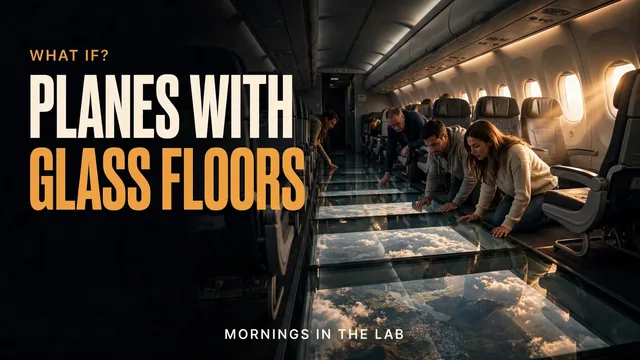
All right, let's get after it. What if, what if the airplane had glass floors? Would you fly in it? Would you fly in a plane with glass floors? Jimmy What if planes had glass floors? Let's assume they meet the same safety standards as other passenger planes. I'd take off my shoes and watch the clouds slide underneath me. It would feel like flying without the plane. You'd see the ground during takeoff and landing too. I'd ask for a rug before we left the runway. But imagine flying over your own house. Everyone's on their knees looking for their backyard, and the drink cart can't get through. What about you? Would you choose the glass floor seat or pay extra for a floor you can't see through? You're flying on has a glass floor. Clouds below your shoes, you can look straight down. Listen, for this imaginary deal, it's a purpose-designed aircraft that, that just meets the same safety standards, but how you make it out? Are you sitting there all comfortable, Jim Jim, or are you freaking out? Yeah, I think for me, I'd be fucking loving it. Oh, I'd just sit there, just sitting down below me. But does knowing that you can see through the floor settle that stomach of yours? So it's funny because I was, uh, uh, I did, uh, I d- I did that situation, where was it? In Chicago, where you walk on that, uh, you walk on a glass floor, and it's, uh, it's fucking crazy, man. Yeah. It's, uh, your knees get all buckly. You're like, "Oh my God, I don't know if I'm gonna… If this thing's gonna fall through here." Sorry, I gotta pause and just admire the set for a second. Holy shit, man, the set is looking good right now. Oh, yeah, I'm just loving it right now. Big time, big time. All right, coming up, loud doesn't mean smelly, and, uh, your drive-thru…
You trust the engineering. Would your knees agree with a view straight through the floor?
Read story +
The imaginary aircraft meets the same safety standards as an ordinary passenger plane. The only difference is the view straight through the floor. Would knowing it was safe be enough to keep your knees steady?
Keith is enthusiastic about watching the clouds beneath his feet, then remembers how a glass floor in Chicago made his body react. The conversation separates trusting the engineering from feeling comfortable in the moment.
Would you book the glass-floor seat—or ask for a rug?
I called her Nora. Mara, that's right. Mara. Yeah, yeah, yeah. Yeah, yeah. Jimmy, are we committed? Johnny, if you're driving down the highway and you see this, are you thinking this dude is getting after it? Are you thinking this guy's pretty… f- like look at this guy. Pretty damn committed to getting home. I gotta tell you, man, that's fucking brilliant. This is not AI. The guy's like, "Hey, I got a flat tire. I got no way to get it, so I put, put a fucking skateboard on it." Yeah, I mean, fuck. I suppose it, I mean, that's- … that's using resource. I'm just sitting there wondering, number one, well, you can tell he's going slow 'cause look at the- Yes … look at the lines. Oh, for sure. Yeah. If he brings that thing up to speed, those little fucking wheels are gonna fucking cook. Yeah. Well, yes. Can you imagine the bearings in those things going 55- … for any length of time? They're, those things are designed to go like- They're just fucking going to town … 15 mile an hour. They're just- Take them up four times their fucking rate for leave them there for a commute home. Yeah. They're just going to town, man. That's fucking funny, man. They're just fucking funny. Jimmy, I'm not sure where my counter- But, you know what? That's, that's a skate board bearing fucking commercial right there. Oh, yeah. Abso- that's a good one there. Yeah, 100%. That's, that's really good. All right, let's keep the show on the road here, my brother.
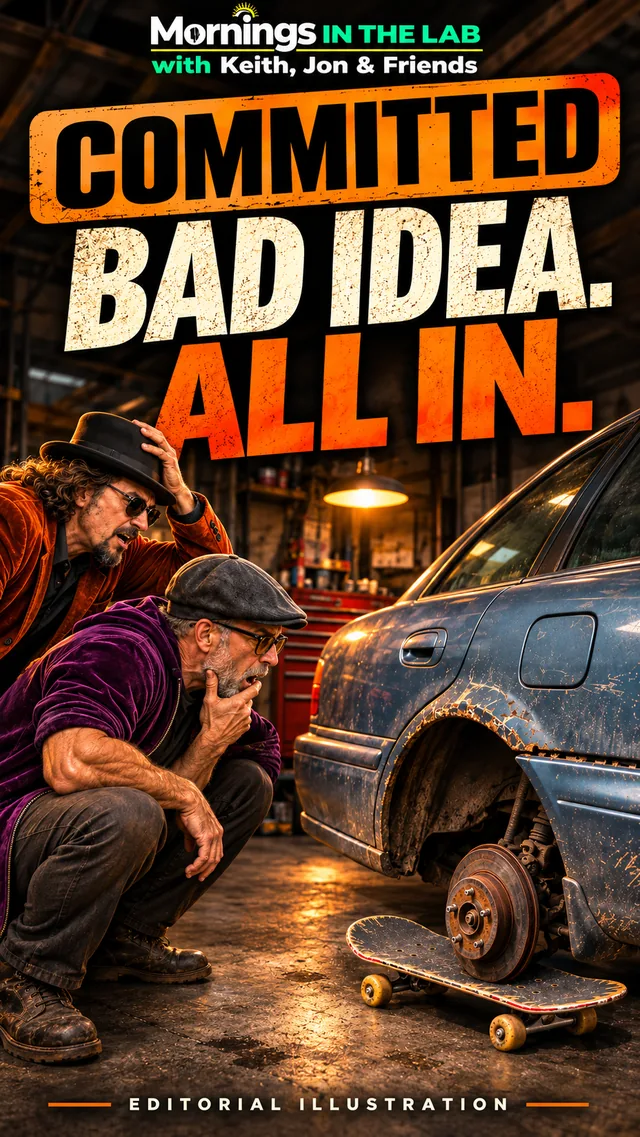
A missing wheel. A skateboard. A solution that raises a few more questions.
Read story +
A driver appears to have put a skateboard under a disabled wheel to keep moving. Keith appreciates the improvisation; Jon immediately asks what happens to those tiny wheels and bearings at road speed.
Their reaction captures the attraction of a clever-looking fix and the limits it may hide. It is a moment of amused commentary, not an endorsement of trying the repair.
Where is the line between resourceful and a very bad idea?
Are you, uh, are you giving them the recipe or are you keeping it to yourself? What's your scoop? Are you telling them what's going on or are you, uh, are you keeping it all to yourself? That's today's pick a side, but before we do that, let's get into the trending topic. Chris Berman, Tom Jackson, both in the news. Sunday morning on the Sunday NFL Countdown, Tom Jackson died Friday at 75 years old. Jimmy, let's run the clip. Berman and Jackson worked together for 30 years and talked Tuesday. My work bestie ghosts me when I need a shift covered. Jackson died Friday. On Sunday, Berman told viewers he'd lost his best friend professionally and personally. Shit. My closest male friendship is a group chat called We Should Grab a Beer. Jon, who's your guy, and when did you last call him? Yeah, so Tom Jackson trending in news this morning, you guys. And to those of you guys that have watched a ton of football over the years, you'd see that, uh, uh, it's a pretty big deal. So I got a cool little foot- foot pedal in my studio to change my cameras, but right now I'm trying to figure out how to use the fucking thing. So Jimmy, hey, I got buttons over here, I got buttons over here, I got a pedal down here, I got the mic over here, and I'm just trying to give you guys a good show. But Tom Jackson is trending right now. The guy died Friday at 75. Berman broke the news, uh, Sunday morning on NFL Countdown. And, um, well, Jackson's family asked Berman to be the one to tell, to tell Nation that the guy passed. So, uh, Berman's waking up, uh, feeling a little bit soft today, and I'm sure NFL Nation is, uh, is sitting aside today knowing that they lost a legend in Tom Jackson. Uh, y- on Friday is when we, uh, we lost Tom. So, uh, guys, listen, most men, you know, most men have, uh, have work friends who vanish the day that the job ends. It's funny, 'cause I was talking with Johnny this weekend. We were hanging out, working on a few different projects, and it's a whole different thing. Uh, but the question for every man, I think, watching right now is simple: Who's your guy? Who is your guy? Who is your guy, guys? And when's the last time you called him? Jimmy, I'm talking to you right now, brother. I'm talking to you, Jimmy. Who's your guy? You got a buddy, you got a brother, you got somebody you can give a call to? Maybe today's the day you give that guy a call just to say one thing, "I'm thinking about you," 'cause I'm gonna do it.
The desk and the title can disappear. Who is the friend you still call?
Read story +
Keith turns the opening conversation about Chris Berman and Tom Jackson toward the friendships that survive a change of job. The desk, the title and the daily routine can disappear; the person you still call is another matter.
He brings the question home to the audience—and to himself. Rather than saving the call for a crisis, he says he plans to reach out to friends simply to tell them he is thinking about them.
Who is the friend you can call without needing a reason?
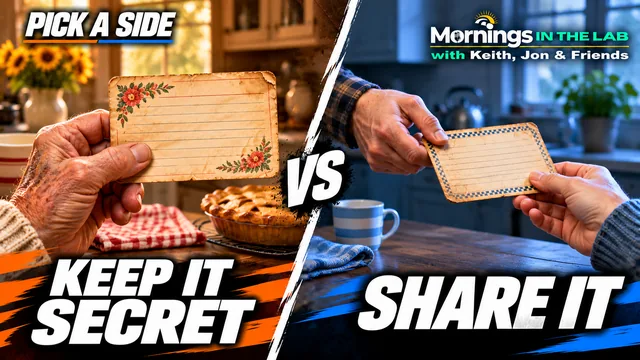
about you," 'cause I'm gonna do it. Yeah. Uh, you know what, Guerino? Uh, uh, Greg, you guys are gonna get a text from me today to say, "What is shaking?" All right, come on, pick a side. Um, man, pick a side. Yes. Do you keep it or do you share it? Jim, what do you do? You got a big recipe in the house, do you keep it for yourself or, uh, do you share it with everybody who's asking for it? Let's put it on the table. Welcome to Pick a Side Nation. A little family tradition can stir up a whole lot of trouble. Your neighbor takes one bite and begs for the recipe. Problem is, your family guards it like the crown jewels. So nation, pick a side. Keep the recipe secret to honor tradition, or share it so the dish lives on. Coming up, Anderson's in the lab, you guys. Anderson's coming up with us live in the lab. Uh, I'm just still fig- trying to figure out how my, my new little setup here. Good morning, Kiesel. I know you're out there as well, my brother. Good to see you. Uh, hey Jo- uh, Jimmy. Uh, Kiesel's, uh, uh, dropping some, uh, shoveling some snow today. Speaking of that, guys, close your eyes. Yesterday morning, uh, 4:15, sitting on the couch. Neman, you know what I'm talking about. Coffee rolling, front window open, some nice snow falling. Yeah, and I was crushing my coffee. Oh my God. Quiet house, a dog over there, a dog over there, and, uh, it was a magical afternoon. A g- magical morning, I guess, here in Manitoba, Canada. Coming up, planes with glass floors. Would you fly in a plane with a glass floor? That's the big question, but right now we're getting to this one. Hey, Jimmy, what do you think of our new graphics right now, pal? Check this out. We got, uh, on now, yeah, we're doing Keep Se- we're doing, uh, Pick a Side, and then up next, planes with glass floors. Pretty fucking cool, eh? Yeah, pretty cool, man. The handsome one was thinking… Oh, wait, who's the handsome one? That's me. Yeah, uh, that's me. I, I, I am the fucking handsome one. You know what, Jim? I think one day here I'm gonna show up without a shirt on. I wanna do Tarps Off Tuesday. Ah, fuck, just take it off right now. Ah. All right, so here's the thing. Do you keep the family recipes secret, or do you share them freely? What do you do? What is it that you do? So my mom makes fucking rocking cookies, man, and I will tell you guys right now that I've shared that recipe, but I've tweaked it up a few times. But here's the thing. Your neighbor, he takes a bite, right? And, and then he asks for the recipe your family has never given out. But yet he's like, "No, I fucking have to have this." And listen, hey, here's the thing. We know that some family rituals are, uh, some family rituals… Uh, oh, let me see here. Is this gonna work here? There we go. Does that work there? No? How about this one? This work there? There we go. We know that s- Neiman, what are you doing? Neiman, are you giving the recipe out or are you keeping it to yourself? Rico says, "I share a little bit, but change a little bit." You know, Rico, that's just it, eh? I think that's exactly the goal, is what you gotta do is you gotta, you gotta take the recipe, make a few slight tweaks to it, and then make it yours. I think that's the whole goal, isn't it? I think that's absolutely the goal of that situation, so that when somebody's like, "Yeah, I got your recipe," they're like, "Oh yeah? Whose recipe is it? Is it actually your recipe or is it my recipe?" Uh, but, um, there's the Pick A Side today. All right, let's get after it.
A neighbour wants the family recipe. Does passing it on give something away—or keep it alive?
Read story +
A neighbour wants the family recipe. Is sharing it a betrayal of tradition, or the way to keep the dish alive? Keith starts with his mother’s cookies and admits he has shared the recipe while making a few changes.
Rico’s comment—share a little, change a little—turns the debate into a question of ownership. Once you have made the dish your own, whose recipe are you passing along?
Does a family recipe mean more when it is protected or passed on?
and the target language that they are learning are very similar, so. Yeah. Yeah, yeah, yeah. I've got our ver- veteran producer, Neiman, who says, uh, "Turkish is a very hard language to learn as well." Speaking of learning, uh, hey, uh, Saiko, do you play an instrument? Johnny, have you ever played an instrument before? I got something pretty funny here, man. I found a dude that, uh… Check this out, man. WTF is this? Jimmy, check this out. Check out this band. Look at this guy. This guy's getting after it, man. He's playing the nut, I think the nut tambourine. Yeah. So there's their band. That's just like a little morning band there. Check that out. Yeah, that's a skill. Look at that skill, just banging the, just banging the tambourine with his hips. I hope that's just for a single song, because- … if that's their, if that happens the whole fucking time, their group is a fucking laughing stock. Saiko, can you play an instrument? Uh, no. No instruments? I le- I learned to play the flute when I was in the seminary, and then after that, I was too poor to buy a flute for myself, so I didn't continue to play. Oh, yeah. Yeah, yeah. Uh, hey, Sophie- The r- the recorder. Yeah, I think they call it a recorder, yeah. A rec- oh, yes. I, I learned the recorder too. It was, uh- I think that was the first instrument you're ever introduced to as a kid. It's true, Johnny. Yes. What was it? Hot Cross Buns. It's very easy, it's very easy to learn that little… I remember learning how to play Mary Had a Little Lamb on one of those. Yes. Hot Cross- Because it's, it's difficult when you are still a child and your fingers are small compared to the rec- to the length of the recorder. Hot Cross Buns is exactly… Oh, I got my, uh… Hey, Jimmy, I lost my camera here, so, uh, let's do this here.
A pub band, an unusual rhythm section, and a question for the room.
Read story +
The guest conversation takes a comic detour into a band member playing a tambourine with his hips. Jon wonders whether the routine is a one-song joke or the group’s entire act.
The sight leads to a gentler memory: Mufwene recalls learning an instrument at the seminary, and the conversation lands on the recorder and the simple songs people learned as children.
What was the first instrument you learned to play?
I do not see them here on my screen here, so we will get that sorted out. If it's not one thing, Jimmy, it is an absolute other. Yeah, that's exactly what we got here. Uh, all right, uh, Jim, let's get this one palled. Um, we're gonna segue over to, um, uh, AI, Gen X. Our, our, our, our folks want AI. Jimmy, let's run this clip My Gen X coworker used AI to write his performance review. The bastard gave himself a promotion and a personality. In Seramount's big company survey, 46% of Gen X wanted AI skills versus 18% of Gen Z. The fax machine generation came to play. So is Gen Z over AI or just afraid the boss will catch them using it? Hell, I hide mine like office porn. Yeah, Johnny, so I met with… So I had a lady yesterday call me. She's like, "Hey, uh, I need help." And she's a Gen X like you, and I'm like, "What's that?" She goes, "I am so lost in the world of AI, and I need some help." I'm like, "All right." We chatted for like 10 minutes. I got her set up, and then I had another call with somebody else on the weekend too that was like, "I need some help with this AI stuff." And I, and I- Where are these people coming from? They, they're coming from the woodwork, from business, and I think, I think, I think they're hearing stuff, Anderson, and then they know that I'm in the world- Yeah … and then what happens is that they, they reach out to me because, "Hey, can they help me?" Right? So, uh, but they're all our generation because there's just more and more kind of samples of things. I mean, after you, you know, you and I spent some time yesterday. I showed you some shit. I just… There's people… I got a text from her last night saying, "Thank you. I, I, I really appreciate your knowledge. You've helped me out immensely already." Right? So, um, I, I think what, what's happening, it's like, you know, when we first were introduced to the internet years ago, it's like you're hearing about it, but you don't know what it means.
The conversation turns to a generation that has already lived through a few changes in the tools of work.
Read story +
Keith describes calls from people of his own generation who want help getting started with AI. The obstacle he hears is practical: they know the tools are being discussed, but do not yet know what using them could mean for their own day.
He compares the moment to first encountering the internet. His approach is to lower the barrier, show something concrete and make a first useful step feel manageable.
What is one real task you would want help learning to do with AI?
the whole fucking thing settles down. Yes. You know? Yes. Yes. Then fucking things go back to normal. I loved having this little rocket ship as a young, as a young boy. I was hoping, I was always hoping- I saw those in the … Those were water-driven. Those were cool as hell … I was always hoping it was gonna do more, uh, but it never did. It was just, you're right, you put that wa- you filled it up with water. Jimmy, let's go to the back, vintage. Uh, you put that water thing up there and, uh, and y- and it … I do remember that. I loved that thing, and, uh, but it was such, it was, you filled it up with water, you shot up, okay, that's it. It was … I loved rockets, man. As you know, I was a NASA nerd writing my shit to NASA, but that was pretty, that's a pretty cool thing.
A red-and-white rocket and a hand pump reopen a childhood memory.
Read story +
A water-powered toy rocket sends Keith back to childhood and his enthusiasm for NASA. He remembers filling it, launching it—and always hoping it would do a little more.
Jon remembers the same simple pleasure. It is a short burst of nostalgia for a toy whose entire appeal was getting something off the ground.
Which childhood toy still makes you want one more turn?
That, well, that's exact- yes, that's exactly it. That's exactly where I took it, too. That's 100% exactly where I took it. Uh, all right, Jimmy, let's get to, let's get some conversations going, my friend. Um, let's get into the first one, uh, which is going to be about, uh, uh, neighborhoods that one might live in. Uh, so get this, man. Your neighborhood's fast food habit predicts your weight. One million adults. Uh, Jimmy, let's run this clip. Preston, the drive-thru speaker just said, "The usual?" I've been here so much, this damn menu board knows me better than my therapist. A Houston study of over a million patients found more obesity in areas with a higher share of fast food visits. Association, Sterling, not a verdict. Fair enough. But when a burger reaches my car faster than a salad reaches my damn fork, who's really winning? Choice or convenience? Hey, Johnny. So, uh, what I found fascinating with this one is that you live in a nice gated community there in California, uh, and you guys, you guys live outside of, of, of a largely populated area, and so do I, actually, here in Winnipeg, Canada. But, uh, there's some research that says that, uh, folks that live in neighborhoods, uh, with, uh, with more fast food restaurants and neighborhoods that have people that are maybe stopping at the same spots, uh, start to, uh, I, I'm just gonna paraphrase, to kind of be the same. You get fat. That's exactly what happens. Well, yeah, and you think about it, it's like your, it's like your corner convenience store, right? If your corner convenience store, uh, has a bunch of healthy foods, well, the whole neighborhood's gonna be healthy. And, you know, same kinda- Well, it's kinda like there's different layers of neighborhoods. Yes. So let's start off with, and I'm not talk… This is not about a race. No. This is not about talking about a person. Yeah. But if your neighborhood- is heavily, if, if, if you go corner by corner and it goes liquor store, church, liquor store, church, liquor store, church, you probably need to relocate, right? Yeah. You go up one, you, then you go up one level, and then it goes, you know, all of a sudden the, the liquor stores aren't quite as prevalent, but you see… And the churches are spread out a little bit. Yeah. But they're filled with fucking fast food restaurants. Yes. You probably need to relocate again. Yes. And then you get to a place where your neighborhoods just kind of have your neighborhoods, right? Yeah. But here's the thing. It's all about, it really comes down to discipline we're talking about. Do you have the discipline to drive past that drive-through restaurant? Oh, absolutely. Yes. That's exactly it. But, but the thing about it is discipline is large, largely to do with the person that's willing to adjust his environment. If, if you put fucking the shit that I don't want to eat in, in my houses, I would have a hell of a hard time with my discipline. But I, I think ahead. I don't allow these things close to me. Yes. Yes. You know? I don't have a fucking fast food goddamn restaurant right outside my… So it's, it's, like, you gotta kinda think about what are you choosing to surround yourself with? Absolutely. Well, then of course you're fucking fat. You surround yourself with those shits, it's gonna make you fat. You know, I actually was thinking about this. So, uh, uh, my old world, I lived in a small community, uh, outside of Manitoba, Canada. I'm sorry, outside, just three hours down the road. All right? Just, just leave that over there for a second. And I was thinking about the, that family there, and I was thinking about where they lived in the community. And Johnny, if you live in a community that doesn't have any healthy, organic food, the whole community's gonna be eating the same way. I don't mean that it's in a negative way. So example, a small little community of, whatever, 500,000 people, somebody's gonna have the store. Maybe, you know, and, and if you don't buy, if you're the store owner and you're not buying the healthy foods for the community, well, look at the influence you're having on the community. I know it's obvious, but, but you think of that through so many spots around North America. You follow me? Right? So, but real quick on that, let's just take the other side of the equation. Sure. That store owner also has to fucking make a living. Well done, bingo. If he puts a bunch of shit into that perish is that nobody's gonna fucking buy- Oh, fuck he's gonna, he's gonna fucking buy the stuff that people in that community- Dude … are going to pay for in frequency. Fucking well said. Chicken and egg, right? You own a store in the community, you're like, "Okay, I'm moving to this town 'cause I want people to eat healthy food," and you stock eggs and whole foods in here. They're not fucking stupid. And, and then you're like, "Well, okay, I guess I'm going out of business because that guy over there is selling the Coca-Cola and selling all the fucking chicken dinners." Yeah. Yeah. Yeah, the, the, the environment, a lot of cases is, is such a, is such a predictor Yeah, absolutely. Hey, coming up we got a guy who was expelled at school at 16 for asking questions.
Keith and Jon ask how much of a food choice is shaped before you ever reach the menu.
Read story +
A reported association between neighbourhood fast-food visits and obesity opens a discussion about convenience, discipline and the food available nearby. Keith and Jon ask how much of a daily choice is shaped before you ever reach the menu.
Jon adds the shopkeeper’s side: stocking healthier perishables only works if customers buy them. The exchange becomes a chicken-and-egg problem about local demand, available choices and what people keep close at hand. The study introduced on the show describes an association, not proof of cause.
What is the easiest food choice in your neighbourhood?
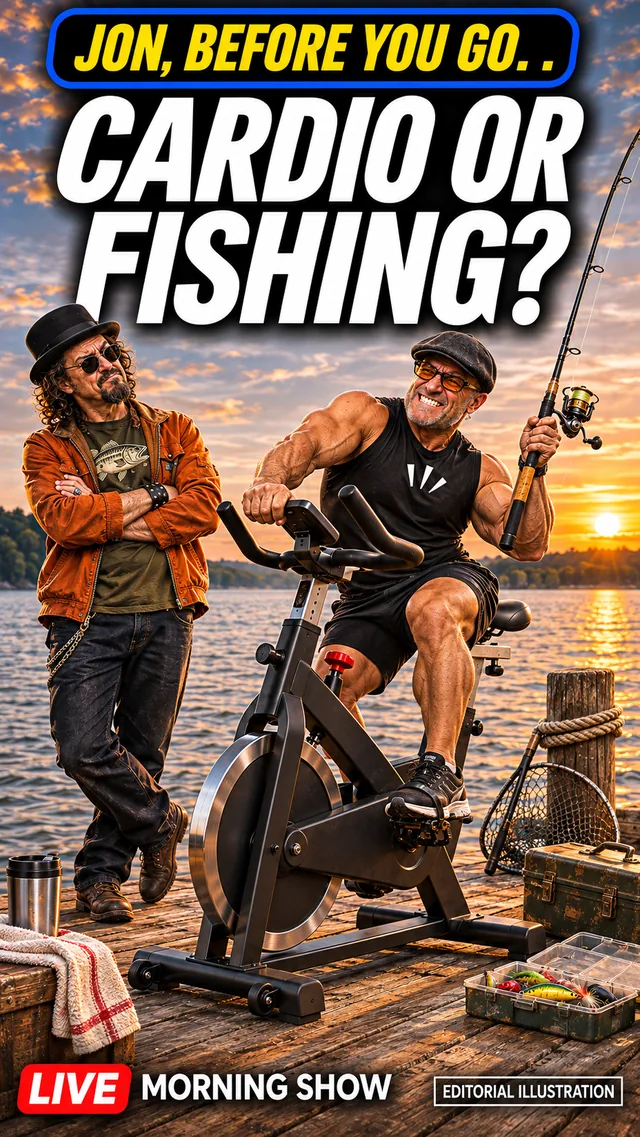
pretty, that's a pretty cool thing. It's absolutely a cool thing. Uh, hey, before you go, I know you like to fish. Uh, is this, uh, would, would you be interested in doing something like this? Jon, before you go Hey, Jon. Before you go, somebody brought a stationary bike to the water and combined a workout with fishing. Finally, cardio for people who think a peaceful afternoon needs more sweating. I'd spend the whole time wondering if the fish are impressed by my mileage. Sorry I'm late, honey. Leg day ran into bass day. Even if you don't catch anything, you can still say you went for a ride. Jon, you'd be peddling out there, waving at every boat and making friends with the fish. Of course, if nothing bites, at least I've had a nice ride and met some lovely people. This guy here just fucking attaching his fishing rod to the, to the bike just to get some shit done. Hey, I guess, uh, if that's what works for you, create some content, and, uh, I guess that's, uh, that's what you gotta do. I mean, if… My, my f- the reason that I fish is to literally enjoy doing nothing. Me too. Yes. But if for some reason I was gonna fish more, to multitask during fishing would not be a huge issue for me. No, no. I, I, I'm the same way. To seriously- I can see both sides of this equation actually. Yeah, 100%. Yeah, absolutely. Absolutely. All right, Pat, I'm gonna get you on- And hey, little, little side note for the team. So if I'm ever gonna wear a baseball hat backwards- … you, you won't even find a picture of me. You can look back on the internet 25 fucking years- … you will never find a picture of me wearing a baseball cap backwards that's a snapback. I would actually believe that. I c- I, I could never see you wearing one. It's a pr- it, it's a pro style. Yeah. You know? So I wear plenty of pro style hats backwards. Yeah. I- Meaning there's no, there's not that fucking goofy thing. I, I could absolutely see that. I, I can see you not wearing a hat backwards. Yeah, that would not be your style. Well, no, no, you're, you're hearing me. I wore it backwards, but it didn't have the snapback. Yeah, the certain style. That's what I meant. Yes, the certain style. Yeah. In the back, but I, I'll wear it forwards or backward, but I don't wear snapbacks period. I don't like those hats. It's- Oh, you don't like- … it's not fitted for me, I'm not wearing it. Oh. Oh, there you go. We're hat shopping with Anderson. Snapback. Yeah, I wasn't a big fan of the snapbacks either actually. Now, now that you say that. Well, my head is fucking big enough- … to usually where I've got like… If it just gets one, I'm fucking hanging in there. Big. But if I can get two, I'm in pretty straight. Yes. Yes. So then it definitely goes straight.
One part workout. One part waiting for a bite. Jon has a combination to consider.
Read story +
Someone has combined a stationary bike with a fishing rod. The joke writes itself: leg day meets a day at the water. Keith and Jon laugh, then consider whether there is any reason the two activities could not share the same afternoon.
Both say part of fishing’s appeal is doing very little. Still, they can see the other side: if you wanted to fish more, a little multitasking might not spoil it. The conversation ends with an unexpected distinction between fitted caps and snapbacks.
Would adding a workout improve a quiet afternoon—or ruin it?
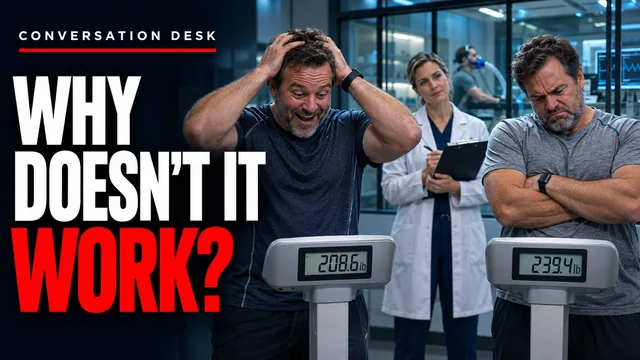
All right, let's keep the show on the road here, my brother. Um, ah, why doesn't it work? Yep. Uh, it's funny 'cause we thought for the last couple weeks we were getting t- you know, we'd get our show shut down because we were talking about certain, uh, topics in- Yeah … the world these days, and some of them are GLP-1s. Well, hey, there's folks complaining that their GLP-1 isn't working. Jimmy, let's run the clip My buddy and I started the same tech stack. He dropped two pant sizes. My scale said, "Fuck you," and asked for a firmware update. University of Alberta researchers are tracking energy use and body composition over six months. Finally, a hotel-like room where the minibar judges your metabolism. Could my body's energy-saving mode explain the difference? Or is the scale just a shitty scorekeeper? Let's get into it. So Jon, for some, when some people… Uh, so University of Alberta researchers are studying how semaglutide, the tech stack we talk about, affects energy expenditure. But for some people, it effectively- We don't really talk much about that one Doesn't- No, we don't actually. But, uh, for some people it doesn't work. And, uh, um, you know, they did a six-month pilot where some adults who, uh, who tried a certain dose, certain, certain, certain adults didn't try a different dose and it didn't work. Now, I have my suspicions. I think there was no truth. I think that some tr- people were doing it and w- weren't telling the full truth Well, I think, I think in, in this world, people's gauge of working or not is- Oh, interesting how hungry are you? Or are you… If you… Most people think, "Well, it's not working. I'm s- I'm still hungry." Yes. That's, that's not the primary fucking gauge there. That's not the primary metric. You know what? I gotta tell you something, man. Yesterday I wa- I was hungry, but not hungry- Does that make sense though, brother? 100%. Absolutely does, yes. Yeah. Just because, just because your, your hunger hasn't disappeared like a whore- Well, it- … doesn't mean it's, they're not working. It means that your, your metric is, of what you're expecting from it is, is goofy. Yeah, and that doesn't mean- Generally speaking, when people have their appetite is gone, it's 'cause they don't fucking feel well, which means- It doesn't- Yes you've gone too far. Yeah, yeah. It doesn't, work is such a loaded term, right? So now I'm in a muscle-building phase, like I'm looking to build, right? So yesterday, brother, I was just fucking crushing meat all day, to be honest with you. I just crushed protein every three hours. I was like, "I'm fucking eating more." I just was eating more. I ate fucking every three hours, I was just crushing protein. I went on my, over my macros. I'm, I'm, I'm not, not, not making a big deal of it, not getting caught in the details, but I was just eating my food. Jon, you're not breaking r- rule two. What's rule two? Uh, don't overeat. Yeah, ne- yeah. D- never be full. Yeah. Oh, yeah. Well, you know what's funny? Oh, my God. Because if you're full, now you're slowing digestion. Dude. And if you're slowing digestion, you're not processing. Awesome point. Yesterday I was, uh, I had my meals and, uh, I wasn't full, but I wasn't not full, and there was a fucking piece of meat on the counter that I wanted to eat. You know what I said to myself? "Fuck, it'll be there tomorrow." Just like the task. I didn't eat it. I ate it this morning instead. And I'll tell you, that's a mindset shift, because yesterday I would've eaten it. True story. I'm using yesterday in quotes, but it's that mindset that t- Yeah, the whole, the whole mindset. Yeah. Well, because the mindset for me was, "Well, tomorrow's gonna come anyways." Like, like, fuck, I went to bed. 12 hours later, today arrives and I ate the meat. You know what I mean? So, because it was so good. Lauren made some fucking burgers and like, oh my God, they were fucking great. So, uh, I just wanted to crush them.
The desk discusses ongoing GLP-1 research and why a treatment does not affect everyone the same way.
Read story +
A segment about semaglutide research leads Keith and Jon to question what people mean when they say a treatment is “working.” Their discussion focuses on expectations, hunger and the limitations of judging everything by a single number.
Keith connects the conversation to his own eating habits and the change from finishing something immediately to leaving it for another day. These are the hosts’ personal interpretations; the research introduced in the segment is ongoing and does not establish the results they speculate about.
Are you measuring the result—or just the signal you expected to notice?
So, uh, I just wanted to crush them. Hey, most couples almost never work out together, and 4 in 10 wish they did. Coming up next, Sakuyo Somlino expelled at 16 for asking questions. Now he studies why languages die. But before we go there, we're gonna go to most couples almost never work out together, and 4 out of 10 wish they did. Jimmy, run the clip. My partner said, "Let's get sweaty together." I showed up naked. Apparently we're going for a fucking walk. A five-country survey found 4 in 10 partnered respondents want slightly more exercise together. Walking's the favorite. Keep your pants on, Sterling. Fine, but if she starts critiquing my walking form, I'm jogging straight into the woods. You walking together or protecting your alone time? Johnny, they surveyed, uh, uh, 2,600 people in Switzerland, Germany, and Austria, and, uh, about two-thirds said they were in a relationship and they wish they trained more with their partner. Well, no shit. Then why don't you? Like, just make it a fucking habit. Well, I mean, there's a lot of reasons why. Yeah. I mean, some, some people don't get along when they train. Oh, yeah. Oh, speaking of that, so, uh, Keith and Lauren were hanging pictures yesterday, Johnny. Yeah. We were doing a household task. My job, uh, I was not the leader in that task, just so we're clear No, I was gonna say, if you think for a fucking second you were acting as the chief, you're fucking that one up. Dude, dude, I was not the leader. Nope, I was pure sup- You just realized, "Um, I need to be a good Indian right now. Tell me what to do." I was the pure support mechanism. My job was to hold it and not say very much. When I said a few things too much, uh, the, the, the, the, the heat in the room rose. So I, I- What you're supposed to say is a little to the left or a little to the right, is what you say No. No, not even that. No, no, you're, you're asking. As you're hanging, she's telling you. Oh, yes. Yes, yes. Jesus Christ, you're missing the boat. See, you're- … you're, you're still talking. You're supposed to be asking questions. That's your role in it. Yeah. Fuck this- If you didn't fucking make any statements, this would've been fine just like our guest coming up, fired for asking too many questions. You're right, maybe I shouldn't have asked so many questions yesterday when we were hanging the pictures in Brooke's room. But hey, it's a funny topic, though. Seriously, couples that tr- Well, you can ask all the questions you want if it's assisting her in getting the job done. Yes. Yes. Jesus Christ, you're dense sometimes. Fuck. Sorry, man. I'm doing the best I can with this motherfucker. Why language has died. Coming up in a few minutes, expel that steam. Hey, real quick, back to the couples training thing. You- Yeah … left that one fucking cold. There's so many reasons why people don't train together. Now, granted- Oh, yeah. Yeah … I wish that I trained more with Terri too, but it j- it's not always the best for us. Yeah. Yeah, that's fair. That's absolutely fair. I mean, she, she likes certain things, I like certain things. She's, uh, like, carries this weirdo perfection into her workouts that I don't subscribe to. Sure. So as soon as she starts with the, the perfectionism, I just keep on fucking going. So I, uh… For me, uh, so to me, since I'm not so much training together with Lauren, it's like being in the s- in the gym for the same time. Do you know what I mean? See, me and Terri and I- Yeah … often we go to the gym together, but we rarely will do anything as like a, an exercise together. Yeah, same thing with us, brother. Same, exact same thing with us. Yeah. Uh, she's doing her thing, I'm doing everything, my thing. It's just we're spending time in the same room together, hanging out. Uh, but, uh- A lot of times the goals are different enough- Yeah. Yes … that's what, that's what's required anyway. Yeah. When we first met with Agent there at the gym, we were tw- we were training together. She was lifting and she… 'Cause she was never really a lifter, so I got her into the world of lifting heavy things. But, uh, um, it was, it was fun. But yeah, now we just, I just enjoy being in the gym with her, 'cause I, 'cause, um, well, there's the whole, there's the, there's the sexual tension and the energy. I'm attracted to my wife, and when she's training, the, the energy of, of, of working and all that, it's, I, I find it quite fun. And, and I find it feeds, it helps feed life expectancy work. And you're, but you… And, and this is a compliment to you guys. Yeah. If you're attracted to your wife, no matter what the fuck you're doing Oh, 100%. Even when she's barking at you hanging pictures? Oh, yeah. Yes. Yeah. I love effort, man. I love the fucking effort. Effort's attractive to me. When you see effort, that's attractive. And, and, and I don't mean, mean, mean attractive and just sexually, but e- effort is, effort's a fucking … Like, not everybody puts effort in. So when you see effort, you're like, "Fuck yeah." I just wanna see effort, right? So, uh, that's exactly what I wanna see. All right, coming up, we got our big guest here, uh, patiently waiting for us, Jimmy. But before we do that, let's get to one more topic on the table here today. Um, yeah, let's go here, Jimmy.
A conversation about the people beside you—and what makes showing up easier.
Read story +
A survey about couples wanting more shared exercise prompts a distinction: going to the gym together is not the same thing as doing the same workout. Jon says different goals and approaches can make separate sessions the better fit.
Keith enjoys sharing the space with Lauren even when each follows a different plan. A detour into hanging pictures at home makes the same point with more laughter: being a team does not mean both people have to lead the task.
Would you rather share a workout, share the gym, or keep that time to yourself?
So then it definitely goes straight. Then you got this motherfucker. Oh, yeah. Yes, yes. Yes, absolutely. Absolutely. Hey, quick question. So now that we've got, uh, we've got the access to rebrand, um, the, the, the foundation portion of L- of Age Strong, once we get that rebranded, when are we gonna start owning the conversation? Uh, yeah. So, uh, my g- 'Cause that's the, that's rebrand, then start to own, start to, start owning the conversation is the plan. So you know what? Uh, y- 100%. Uh- Uh, so it's funny you ask, but, um, I'm, I'm glad you asked for that. I lost the whole week last week trying to figure out our fucking situation. So- Yeah … now that we got last week behind me, this week is the week that it all starts to roll here. So I was… I felt like by the time I went to bed last night, Anderson, I finally felt a little caught up. Like, dude, I actually lost every fucking day. Like, I was- Oh, I bet … I was talking to- Every day you were showing up, you're like, "Fuck, it's still happening." I was talking to Carter. He's like, "Dad, explain to me what happened." I was telling him, I said, I said, "I think I finally got it figured out." So yesterday morning I got up, drank my coffee. I rolled my sleeves up and kind of went back into the lab, back to the agents, went, "Okay." How we doing? Yeah. No, it's like, "Okay, let's try this. Is it gonna break?" And then one did o- it didn't break, and then sure enough, this morning the show's gone. N- nothing broke, so we're in good shape. So I would like to think by the end of this week… So what I'm gonna do, Anderson, is the same way we have Mara, who's leading our, uh, our, that part over there, I got the same Axel. I got somebody who's gonna lead EEATE Strong for- So Axel is, I was gonna say, who's our agent for- Axel … for this pro- Axel's gonna lead EEATE Strong for us. Yeah, it's all integrated. Oh, I- Yeah. So Axel will be the guy. So his job is to, uh, is to build that whole thing. Uh, build authority, build presence, build content, and ultimately help us sell it, right? So, um, uh, I got a, uh, we got a special X account for it, so there's a number of things happening that are gonna start, really start rolling today. And that project is not an issue for Stripe. At all. Oh, not at all. Yeah. No. Yeah. No, not at all. Yeah. Uh, and- And the course, I think the course actually has its own, it's, uh, has its own billing internally set up in there. Yeah. Right? So my goal this week is to peel the onion back on that and, uh, and start getting into that. So our… So, sort of f- get further into it. So ideally by end of week there's more happening. Uh, and then as we get into next week, more continues to roll. But I'd like to think that everything that I missed last week it was… You know, like I said, I'm essentially about a week behind, but I, I, I, we'll start catching up pretty rapidly. I'll tell you something else too. I was talking to Neeman about this, actually. And, um, so I'm not sure if you're aware or aware that the, the AI world works on tokens, right? So you pay a monthly- Yeah … fee and then, right? So, uh, my, my tokens reset today. So think of like cellular minutes, they reset but they don't roll over to next week, right? So like- Now that they're not rogue, it's way down, correct? Y- yes. But also, but also, but also … Well, fuck, man, what also happened last week is that in my inbox I have these bills show up, and like, where the fuck is that mon- like, wh- who is spending all this money? Yeah, because the agents are going bananas and you don't know it. Dude, I found a fucking $900 bill last Friday. I'm like, "What the fuck is this?" And it was a bunch of compute time that this thing was just fucking working. Because I guess last week I had set this thing up to work every five minutes, and I, and I don't wanna say I forgot about it, but I guess I forgot. So it was doing something every five minutes and, and we talk doing, that's energy, right? Compute. Yeah. Right? So it wasn't until I got this notice, it was an alert going, "You know your usage is up." I was like, "Oh, that's what maybe the problem is." So I figured that out. Um, but my point is though is that, um, is that when your tokens don't roll over, I find like on a day like today, I got like 30, 40% of my tokens left. I'm gonna get a few agents going like a fucking motherfucker today because they don't- Yeah … because they expire- Use them up … tomorrow. Yes. Yeah. That's exactly it. Use them up, man. Use them up. That's exactly it. So I'm gonna get our things lit up with, uh, with Age Strong today and tomorrow because I got some tokens to use. Well, this'll be good because now obviously we have, you know, Age Strong can kind of lead the way. Yeah. Yes. Right? So- Yes … obviously it's once that thing's in motion, then- 100% … Cell War can follow up to that. Yeah. Bingo. And that gives plenty of time for us to kind of reacclimate in the pet project. Bingo. Bingo, bingo. Exactly. Exactly. 'Cause they were all coming, they were all fucking lining up. We- single file is gonna be much easier for us to launch these things. Until, until- They're all three standing there going, "When is my turn?" Until Mara stopped us cold in our tracks yesterday. That was good. I think because that creates some longevity. Well, she saved some time for us, right? 'Cause she stopped a bunch of the speculation. I thought it was great. It was really great, actually. Yeah. So, uh, it was, uh, it was, it was extremely helpful because she's like, "Nope." Oh, okay. I can see your smoke coming out of your brain wondering this, wondering that. Oh.
An unexpected compute bill brings the conversation back to attention, priorities and checking what is still running.
Read story +
A catch-up about upcoming projects turns into a candid discussion of automation and attention. Keith describes discovering unexpected compute charges after a recurring task had continued running every few minutes. The detail brings the cost of leaving tools unattended into the conversation.
Keith and Jon also describe why putting their projects into a sequence helps. One can move forward while another returns to development. The exchange is about their own experience: clearer priorities and closer oversight, rather than simply asking the tools to do more.
Which recurring task is still running because nobody has looked at it lately?
it, but you don't know what it means. Yeah. Right? So what I've been doing is lowering the barrier to entry and just making it real simple for somebody. You know what I'm saying? Yeah. Do- doing whatever I can to help. So, um, so yeah, but people certainly want, uh, want AI. And then who owns the AI score? Jimmy, let's get the sixth clip. This one. Our AI strategy has 12 vice presidents and zero owners. We've got an intern whose job title is, "Oh, shit, blame him." Profit found 57% of firms with AI-linked leadership metrics reported significant positive impact versus 2% without. So who owns the AI result? The CEO or the poor bastard resetting the printer? Let's talk about it Yeah, so this, uh, this conversation here is about, uh, folks that, that… Leader, leaders that are using AI to score and, uh, and so forth. Where's my topic here? Uh, it is all about, uh, who owns the AI score. So leaders who are measured get the results. Jonah, when you're, when you're working with your team, um, do you measure results on performance? Like, do you guys set goals and, and, and, uh, are you motivating by performance or is it, uh, is, is there a true, is there a true measurement with performance with you guys? Uh, I think when it comes down to it, there, I mean, there's a few metrics. I mean, performance is, is measured in a few different ways. I mean, um, number one is gonna be… I mean, keep in mind, it's, it's… Is if you just… If, if you're guiding your team with just a number of, "Look, you have to hit these numbers," it doesn't create, it doesn't cultivate an environment that I'm wanting to cr- to cultivate for them. I, I, I would agree with you 100%. Yes. So number one is your effort in following the system. Those kind of fit hand-in-hand. Yes. If you're putting in effort and you're following the system, then you're protected- Yes … because if you're, if the numbers in the, in the, in the actual metric of success by the numbers are not playing out, it's because the system needs to be adjusted. Ah, yes. Yeah. That's absolutely… Yeah. I, I'm the same way. I, uh, uh, and I, I was, I was talking to somebody yesterday about the world of AI and I said to them, I said, "You know, uh, as I've been encouraging my team to, to use the tools, not to give their time back to you, me, or the business. Give the time back to themselves." Right? So- Well, give them, give them the option, though. Well, sure. Yeah. As you said, 100%. Yes. If you wanna learn, you… I won't argue with you there. Uh- If you want more opportunity with this time- Yes. Yes … it's your choice. We- Yes … you do what you want with this time. Well said. Well said. Jon, if you put, you know, raise your hand, if you wanna go spend it on your family, go do it. Yeah. Yeah. That's, that's, that, that's, that's a wa- correction. I was talking with An- Anderson about this last week, and he's like, "That's fair." He's like, "What I, what I've been encouraging my team is if they want more, I'll give them more to do." I think for me, Anderson, where I just wanted to kinda correct myself was I didn't want, I didn't want somebody to feel like, "Here's the tool. Use the tool to make yourself more efficient, and then I want you to give me, us, the business, that time back." I know you don't agree with that either. So I like how you reframed it, which was, "You're gonna get a bunch of time back. If you either wanna use that time for yourself personally or use that time to learn more in the business, we are happy to support you with that." And I liked how you reframed that actually a lot because, uh, because somebody might not have the courage to say, "I wanna learn more," or, "I wanna do more," to your point, right? Yeah. It's funny, Ne- Neiman says, "Don't give a workaholic the option, though." Yeah, well, it's, it's - Well, but I mean, keep in mind, a, a workaholic, uh, that person is gonna go do the… Okay, so they're gonna take that time and they're gonna go work somewhere else So let's talk about the word w- uh, workaholic. Uh, Neiman, I, and so I see your word there. Um, I, I, I don't, I, I dislike the negative connotation of that word. Uh, I have my whole life. I, I don't know, I, I, I, I dislike it. I, I think that it's a misleading word that, uh, um, if you're building- I guess that would be a word, 'cause it is all one word. Yeah, but it's, but I believe it's a misleading word, Johnny. I, 'cause- No, I know, I'm totally with you. Yeah. I'm just saying workaholic is a word, so when you say word, you're correct. Well, it's funny because I was talking to somebody about this a couple weeks back, and she asked me, she goes, "Oh, you're working all the time." I go, "No, I'm building." And she looked at me, she goes, "Oh, I like how you reframed that." Right? Because when you're building, it doesn't seem as bad as workaholic. I'm building, I'm creating. I'm, I, I'm, I'm building wealth. I'm creating opportunity. I'm, I'm, uh, you know, um, if- See, but, but try to go back to it like this. Sure. Building, yes, but you're working all the time. Well, I'm actually doing what I choose to do all the time. Yes. You know? What I choose to do. Work, work, work is a term that, you know, does it, does, does what I choose to do, is it productive? Does it make me money? Yes. But this is a choice that I, I enjoy to do this. See, the person that's working all the time, that's the person that's selling his fucking soul all the time. Yes. Hear, hear. I don't, I don't connect work to what I do every day. There are elements and there are times of, "Fuck, of right now I'm working on this task," but that's far and few between. Yeah. It's, um, it's interesting because Neiman says here, uh, "It's just another obsessive behavior though." I, I'm with you, Neiman. I, I'm… And I think it's, it's framing words, right? So, uh, and like we've talked before, if somebody has an obsessive or addictive behavior that's negative, if you can take that energy and channel it into a positive, magic is what happens. Magic- It's task-oriented. Yeah. Yes. Yes. Because if, if you're doing something that, that you are… Okay, if you're working all the time, and unless you're being paid to do that work, if, if, if you weren't being paid, would you do it? No. Okay, you're working. Y- yeah, 100%. 100%. But if you weren't being paid, would you still be doing it? Are you working? I just, I argue no. Well, and I, uh… I, I, I won't argue with you. The last couple years of building this, not getting paid, I don't know if I would call it working. Sure, I was working, but that wasn't… I, I w- I was choosing to want to do this so that I knew that we put the time in, we were gonna get paid, right? So, uh, but that's ch- I like, I like how you referred to choosing.
If AI saves an hour, who gets to choose what happens to it?
Read story +
A question about measuring AI results becomes a broader exchange about leading a team. Jon says that if people are making the effort and following the system, disappointing numbers may mean the system needs adjusting.
Keith then asks who should benefit when AI saves time. Jon adds a choice: use that time personally or pursue more opportunity at work. Keith accepts the reframing because efficiency should not silently become an obligation to give every saved minute back to the business.
Their discussion of the word “workaholic” returns to agency. They describe a difference between unwanted work and projects they would choose to keep building even before a paycheque arrives.
When a tool saves you an hour, who gets to decide what happens to it?
my screen with like a little camera. Oh. Oh, Jimmy, I thought I solved that p- problem. I guess I didn't solve that one. All right, so why loud f- farts aren't always the smelliest. Yeah, that's exactly what we're talking about. Jimmy, let's cue it up. Sterling, you just farted in this elevator. You blame the guy whose ass sounded like a fucking trumpet. A microbiologist says loud doesn't mean stinkiest. Gut bacteria makes sulfur gases that can clear a room without making a sound. So your ass committed a chemical attack and let an innocent man take the fall? Which is worse? Loud and harmless or silent and deadly? So there you go. So, uh, we blame the loud ones. The sound is not the, is not the gauge. No. The temperature is the gauge. Yes. Yeah, yeah. 'Cause if it's hot, it's coming right off the turd. Uh, listen, the- If it's, if it's not hot, it's just some air that's been sitting there. The gases that make up the most flatulence are actually nearly odorless. They're just trace sulfur compounds that drive much of the smell. So, uh, you know, it's… just because it's loud doesn't mean that it's wrecking the room. Nope. Uh, because most, Johnny, most intestinal gas is made up of gases that contribute little or no odor. I'll tell you something actually, since we're getting into it. I eat so much single ingredient foods, I gotta tell you, man, my, my bathroom habits are so predictable now. Like honest to God, like my body just processes the good food and I don't have much left over to expel. And you know, just to think, wasn't very long ago, recently you were looking for fiber in blueberries. I like my blueberries, Johnny. And what would be the rea- and usually the reason for that fiber is to make sure that the, the bathroom habits are on point. So, uh, I think, I think the blueberries were a disguise for me able to get my, uh, I think the blueberry- Oh. I think- Oh, goodness. Oh. How did that come to fru- come to that? I think the blueberries might've been a disguise for me to get a little bit of the stevia sugar into my body to get a little bit of a sweet taste in my body. Yeah. Yeah. It's, it's amazing what we'll tell ourselves. I was looking for fiber. Fuck. Hey, is this a bad idea or is this a good idea? If you're traveling down the highway and you see this, uh- But you know what? The thing about it, brother, you just remember, you did your research. Oh, hey, man, I'm a fucking research king, dude. I'm the fucking researcher. Yesterday, when you were asking me questions during our meeting yesterday, I was, I was pausing. I was gonna say, "Well, I'm researching," but I didn't want- … I didn't wanna offend Mara, our British helper. Hey, Jimmy. You know, I k- I keep for- forgetting her name. I called her Nora.
A noisy detour through the difference between what you hear and what you smell.
Read story +
The Desk tackles a deeply unserious way of testing an assumption: does the loudest fart deserve the blame? The introduction distinguishes the sound from the compounds responsible for the smell.
The hosts’ banter then takes a detour through eating habits, blueberries and the explanations people give themselves for the things they want. Keith concedes that his search for fibre may also have been a search for something sweet.
When have you confidently blamed the wrong culprit?
Uh, y- on Friday is when we, uh, we lost Tom. So, uh, guys, listen, most men, you know, most men have, uh, have work friends who vanish the day that the job ends. It's funny, 'cause I was talking with Johnny this weekend. We were hanging out, working on a few different projects, and it's a whole different thing. Uh, but the question for every man, I think, watching right now is simple: Who's your guy? Who is your guy? Who is your guy, guys? And when's the last time you called him? Jimmy, I'm talking to you right now, brother. I'm talking to you, Jimmy. Who's your guy? You got a buddy, you got a brother, you got somebody you can give a call to? Maybe today's the day you give that guy a call just to say one thing, "I'm thinking about you," 'cause I'm gonna do it.
A reason to call the friend who outlasted the job.
Read story +
Keith turns a conversation about longtime broadcast partners into a direct question for the men watching: who is your guy? He says he will contact his own friends that day simply to tell them he is thinking about them.
When a young person abandons a family's language for the language of school or work, is that a free choice, a survival strategy, or both? Well, it's a survival strategy in a way because the child wants to fit in the, uh, uh, language, in the c- culture of the larger community. The child wants to feel like they fit in that particular culture, and that's why they invest so much time and energy in learning that particular language. It's not necessarily because they hate their parents' language. Uh, it's that for practical reasons they are going to spend a lot more time outside home with the larger population than with their parents, so they… It's an adaptive process. And if they happen to speak that language more frequently than what is spoken at home, they may just find it more, well, convenient to use the language of the larger population if the parents understand it, and then forget about the language of the home.
Mufwene on why a child may choose the language of the wider community.
Read story +
Mufwene explains why a child might reach for the language of school and work more often than the one spoken at home. He describes fitting into the wider community as an adaptive process, not necessarily a rejection of parents.
Can belonging to a new place change the words you reach for?
Um, Jon, let's talk about the titles a little bit. When you see somebody with a title, does that mean anything more to you? And I believe I know your answer, but does it, does that give you credibility? Uh, does it, does it, does it, does it, does that title, those letters before the name or after the name, uh, give you more questions to ask, or does it walk you into a conversation with that person knowing that they're coming into this with maybe some knowledge that you don't have? A doctor or a physicist or somebody like that. Mm-hmm. You're like, "Okay, they're smart. They're a smart motherfucker," or they just put the time in. Do you follow me? I think it depends on, you know, what arena or what industry we're speaking of. Oh, I like that. Yes. Like, they're… A perfect example. I'll make a, I'll, like, make two extremes. Yeah, yeah. You're not gonna go… We, we couldn't have you go sign up for a series of, of courses this afternoon that you could complete probably in a 24-hour period that would give you a PhD behind your name. Right. But we could do that for all sorts of other fucking letters behind your name. That's fair.
Keith and Jon separate qualifications from a blanket claim to authority.
Read story +
Keith asks whether a title earns credibility. Jon distinguishes qualifications that require years of work from letters that can be obtained quickly. The exchange makes room for asking what a credential actually represents.
What does this title demonstrate in this particular situation?
Yeah. That's absolutely… Yeah. I, I'm the same way. I, uh, uh, and I, I was, I was talking to somebody yesterday about the world of AI and I said to them, I said, "You know, uh, as I've been encouraging my team to, to use the tools, not to give their time back to you, me, or the business. Give the time back to themselves." Right? So- Well, give them, give them the option, though. Well, sure. Yeah. As you said, 100%. Yes. If you wanna learn, you… I won't argue with you there. Uh- If you want more opportunity with this time- Yes. Yes … it's your choice. We- Yes … you do what you want with this time. Well said. Well said. Jon, if you put, you know, raise your hand, if you wanna go spend it on your family, go do it. Yeah. Yeah. That's, that's, that, that's, that's a wa- correction. I was talking with An- Anderson about this last week, and he's like, "That's fair." He's like, "What I, what I've been encouraging my team is if they want more, I'll give them more to do." I think for me, Anderson, where I just wanted to kinda correct myself was I didn't want, I didn't want somebody to feel like, "Here's the tool. Use the tool to make yourself more efficient, and then I want you to give me, us, the business, that time back." I know you don't agree with that either. So I like how you reframed it, which was, "You're gonna get a bunch of time back. If you either wanna use that time for yourself personally or use that time to learn more in the business, we are happy to support you with that."
More efficiency can create a choice, not just another task.
Read story +
Keith says he wants AI to give time back to his team. Jon adds that someone may choose to use that time personally or take on a new opportunity. Keith accepts the distinction: the time should not automatically become a debt to the business.
as a matter of fact, and I couldn't tell you what I was late for. No, I just came home from a hockey weekend in Saskatchewan. Yep, back in my own bed, ready to get into my Monday, except Monday, Monday had, you know, apparently started when, 10 minutes before I did, and that was the feeling. So what did I do? Got up, went for a walk, yeah, lifted, got on the bike. And then somewhere in the middle of a morning I'd already done a hell of a lot with, I still felt like I needed to catch up. You ever been there? You ever been there? You been, and you're like, "Fuck, why am I feeling like I'm running behind even though I'm not late?" So I asked myself a very, very straightforward question: Late, late for what? What are you late for, Bilous? Why do you feel like you're late? Because I hadn't missed anything yet. No, I wa- It, it wasn't… I didn't miss any meetings. Nobody was waiting for me. I was comparing the morning I was having to the morning my head had already rehearsed. And you see, I'm a guy who likes knowing what's coming next, and that's one of the things that made Age Strong work for me 100% along the way here. Um, I just realized, Jim, I didn't change my, uh, my little background here so we have it all organized for the, for the post-show cut. Yeah. So because in that moment, I was feeling late, and I was like, "Man, I'm not really late, but I feel like I am," and why is that? Because I can take a schedule I built to make life easier and use it to give myself shit before breakfast, and I do it all the time. I'm like, "Wait a minute. I'm hitting my marks. I'm hitting my marks. I'm hitting my marks." And what I'm trying to do every time it happens, if I say I'm behind, I have to finish the sentence. Behind on what? Behind on what, Bilous? What are you behind on? Well, you're behind on where's your mouse so you can get this thing rolling right now.
Keith names the difference between a real deadline and a rehearsed morning.
Read story +
Keith remembers feeling late on a morning when nobody was waiting and he had missed nothing. His question—late for what?—separates an actual obligation from the day he had imagined he should already be having.
Jimmy, let's get it Life hacker time, nation. The end of this clear packing tape has vanished. Tommy, show us how to keep it from disappearing again. After you tear off the tape, fold a small corner of the end back onto itself. That gives you a tab to grab next time. It's not magic. That tab can make the end easier to grab later, but it won't find an edge that's already lost. Turn the roll under a light and look for the seam. Gently lift it with a fingernail. Today's life hacker: leave yourself a handle
A small practical favour for the next time you need the tape.
Read story +
The tape tip is a small act of preparation: fold a corner back onto itself after tearing off a strip. The narration is clear that a tab helps next time; finding an edge that is already lost still takes a look under the light.
What can you make easier for the next person—including yourself?
Yeah, 100%. 100%. Hey, Jim, before- That happens a lot, unfortunately. Yeah. Yeah, yeah. Hey, Jim, before we bring our guest in, let's get to this epic spot. We got a car flying. Is that what it was, Jimmy, Jimmy? Uh, check this out, brother. Uh, look at this. Uh, this is real naughty eye. Uh, I always get, get fascinated by these stunts. They launched the car- What is the, what is the company they're promoting? Uh, so we'll, we'll go back to the beginning there when that happens there, but, uh, you'll see there that, uh, uh, it's, uh… Yeah, I'm not sure what it was. They launched the car. Great, great promotion. Totally. Yeah, I, I think so too. Um, car landed, everything was safe and fine, but, uh, I'll- As it landed, the car looked like it was just gonna hit the ground. There you go. Room f- room for you. Room for you. Yeah. There you go. All right, Jim, let's get it set up, man. Let's bring in our guest. Let's bring him up. He was, uh, uh… The guy was, uh, expelled at 16. Yeah. Why languages die. Sophia Grete set the conversation of Keith and John and our guest live on Mornings in the Live with Keith, John and friends.
A car advertisement takes the idea of a launch remarkably literally.
Read story +
A car-launch stunt catches the hosts’ attention. Keith is fascinated by the spectacle, while Jon asks the question an advertiser would want answered: what company is it promoting?
They replay the moment to catch the branding. The brief exchange is about the gap between remembering an extraordinary image and remembering who paid to put it in front of you.
When an ad has an unforgettable stunt, do you remember the brand?
I, what you're saying- I have a choice Yes … I choose to do this, and I choose to do this even when there is no paycheck. Yeah. Now, granted, I've done this and now I get paid, but there was a period where I did this and there was no paycheck, and I still chose to do it. Yeah. Yeah, yeah, yeah. Uh, hey, so guys, which came first, the last woolly mammoths or the first Egyptian pyramids? Uh, Frankie, tell me. Did we know what? Did you know woolly mammoths were still alive after Egypt built the Great Pyramid? Prehistoric giants and ancient civilization actually overlapped. Most mammoths vanished long before, but a surviving population on Wrangel Island off Siberia lasted until about 4,000 years ago. The Great Pyramid was built around 2600 BCE. Those island mammoths lived for centuries after it was finished. Think about that. But don't picture mammoths marching past pyramids. They lived thousands of miles away, isolated on an Arctic island. A 2024 genetic study found that population remained stable for thousands of years. Scientists still don't know exactly what caused its extinction. Same planet, same era, entirely different worlds. That's our today's Did You Know? Back to Keith and John.
Two familiar chapters of history sit closer together than the mental timeline suggests.
Read story +
Did You Know puts two familiar mental pictures on the same timeline: the Great Pyramid and the last surviving woolly mammoths. The segment describes a population on Wrangel Island that persisted long after most mammoths had disappeared.
The important visual correction is built into the narration: this does not mean mammoths wandered past the pyramids. These were distant places sharing part of the same historical period.
Which two eras did you assume could never overlap?
So let's break down the morning routine. You know, morning routine, the- just that phrase takes a lot of heat because the morning routine kind of got overdone with social media influencers, if you wanna call them that. Well, here's the deal. Let's just remove that title, routine, and… or, or whatever you wanna call that adjective and, and basically let's call it, what do you need to do, you, to have a better day? Maybe it's a little bit of exercise. Maybe it's a little bit of reading. Maybe it's not scrolling. Maybe it's not about adding something. Maybe it's about removing something. But think about this. What do you need to do in the morning so you can have a better day? What do you need to do in the morning so you can win the day? Maybe that's another way to put it. Because if you win the day, which usually is in the morning, stack up some good days, you can have a good week. Have some good weeks, you have a good month. Have some good months, you have a good year. And just two good years can completely change your life. So don't think about morning routines, just think, "What do I need to do to win the morning?"
Jon asks what your morning actually needs. Sometimes the useful change is something you remove.
Read story +
Jon takes the pressure out of the phrase “morning routine.” Instead of adopting somebody else’s list, he asks what you personally need to do to have a better day. It might be movement or reading. It might be less scrolling.
The idea is as much about subtraction as addition. A small change that helps you win the morning can be repeated; Jon connects those better days to better weeks, months and years.
What could you remove from your morning to make the day better?
We got Mike Is Making Stuff hanging out with us this morning. Uh, it's been a while since we had Mike in the live here. So I'm very, very pleased to have him there this morning. Uh, all right, Jim, let's do this. Let's go to magic, man. Let's do some magic this morning. Uh, how did they do it? Yes. So do you guys ever watch magic shows and wondering how they do stuff? Uh, I do. I fucking love magic. And, uh, maybe I'll do some… Jim, maybe I'll bring some magic to the show here. But, uh, if you could learn exactly how the magician fooled you, would you actually need to know? Would you? Right. So, uh, we got, um… I want to, uh, uh… Let me see here. Uh, do you watch the performer, the assistants, or whatever the performer wants you to look at when you're watching magic? Right. I guess, uh, do you guys love magic? Do you hate magic? And, uh, what's the magic trick that still bothers you because you couldn't figure it out? Right. I think, uh… So I, I… Magic to me is fascinating, 'cause it's not real, but it, but it, but it plays with our mind to make it real. And, uh, I think that we could, uh… Yeah This segment flopped, Jimmy. It didn't go as well as I wanted it to go. I was expecting more out of this segment myself, but, uh, it was a flopper. All right, let's get into the morning focus, Jimmy. Let's do this one. Let's do the monologue this morning on the focus this morning on the big show we call Mornings in the Lab.
The room watches a trick, then tries to find the moment that made it possible.
Read story +
Keith asks whether knowing how a magician fools you would deepen the pleasure or take it away. Where do you look: at the performer, at the assistants, or exactly where the performer wants your attention?
It stays a short conversation starter rather than a full demonstration. Keith acknowledges that the segment did not develop as he had hoped, then moves the show along.
Would you choose to learn the secret behind your favourite illusion?
Um, yeah, let's go here, Jimmy. Let's get to, uh … Let's go here. Let's go to, uh, let's go to some words of wisdom with Mr. David Goggins. Up next, we got our guest. Jimmy, let's run it. You wanna be the baddest motherfucker ever at what you do? You're gonna be misunderstood by everybody because you're gonna be so fucking obsessed and so driven to get there. That's what it takes. That's the truth. Takes every second of your fucking life. Anybody says balance, yeah, balance is important for a lot of fucking people. It is. But if you wanna fucking go to that edge where people do not like you, don't understand you, question everything you fucking do, you, you've arrived You know what I like about, love about this guy, and I know, I know you do too, is that people look up to this guy, read his books, and then they put the book down, they don't follow through with it. And I'm not saying everybody, but I kn- I know a percentage of people that talk about him like he's the greatest, and I'm like… Which is great. But I, I, I do those things Goggins does, and so does Anderson. So I say to someone, "So why don't you?" "Oh, that's hard." What do you mean it's hard? Fuck, man, just be committed. Get up and get after it. Well, so keep in mind- I know it's not for everyone … people read for lots of different reasons, right? Yes. Yes. And I'm not saying I disagree with you, I'm just, I'm just playing the devil's advocate in your- Yes … your, your perspective, so. Yes. Maybe somebody likes reading fucking novels. A woman likes to read a novel about some chick who gets fucking banged by 50 dudes at the same time, doesn't mean she wants to go do it. Yeah. Well, she- She might want to, but, but, but it lives in her mind. Yes. That same guy that has these dreams of running till his feet are broken probably loves to read about Goggins, but obviously is not gonna go do it. Yes. Yeah. Sometimes people read just for a form of entertainment. Now granted, I agree with you. If you're gonna read something like that, you know, take some nuggets and fucking make some changes. But a lot of times just 'cause someone reads something doesn't mean they have a single intention of doing it. Yeah. No, that's, that's fair. 100% fair. That's absolutely fair. I mean, you're- 'Cause, I mean, some people just reading about that is entertaining. Yes. Well, shit, I- Like out of reach- Yes. Oh, yes … in their mind, but entertaining. I never thought about that. Yeah, I never thought about it from that point of view. You're absolutely right. Yeah, out of reach. Be inspired by or be curious about it, right? Or why is that guy do it, right? But to, but to jump back on your side of the fence, the guy that fucking buys that book, says, "I'm gonna read this and I'm gonna make a change," and doesn't do it, he… damned. Yes. Yeah, 100%.
David Goggins supplies the spark. Keith and Jon consider commitment, effort and making room for enjoyment.
Read story +
After a David Goggins clip about obsession and commitment, Keith asks why people admire an approach without acting on it. Jon offers another possibility: sometimes a person reads because the story is entertaining, not because they intend to live it.
They settle on a useful distinction. Reading for interest and reading with a stated intention to change are different promises. The question is whether your next action matches the promise you actually made.
Did you pick up that book to escape for a while—or to change something?
Jimmy, let's get it Life hacker time, nation. The end of this clear packing tape has vanished. Tommy, show us how to keep it from disappearing again. After you tear off the tape, fold a small corner of the end back onto itself. That gives you a tab to grab next time. It's not magic. That tab can make the end easier to grab later, but it won't find an edge that's already lost. Turn the roll under a light and look for the seam. Gently lift it with a fingernail. Today's life hacker: leave yourself a handle
A folded corner leaves a handle for the next time you need the tape.
Read story +
The closing Life Hacker is deliberately small: after tearing off packing tape, fold a corner back onto itself to leave a tab for next time.
The narration also names the limitation. The tab prevents the next lost edge; it does not locate one that is already stuck. For that, turn the roll under a light, find the seam and gently lift it with a fingernail.
What tiny favour could you leave for your future self?
All right, we're back at it, nation. Yes, we are. Good morning, everybody. Hey, if you take your job title away, how do you introduce yourself? Oh-ho. Yeah, no peeking at LinkedIn. Hey, it's Monday, we're live from Winnipeg, Canada, and this is the big show we call… What do we call it, Jimmy? We call it Mornings in the Live with Keith Jon and friends. Hey, Chris Berman is here. He had to tell the world yesterday that his longtime broadcast partner, yeah, Tom, uh, Jim- give me just as what I… I get my shit rolling, it's gonna stop working on me right now. Uh, yeah. Well, Tom, Tom Jackson died. Yeah, I'm sorry that the guy died. Yeah. Uh, what stayed me wasn't the footage from the old desk. No, it was still picked up the phone long after they stopped sharing it. We're talking Chris Berman this morning. We've got a bunch of big topics on the big show we call Mornings in the Live with Keith Jon and friends. We know the titles. What else we got? We got trending topics. We got Pick a Side. What if… What if, uh, what if airplanes had glass floors? Yeah. Uh, plus Gen X wants what? Yeah, plus a bunch of other big topics on the big show this morning. Uh, hey, guys, so fingers crossed. Fingers crossed. Good morning, Rico. Good morning, uh, Holroyd. Good morning, Solid. Fingers crossed the show lasts for the whole two hours. Yeah. Uh, so I think we got the, we think we got the gremlins figured out. Uh, if there's any gremlins, I'm figuring out right now is how to use my, uh, new setup here in the lab, uh, that I'm still trying to, uh, figure out. Uh, where does my mouse go when I move it this way, this way? Uh, good morning, everybody. Um, yeah. Uh, let me see here. All right. So if that goes over there, that goes over there, and that just doesn't go over there. Uh, all right. So Jon is in the house today. Yeah, we got Jon Anderson in the house today. We got a big guest coming up on the show today. We're talking language, plus a bunch of other big topics that we got rolling today on the show. Um, and, uh, so if you guys were tuning in last week, you guys know that we've had nothing but some headaches here at the show. And the headaches had to do with, uh, our technology, uh, not always working. Yeah. And, uh, it was… Shit was going off sideways. Yeah. The show would run for a couple hours and then the show would end, and we had no clue why it was, uh, why it was doing that. So, uh, we think we got it sorted out here today, guys. We think we absolutely got it sorted out here today. So we are going to, uh, have some fun. Uh, a lot of big topics to get into today. Uh, and you know, here's the thing, I just gotta get my tech working. 'Cause once my tech is working, it's all gonna work just fine. It's funny, I was talking to Keith last week, he's like, "Bilous, you always got something going on." I'm like, "Well, it seems like something's going on, but I don't know if something is always going on." Except right now, something is absolutely going on. All right, Jimmy, let's do it. Let's get into The Morning Loop.
Wednesday, we got Mika Trevino. We're going back to the cartel world. And on Friday, of course, we've got our very own Dr. Jon Petchely. But hey, Nation, Rico, Good Time, Patterson, Holroyd, Whitaker, all of you guys, the show stayed live for two hours. It looks like the handsome one got the bugs out of the, got the bugs out of the systems. I hope you guys like our new set. We're bringing it to life. Um, Jimmy, we got some gremlins to work out, and, uh, my goal is to get better at it for tomorrow. Um, I think we could, uh, uh, do some areas of improvement here. I don't think I need this here. Um, I'm just gonna get the… I'm, I'm gonna… Yeah, I don't think I need this here. And, uh, we'll get rid of this little gadget on the table, and we'll keep the… Let's just try this here. Let's do this here and go widescreen. Yeah, there we go. All right, we're gonna keep cleaning the desk to give you guys the show you guys deserve. We're trying to get this thing better every single day so that we can create the greatest morning show on the planet. For the generation that is you, Generation X, I'm the host, I'm the handsome one. My real name? Ha. Go find me. My name is Keith Bilous. AG 强. life. Join myself and Jon Anderson. We'll see you guys tomorrow live, 8:00, myself, Jimmy, and Melissa back at it. Have a good one, guys. I'm out of here
A new set, a foot pedal and the familiar names in the chat. The people make the equipment worth getting right.
Read story +
Keith starts Monday with a new set, a camera-switching foot pedal and fingers crossed that the technical problems from the previous week are behind the team. The opening makes room for the people producing the show and the familiar names arriving in the chat.
At the close, he returns to the same theme: the show stayed on, the desk still needs a few adjustments, and he wants to make the next morning better. The equipment matters because of the conversation it allows everyone to share.
What makes a daily show feel like a place you belong?
Some mornings we wake up feeling behind before we've even begun. The pressure is real, even when we can't name what's causing it. That doesn't mean every deadline is imaginary, but feeling rushed and actually being late aren't always the same thing. We can get so attached to the morning we planned that any change feels like failure. Then we spend the day trying to catch up. That pressure can steal our attention from what we're actually doing. Even a productive morning starts to feel like it doesn't count. A routine can give us structure and help us keep our commitments. The trouble starts when the routine becomes another way to punish ourselves. We might have built that schedule to make life easier. We're still responsible for noticing when it's making the day harder. When that rushed feeling shows up, pause before obeying it. Ask whether there's an actual commitment that needs your attention. That question sounds simple, but the feeling can be loud. It takes honesty to separate a real obligation from the pressure we've put on ourselves. Handsome Chief knows what it's like to feel behind without knowing why. This morning, he's taking a closer look at that pressure. Guys, send this show to a friend who always feels like they're running late, even, even, even when nobody's waiting. Yes, morning focus is next, and I wanna know who told you that you were behind in the first place. All right. Guys, I felt like I was fucking minutes behind, 10 minutes behind as a matter of fact, and I couldn't tell you what I was late for. No, I just came home from a hockey weekend in Saskatchewan. Yep, back in my own bed, ready to get into my Monday, except Monday, Monday had, you know, apparently started when, 10 minutes before I did, and that was the feeling. So what did I do? Got up, went for a walk, yeah, lifted, got on the bike. And then somewhere in the middle of a morning I'd already done a hell of a lot with, I still felt like I needed to catch up. You ever been there? You ever been there? You been, and you're like, "Fuck, why am I feeling like I'm running behind even though I'm not late?" So I asked myself a very, very straightforward question: Late, late for what? What are you late for, Bilous? Why do you feel like you're late? Because I hadn't missed anything yet. No, I wa- It, it wasn't… I didn't miss any meetings. Nobody was waiting for me. I was comparing the morning I was having to the morning my head had already rehearsed. And you see, I'm a guy who likes knowing what's coming next, and that's one of the things that made Age Strong work for me 100% along the way here. Um, I just realized, Jim, I didn't change my, uh, my little background here so we have it all organized for the, for the post-show cut. Yeah. So because in that moment, I was feeling late, and I was like, "Man, I'm not really late, but I feel like I am," and why is that? Because I can take a schedule I built to make life easier and use it to give myself shit before breakfast, and I do it all the time. I'm like, "Wait a minute. I'm hitting my marks. I'm hitting my marks. I'm hitting my marks." And what I'm trying to do every time it happens, if I say I'm behind, I have to finish the sentence. Behind on what? Behind on what, Bilous? What are you behind on? Well, you're behind on where's your mouse so you can get this thing rolling right now. Yeah. When was it due? When was that assignment you were working on due? Then if you feel like you're late, you know what to fix. But it was that Monday. Monday, it was that Monday after that weekend, Jimmy, in Saskatchewan that I had actually no answer for. Nope, no answer at all. I felt like I was rushing. I felt like I was all over the planet, and by the time I went to bed, the feeling, gone. So I'm glad I asked what I was late for because I spent the whole day trying to catch up. And what did I do? I actually made myself a little journal and said, "Bilous, slow the fuck down." All right, Life Hacker coming up next. That little roll of tape. Yeah, that little roll of tape, you know, you can't find the starting spot on it?
Keith catches himself feeling late when nobody is waiting. The question becomes: late for what?
Read story +
After returning from a hockey weekend, Keith remembers a Monday when he felt ten minutes behind before he could identify a single missed commitment. He had walked, lifted and ridden the bike, yet the feeling persisted.
The useful question was specific: late for what? Nobody was waiting and no meeting had been missed. He was measuring the real morning against a version his mind had already rehearsed.
His practice is to finish the sentence whenever he says he is behind: behind on what, and when was it due? A schedule should help you keep commitments; it need not become another reason to criticise yourself before breakfast.
If you feel behind today, can you name the actual deadline?
The run of today’s show.
Find what we were talking about. Times follow the full recording; the language interview resumes after WTF Is This?
From the earlier rundown: “Move for Your Future,” the planned mobility conversation, was not found in the completed show transcript.
What did they say?
Search the full conversation. Original automated wording is preserved, including recognition errors and strong language. No speaker labels were supplied.
This transcript preserves the broadcast as spoken. Unscripted opinions, news claims and market figures are part of the conversation and are not independently verified by this transcript.
You worked hard for that title. You earned it, and you're proud of it. I know. It finally made my business card look expensive. But what happens when the business card changes? Do I still get a chair? Because nobody mentioned that part. Today, we're talking about identity beyond your work. Who are you when the title disappears? Same guy, same coffee, just a lot less paperwork. Only on the big show.
Good morning, nation. Good morning, good morning, good morning, good morning, good morning. Good morning, and welcome back to Mornings in the Live with Keith, Jon, and Friends, your live morning show for real talk, motivating content, and big conversations. We got Jimmy on the buttons, and of course, we got our very own producer, Neiman, out there making sure the words sound as good as I look this morning. We got Dwayne and Rico doing the fucking arm wrestle for who's
gonna own the baby boomer token. Our very own Dr. Jon Petrucelli, our resident bullshit professor. Brianna, you're always teaching me, man, every single Tuesday. Nation, you will not find this kind of knowledge anywhere on the planet to start your day other than Mornings in the Live with Keith, Jon, and Friends. You know where you are?
All right, we're back at it, nation. Yes, we are. Good morning, everybody. Hey, if you take your job title away, how do you introduce yourself? Oh-ho. Yeah, no peeking at LinkedIn. Hey, it's Monday, we're live from Winnipeg, Canada, and this is the big show we call… What do we call it, Jimmy? We call it Mornings in the Live with Keith Jon and friends. Hey, Chris Berman is here. He had to tell the world yesterday that his longtime broadcast partner, yeah,
Tom, uh, Jim- give me just as what I… I get my shit rolling, it's gonna stop working on me right now. Uh, yeah. Well, Tom, Tom Jackson died. Yeah, I'm sorry that the guy died. Yeah. Uh, what stayed me wasn't the footage from the old desk. No, it was still picked up the phone long after they stopped sharing it. We're talking Chris Berman this morning. We've got a bunch of big topics on the big show we call Mornings in
the Live with Keith Jon and friends. We know the titles. What else we got? We got trending topics. We got Pick a Side. What if… What if, uh, what if airplanes had glass floors? Yeah. Uh, plus Gen X wants what? Yeah, plus a bunch of other big topics on the big show this morning. Uh, hey, guys, so fingers crossed. Fingers crossed. Good morning, Rico. Good morning, uh, Holroyd. Good morning, Solid. Fingers crossed the show lasts for the whole two hours.
Yeah. Uh, so I think we got the, we think we got the gremlins figured out. Uh, if there's any gremlins, I'm figuring out right now is how to use my, uh, new setup here in the lab, uh, that I'm still trying to, uh, figure out. Uh, where does my mouse go when I move it this way, this way? Uh, good morning, everybody. Um, yeah. Uh, let me see here. All right.
So if that goes over there, that goes over there, and that just doesn't go over there. Uh, all right. So Jon is in the house today. Yeah, we got Jon Anderson in the house today. We got a big guest coming up on the show today. We're talking language, plus a bunch of other big topics that we got rolling today on the show. Um, and, uh, so if you guys were tuning in last week, you guys know that we've had nothing but some headaches here at the show. And the headaches had to do with, uh, our technology, uh, not always working.
Yeah. And, uh, it was… Shit was going off sideways. Yeah. The show would run for a couple hours and then the show would end, and we had no clue why it was, uh, why it was doing that. So, uh, we think we got it sorted out here today, guys. We think we absolutely got it sorted out here today. So we are going to, uh, have some fun. Uh, a lot of big topics to get into today. Uh, and you know, here's the thing, I just gotta get my tech working. 'Cause once my tech is working, it's all gonna work just fine.
It's funny, I was talking to Keith last week, he's like, "Bilous, you always got something going on." I'm like, "Well, it seems like something's going on, but I don't know if something is always going on." Except right now, something is absolutely going on. All right, Jimmy, let's do it. Let's get into The Morning Loop. We got a bunch of big topics to get on the table tomor- this morning. Let's get the show on the road. The Morning Loop, it's gonna start right now Good morning, Nation. We had one hell of a week in the lab.
Big questions, incredible guests, and a few surprises nobody could've predicted. First, a snake venom scientist told us he'd never been bitten. Keith couldn't believe it, and I thought that was our strangest guest moment. Then Sally Marvel explained how she swallows actual swords. Suddenly, the scientist who swallows been bitten sounded like the cautious one. And then an artist told us his papaya artwork went to the moon.
I thought we'd finally reached peak weird. Not even close. He said SpongeBob inspired his art, and Jon couldn't get over a cartoon sponge entering the conversation. If SpongeBob confused Jon that much, imagine him interviewing a sword-swallowing papaya on the moon. I'm not ready. Let's start the Morning Loop
All right. Hey, whose side are you on? The Morning Loop's about to put your family recipe on the line, so please come tell us if you're sharing it or taking it to the grave. Uh, yeah, and then, Kate, up next, we've got a pick a side, which is, uh, if you got a recipe… Are, and, and… Hey, Jimmy, somebody comes to your house, you're making some good food. Are you, uh, are you giving them the recipe or are you keeping it to yourself? What's your scoop?
Are you telling them what's going on or are you, uh, are you keeping it all to yourself? That's today's pick a side, but before we do that, let's get into the trending topic. Chris Berman, Tom Jackson, both in the news. Sunday morning on the Sunday NFL Countdown, Tom Jackson died Friday at 75 years old. Jimmy, let's run the clip. Berman and Jackson worked together for 30 years and talked Tuesday. My work bestie ghosts me when I need a shift covered.
Jackson died Friday. On Sunday, Berman told viewers he'd lost his best friend professionally and personally. Shit. My closest male friendship is a group chat called We Should Grab a Beer. Jon, who's your guy, and when did you last call him? Yeah, so Tom Jackson trending in news this morning, you guys. And to those of you guys that have watched a ton of football over the years, you'd see that, uh, uh, it's a pretty big deal.
So I got a cool little foot- foot pedal in my studio to change my cameras, but right now I'm trying to figure out how to use the fucking thing. So Jimmy, hey, I got buttons over here, I got buttons over here, I got a pedal down here, I got the mic over here, and I'm just trying to give you guys a good show. But Tom Jackson is trending right now. The guy died Friday at 75. Berman broke the news, uh, Sunday morning on NFL Countdown.
And, um, well, Jackson's family asked Berman to be the one to tell, to tell Nation that the guy passed. So, uh, Berman's waking up, uh, feeling a little bit soft today, and I'm sure NFL Nation is, uh, is sitting aside today knowing that they lost a legend in Tom Jackson. Uh, y- on Friday is when we, uh, we lost Tom. So, uh, guys, listen, most men, you know, most men have, uh, have work friends
who vanish the day that the job ends. It's funny, 'cause I was talking with Johnny this weekend. We were hanging out, working on a few different projects, and it's a whole different thing. Uh, but the question for every man, I think, watching right now is simple: Who's your guy? Who is your guy? Who is your guy, guys? And when's the last time you called him? Jimmy, I'm talking to you right now, brother. I'm talking to you, Jimmy. Who's your guy? You got a buddy, you got a brother, you got somebody you can give a call to?
Maybe today's the day you give that guy a call just to say one thing, "I'm thinking about you," 'cause I'm gonna do it. Yeah. Uh, you know what, Guerino? Uh, uh, Greg, you guys are gonna get a text from me today to say, "What is shaking?" All right, come on, pick a side. Um, man, pick a side. Yes. Do you keep it or do you share it? Jim, what do you do? You got a big recipe in the house, do you keep it for yourself or, uh, do you share it with everybody who's asking for it?
Let's put it on the table. Welcome to Pick a Side Nation. A little family tradition can stir up a whole lot of trouble. Your neighbor takes one bite and begs for the recipe. Problem is, your family guards it like the crown jewels. So nation, pick a side. Keep the recipe secret to honor tradition, or share it so the dish lives on.
Coming up, Anderson's in the lab, you guys. Anderson's coming up with us live in the lab. Uh, I'm just still fig- trying to figure out how my, my new little setup here. Good morning, Kiesel. I know you're out there as well, my brother. Good to see you. Uh, hey Jo- uh, Jimmy. Uh, Kiesel's, uh, uh, dropping some, uh, shoveling some snow today. Speaking of that, guys, close your eyes. Yesterday morning, uh, 4:15, sitting on the couch. Neman, you know what I'm talking about. Coffee rolling, front window open, some nice snow falling.
Yeah, and I was crushing my coffee. Oh my God. Quiet house, a dog over there, a dog over there, and, uh, it was a magical afternoon. A g- magical morning, I guess, here in Manitoba, Canada. Coming up, planes with glass floors. Would you fly in a plane with a glass floor? That's the big question, but right now we're getting to this one. Hey, Jimmy, what do you think of our new graphics right now, pal? Check this out. We got, uh, on now, yeah, we're doing Keep Se- we're doing, uh, Pick a Side, and
then up next, planes with glass floors. Pretty fucking cool, eh? Yeah, pretty cool, man. The handsome one was thinking… Oh, wait, who's the handsome one? That's me. Yeah, uh, that's me. I, I, I am the fucking handsome one. You know what, Jim? I think one day here I'm gonna show up without a shirt on. I wanna do Tarps Off Tuesday. Ah, fuck, just take it off right now. Ah. All right, so here's the thing. Do you keep the family recipes secret, or do you share them freely?
What do you do? What is it that you do? So my mom makes fucking rocking cookies, man, and I will tell you guys right now that I've shared that recipe, but I've tweaked it up a few times. But here's the thing. Your neighbor, he takes a bite, right? And, and then he asks for the recipe your family has never given out. But yet he's like, "No, I fucking have to have this." And listen, hey, here's the thing. We know that some family rituals are, uh, some family rituals…
Uh, oh, let me see here. Is this gonna work here? There we go. Does that work there? No? How about this one? This work there? There we go. We know that s- Neiman, what are you doing? Neiman, are you giving the recipe out or are you keeping it to yourself? Rico says, "I share a little bit, but change a little bit." You know, Rico, that's just it, eh? I think that's exactly the goal, is what you gotta do is you gotta, you gotta take the recipe, make a few slight tweaks to it, and then make it yours.
I think that's the whole goal, isn't it? I think that's absolutely the goal of that situation, so that when somebody's like, "Yeah, I got your recipe," they're like, "Oh yeah? Whose recipe is it? Is it actually your recipe or is it my recipe?" Uh, but, um, there's the Pick A Side today. All right, let's get after it. What if, what if the airplane had glass floors? Would you fly in it? Would you fly in a plane with glass floors?
Jimmy What if planes had glass floors? Let's assume they meet the same safety standards as other passenger planes. I'd take off my shoes and watch the clouds slide underneath me. It would feel like flying without the plane. You'd see the ground during takeoff and landing too. I'd ask for a rug before we left the runway. But imagine flying over your own house.
Everyone's on their knees looking for their backyard, and the drink cart can't get through. What about you? Would you choose the glass floor seat or pay extra for a floor you can't see through? You're flying on has a glass floor. Clouds below your shoes, you can look straight down.
Listen, for this imaginary deal, it's a purpose-designed aircraft that, that just meets the same safety standards, but how you make it out? Are you sitting there all comfortable, Jim Jim, or are you freaking out? Yeah, I think for me, I'd be fucking loving it. Oh, I'd just sit there, just sitting down below me. But does knowing that you can see through the floor settle that stomach of yours? So it's funny because I was, uh, uh, I did, uh, I d- I did
that situation, where was it? In Chicago, where you walk on that, uh, you walk on a glass floor, and it's, uh, it's fucking crazy, man. Yeah. It's, uh, your knees get all buckly. You're like, "Oh my God, I don't know if I'm gonna… If this thing's gonna fall through here." Sorry, I gotta pause and just admire the set for a second. Holy shit, man, the set is looking good right now. Oh, yeah, I'm just loving it right now. Big time, big time. All right, coming up, loud doesn't mean smelly, and, uh, your drive-thru…
Listen, apparently, if you live in a neighborhood with a lot of fat people and drive-thrus, you might be the same. Let's have that conversation coming up next with my brother from the other mother. His name is Jon Anderson. Friday, Alejandro said SpongeBob is his spirit animal. I've spent the whole fucking weekend figuring out mine.
Chief, turns out I'm a kitchen sponge. Everybody squeezes the shit out of me, and I still show up Monday What's up, Anderson? Oh, he's got a new shirt on today. It's a little chilly here. It… Oh, God. All right. Chilly to my standards. All right. Says the guy who lives in California. It's, uh, minus 10 degrees Celsius here up in, uh, Winnipeg, Canada,
which would be about, uh, uh… So 35 is zero, so it's probably, what, about, uh, uh, uh- Minus 20. Yeah. Yeah. Well, but there, see, there's a big distinction. There's a thing… Uh, so you make the choice to live in that environment. Yeah, I, I do. I do. And I lovingly, I absolutely- So when I say, when I say it's cold- Yes … it's cold in the environment where I choose to live.
Yes. It is cold in the environment where you choose to live, 100%. Yes. Yes. Yeah, yeah. How are you? You good? Good, yeah. I got some good sleep last night, uh- Yeah, you and me both. Yeah, uh, definitely. Yeah, I had a, I had a, a good conversation with Steven, so obviously we gotta do some rebooting, but yeah. Yeah. We got the project will just be a little delayed, that's all. It's fun learning yesterday, eh?
Yeah, 100%. I, I, as, as, when we ended our meeting, I was reflecting on it. What I really enjoyed about it, and what I enjoyed about that particularly, was it removed all ambiguity. Like we talked. Yeah. 'Cause we could speculate till the sun doesn't shine, right? But when you have that third party sitting there and, and, and offering, you know, advice, or offering points of view that you know you're thinking about, but maybe not fully thinking about, uh, it was certainly helpful to have
that point of view for us, wasn't it? 100%. Yeah. 100. Yeah. Yeah, absolutely. So while I'm looking at the- Yeah, that's, and that's also… I mean, granted that's, that's the, um, the black and white. There's a lot of- Oh, totally … there's a lot, a lot of gray in there. But at the same time, we're deciding what gray, what gray do we wanna negotiate. That, well, that's exact- yes, that's exactly it. That's exactly where I took it, too.
That's 100% exactly where I took it. Uh, all right, Jimmy, let's get to, let's get some conversations going, my friend. Um, let's get into the first one, uh, which is going to be about, uh, uh, neighborhoods that one might live in. Uh, so get this, man. Your neighborhood's fast food habit predicts your weight. One million adults. Uh, Jimmy, let's run this clip.
Preston, the drive-thru speaker just said, "The usual?" I've been here so much, this damn menu board knows me better than my therapist. A Houston study of over a million patients found more obesity in areas with a higher share of fast food visits. Association, Sterling, not a verdict. Fair enough. But when a burger reaches my car faster than a salad reaches my damn fork, who's really winning? Choice or convenience?
Hey, Johnny. So, uh, what I found fascinating with this one is that you live in a nice gated community there in California, uh, and you guys, you guys live outside of, of, of a largely populated area, and so do I, actually, here in Winnipeg, Canada. But, uh, there's some research that says that, uh, folks that live in neighborhoods, uh, with, uh, with more fast food restaurants and neighborhoods that have people that are maybe stopping at the same spots,
uh, start to, uh, I, I'm just gonna paraphrase, to kind of be the same. You get fat. That's exactly what happens. Well, yeah, and you think about it, it's like your, it's like your corner convenience store, right? If your corner convenience store, uh, has a bunch of healthy foods, well, the whole neighborhood's gonna be healthy. And, you know, same kinda- Well, it's kinda like there's different layers of neighborhoods.
Yes. So let's start off with, and I'm not talk… This is not about a race. No. This is not about talking about a person. Yeah. But if your neighborhood- is heavily, if, if, if you go corner by corner and it goes liquor store, church, liquor store, church, liquor store, church, you probably need to relocate, right? Yeah. You go up one, you, then you go up one level, and then it goes, you know,
all of a sudden the, the liquor stores aren't quite as prevalent, but you see… And the churches are spread out a little bit. Yeah. But they're filled with fucking fast food restaurants. Yes. You probably need to relocate again. Yes. And then you get to a place where your neighborhoods just kind of have your neighborhoods, right? Yeah. But here's the thing. It's all about, it really comes down to discipline we're talking about. Do you have the discipline to drive past that drive-through restaurant?
Oh, absolutely. Yes. That's exactly it. But, but the thing about it is discipline is large, largely to do with the person that's willing to adjust his environment. If, if you put fucking the shit that I don't want to eat in, in my houses, I would have a hell of a hard time with my discipline. But I, I think ahead. I don't allow these things close to me.
Yes. Yes. You know? I don't have a fucking fast food goddamn restaurant right outside my… So it's, it's, like, you gotta kinda think about what are you choosing to surround yourself with? Absolutely. Well, then of course you're fucking fat. You surround yourself with those shits, it's gonna make you fat. You know, I actually was thinking about this. So, uh, uh, my old world, I lived in a small community, uh, outside of Manitoba, Canada. I'm sorry, outside, just three hours down the road. All right? Just, just leave that over there for a second.
And I was thinking about the, that family there, and I was thinking about where they lived in the community. And Johnny, if you live in a community that doesn't have any healthy, organic food, the whole community's gonna be eating the same way. I don't mean that it's in a negative way. So example, a small little community of, whatever, 500,000 people, somebody's gonna have the store. Maybe, you know, and, and if you don't buy, if you're the store owner and you're not buying the healthy foods for the community, well, look at the
influence you're having on the community. I know it's obvious, but, but you think of that through so many spots around North America. You follow me? Right? So, but real quick on that, let's just take the other side of the equation. Sure. That store owner also has to fucking make a living. Well done, bingo. If he puts a bunch of shit into that perish is that nobody's gonna fucking buy- Oh, fuck he's gonna, he's gonna fucking buy the stuff that people in that community- Dude … are going to pay for in frequency. Fucking well said.
Chicken and egg, right? You own a store in the community, you're like, "Okay, I'm moving to this town 'cause I want people to eat healthy food," and you stock eggs and whole foods in here. They're not fucking stupid. And, and then you're like, "Well, okay, I guess I'm going out of business because that guy over there is selling the Coca-Cola and selling all the fucking chicken dinners." Yeah. Yeah. Yeah, the, the, the environment, a lot of cases is, is such a, is such a predictor Yeah, absolutely.
Hey, coming up we got a guy who was expelled at school at 16 for asking questions. Maybe his name was Jon Anderson. Now he studies why languages die. What kind of fucking questions? Was he asking Jesus questions? Yeah, I know. I'm looking forward to having this guy in. Why languages die, I'm actually quite curious about that guy. They must have been fucking highly offensive questions. So I've done no research on this except what we have here, but I'm fascinated by this, 'cause you know, like yourself, I love language, I like
communicating, I love the power of words. And, uh, this is gonna be a fascinating one coming up today on the show, uh, which is, uh, uh, ba, ba, ba, ba, ba, ba, yes. Uh, coming on, uh, yeah, so Saleko Salmo Ween, expelled at 16 to asking questions, now he shares why languages, uh, often die. Hey Jonny, what do you think of our set today? It's looking pretty good. I've been working on it. I've been working pretty hard on it, man, and, uh- It's fucking,
it's different all the time now. Yeah, every single day. We got a new little thing going here, and I got a little, I got a little toy I picked up on the weekend, a little foot pedal that changes my, uh, changes my screen with like a little camera. Oh. Oh, Jimmy, I thought I solved that p- problem. I guess I didn't solve that one. All right, so why loud f- farts aren't always the smelliest. Yeah, that's exactly what we're talking about. Jimmy, let's cue it up. Sterling, you just farted in this elevator.
You blame the guy whose ass sounded like a fucking trumpet. A microbiologist says loud doesn't mean stinkiest. Gut bacteria makes sulfur gases that can clear a room without making a sound. So your ass committed a chemical attack and let an innocent man take the fall? Which is worse? Loud and harmless or silent and deadly? So there you go. So, uh, we blame the loud ones.
The sound is not the, is not the gauge. No. The temperature is the gauge. Yes. Yeah, yeah. 'Cause if it's hot, it's coming right off the turd. Uh, listen, the- If it's, if it's not hot, it's just some air that's been sitting there. The gases that make up the most flatulence are actually nearly odorless. They're just trace sulfur compounds that drive much of the smell. So, uh, you know, it's…
just because it's loud doesn't mean that it's wrecking the room. Nope. Uh, because most, Johnny, most intestinal gas is made up of gases that contribute little or no odor. I'll tell you something actually, since we're getting into it. I eat so much single ingredient foods, I gotta tell you, man, my, my bathroom habits are so predictable now. Like honest to God, like my body just processes the good food and I don't have much left over to expel.
And you know, just to think, wasn't very long ago, recently you were looking for fiber in blueberries. I like my blueberries, Johnny. And what would be the rea- and usually the reason for that fiber is to make sure that the, the bathroom habits are on point. So, uh, I think, I think the blueberries were a disguise for me able to get my, uh, I think the blueberry- Oh.
I think- Oh, goodness. Oh. How did that come to fru- come to that? I think the blueberries might've been a disguise for me to get a little bit of the stevia sugar into my body to get a little bit of a sweet taste in my body. Yeah. Yeah. It's, it's amazing what we'll tell ourselves. I was looking for fiber. Fuck. Hey, is this a bad idea or is this a good idea? If you're traveling down the highway and you see this, uh- But you know what?
The thing about it, brother, you just remember, you did your research. Oh, hey, man, I'm a fucking research king, dude. I'm the fucking researcher. Yesterday, when you were asking me questions during our meeting yesterday, I was, I was pausing. I was gonna say, "Well, I'm researching," but I didn't want- … I didn't wanna offend Mara, our British helper. Hey, Jimmy. You know, I k- I keep for- forgetting her name. I called her Nora. Mara, that's right. Mara. Yeah, yeah, yeah. Yeah, yeah. Jimmy, are we committed? Johnny, if you're driving down the highway and you see this, are you
thinking this dude is getting after it? Are you thinking this guy's pretty… f- like look at this guy. Pretty damn committed to getting home. I gotta tell you, man, that's fucking brilliant. This is not AI. The guy's like, "Hey, I got a flat tire. I got no way to get it, so I put, put a fucking skateboard on it." Yeah, I mean, fuck. I suppose it, I mean, that's- … that's using resource. I'm just sitting there wondering, number one, well, you can tell
he's going slow 'cause look at the- Yes … look at the lines. Oh, for sure. Yeah. If he brings that thing up to speed, those little fucking wheels are gonna fucking cook. Yeah. Well, yes. Can you imagine the bearings in those things going 55- … for any length of time? They're, those things are designed to go like- They're just fucking going to town … 15 mile an hour. They're just- Take them up four times their fucking rate for leave them there for a commute home. Yeah. They're just going to town, man.
That's fucking funny, man. They're just fucking funny. Jimmy, I'm not sure where my counter- But, you know what? That's, that's a skate board bearing fucking commercial right there. Oh, yeah. Abso- that's a good one there. Yeah, 100%. That's, that's really good. All right, let's keep the show on the road here, my brother. Um, ah, why doesn't it work? Yep. Uh, it's funny 'cause we thought for the last couple weeks we were getting t- you know, we'd get our show shut down because we were talking about certain,
uh, topics in- Yeah … the world these days, and some of them are GLP-1s. Well, hey, there's folks complaining that their GLP-1 isn't working. Jimmy, let's run the clip My buddy and I started the same tech stack. He dropped two pant sizes. My scale said, "Fuck you," and asked for a firmware update. University of Alberta researchers are tracking energy use and body composition over six months.
Finally, a hotel-like room where the minibar judges your metabolism. Could my body's energy-saving mode explain the difference? Or is the scale just a shitty scorekeeper? Let's get into it. So Jon, for some, when some people… Uh, so University of Alberta researchers are studying how semaglutide, the tech stack we talk about, affects energy expenditure. But for some people, it effectively- We don't really talk much about that
one Doesn't- No, we don't actually. But, uh, for some people it doesn't work. And, uh, um, you know, they did a six-month pilot where some adults who, uh, who tried a certain dose, certain, certain, certain adults didn't try a different dose and it didn't work. Now, I have my suspicions. I think there was no truth. I think that some tr- people were doing it and w- weren't telling the full truth Well, I think, I think in, in this world, people's gauge of
working or not is- Oh, interesting how hungry are you? Or are you… If you… Most people think, "Well, it's not working. I'm s- I'm still hungry." Yes. That's, that's not the primary fucking gauge there. That's not the primary metric. You know what? I gotta tell you something, man. Yesterday I wa- I was hungry, but not hungry- Does that make sense though, brother? 100%. Absolutely does, yes. Yeah. Just because, just because your, your hunger hasn't disappeared
like a whore- Well, it- … doesn't mean it's, they're not working. It means that your, your metric is, of what you're expecting from it is, is goofy. Yeah, and that doesn't mean- Generally speaking, when people have their appetite is gone, it's 'cause they don't fucking feel well, which means- It doesn't- Yes you've gone too far. Yeah, yeah. It doesn't, work is such a loaded term, right? So now I'm in a muscle-building phase, like I'm looking to build, right? So yesterday, brother, I was just fucking crushing meat all
day, to be honest with you. I just crushed protein every three hours. I was like, "I'm fucking eating more." I just was eating more. I ate fucking every three hours, I was just crushing protein. I went on my, over my macros. I'm, I'm, I'm not, not, not making a big deal of it, not getting caught in the details, but I was just eating my food. Jon, you're not breaking r- rule two. What's rule two? Uh, don't overeat. Yeah, ne- yeah. D- never be full. Yeah. Oh, yeah. Well, you know what's funny? Oh, my God. Because if you're full, now you're slowing digestion.
Dude. And if you're slowing digestion, you're not processing. Awesome point. Yesterday I was, uh, I had my meals and, uh, I wasn't full, but I wasn't not full, and there was a fucking piece of meat on the counter that I wanted to eat. You know what I said to myself? "Fuck, it'll be there tomorrow." Just like the task. I didn't eat it. I ate it this morning instead. And I'll tell you, that's a mindset shift, because yesterday I would've eaten it.
True story. I'm using yesterday in quotes, but it's that mindset that t- Yeah, the whole, the whole mindset. Yeah. Well, because the mindset for me was, "Well, tomorrow's gonna come anyways." Like, like, fuck, I went to bed. 12 hours later, today arrives and I ate the meat. You know what I mean? So, because it was so good. Lauren made some fucking burgers and like, oh my God, they were fucking great. So, uh, I just wanted to crush them. Hey, most couples almost never work out together, and 4 in 10 wish they did.
Coming up next, Sakuyo Somlino expelled at 16 for asking questions. Now he studies why languages die. But before we go there, we're gonna go to most couples almost never work out together, and 4 out of 10 wish they did. Jimmy, run the clip. My partner said, "Let's get sweaty together." I showed up naked. Apparently we're going for a fucking walk. A five-country survey found 4 in 10 partnered respondents want
slightly more exercise together. Walking's the favorite. Keep your pants on, Sterling. Fine, but if she starts critiquing my walking form, I'm jogging straight into the woods. You walking together or protecting your alone time? Johnny, they surveyed, uh, uh, 2,600 people in Switzerland, Germany, and Austria, and, uh, about two-thirds said they were in a relationship and they wish they trained more with their partner.
Well, no shit. Then why don't you? Like, just make it a fucking habit. Well, I mean, there's a lot of reasons why. Yeah. I mean, some, some people don't get along when they train. Oh, yeah. Oh, speaking of that, so, uh, Keith and Lauren were hanging pictures yesterday, Johnny. Yeah. We were doing a household task. My job, uh, I was not the leader in that task, just so we're clear No, I was gonna say, if you think for a fucking second you were acting as the
chief, you're fucking that one up. Dude, dude, I was not the leader. Nope, I was pure sup- You just realized, "Um, I need to be a good Indian right now. Tell me what to do." I was the pure support mechanism. My job was to hold it and not say very much. When I said a few things too much, uh, the, the, the, the, the heat in the room rose. So I, I- What you're supposed to say is a little to the left or a little to the right, is what you say No.
No, not even that. No, no, you're, you're asking. As you're hanging, she's telling you. Oh, yes. Yes, yes. Jesus Christ, you're missing the boat. See, you're- … you're, you're still talking. You're supposed to be asking questions. That's your role in it. Yeah. Fuck this- If you didn't fucking make any statements, this would've been fine just like our guest coming up, fired for asking too many questions. You're right, maybe I shouldn't have asked so many questions yesterday when we were
hanging the pictures in Brooke's room. But hey, it's a funny topic, though. Seriously, couples that tr- Well, you can ask all the questions you want if it's assisting her in getting the job done. Yes. Yes. Jesus Christ, you're dense sometimes. Fuck. Sorry, man. I'm doing the best I can with this motherfucker. Why language has died. Coming up in a few minutes, expel that steam. Hey, real quick, back to the couples training thing.
You- Yeah … left that one fucking cold. There's so many reasons why people don't train together. Now, granted- Oh, yeah. Yeah … I wish that I trained more with Terri too, but it j- it's not always the best for us. Yeah. Yeah, that's fair. That's absolutely fair. I mean, she, she likes certain things, I like certain things. She's, uh, like, carries this weirdo perfection into her workouts that I don't subscribe to. Sure. So as soon as she starts with the, the perfectionism, I
just keep on fucking going. So I, uh… For me, uh, so to me, since I'm not so much training together with Lauren, it's like being in the s- in the gym for the same time. Do you know what I mean? See, me and Terri and I- Yeah … often we go to the gym together, but we rarely will do anything as like a, an exercise together. Yeah, same thing with us, brother. Same, exact same thing with us. Yeah. Uh, she's doing her thing, I'm doing everything, my thing. It's just we're spending time in the same room together, hanging out.
Uh, but, uh- A lot of times the goals are different enough- Yeah. Yes … that's what, that's what's required anyway. Yeah. When we first met with Agent there at the gym, we were tw- we were training together. She was lifting and she… 'Cause she was never really a lifter, so I got her into the world of lifting heavy things. But, uh, um, it was, it was fun. But yeah, now we just, I just enjoy being in the gym with her, 'cause I, 'cause, um, well, there's the whole, there's the, there's the sexual tension and the energy. I'm attracted to my wife, and when she's training, the, the energy
of, of, of working and all that, it's, I, I find it quite fun. And, and I find it feeds, it helps feed life expectancy work. And you're, but you… And, and this is a compliment to you guys. Yeah. If you're attracted to your wife, no matter what the fuck you're doing Oh, 100%. Even when she's barking at you hanging pictures? Oh, yeah. Yes. Yeah. I love effort, man. I love the fucking effort. Effort's attractive to me. When you see effort, that's attractive. And, and, and I don't mean, mean, mean attractive and just sexually,
but e- effort is, effort's a fucking … Like, not everybody puts effort in. So when you see effort, you're like, "Fuck yeah." I just wanna see effort, right? So, uh, that's exactly what I wanna see. All right, coming up, we got our big guest here, uh, patiently waiting for us, Jimmy. But before we do that, let's get to one more topic on the table here today. Um, yeah, let's go here, Jimmy. Let's get to, uh … Let's go here. Let's go to, uh, let's go to some words of wisdom with Mr.
David Goggins. Up next, we got our guest. Jimmy, let's run it. You wanna be the baddest motherfucker ever at what you do? You're gonna be misunderstood by everybody because you're gonna be so fucking obsessed and so driven to get there. That's what it takes. That's the truth. Takes every second of your fucking life. Anybody says balance, yeah, balance is important for a lot of fucking people. It is. But if you wanna fucking go to that edge where people do not like you, don't
understand you, question everything you fucking do, you, you've arrived You know what I like about, love about this guy, and I know, I know you do too, is that people look up to this guy, read his books, and then they put the book down, they don't follow through with it. And I'm not saying everybody, but I kn- I know a percentage of people that talk about him like he's the greatest, and I'm like… Which is great. But I, I, I do those things Goggins does, and so does Anderson.
So I say to someone, "So why don't you?" "Oh, that's hard." What do you mean it's hard? Fuck, man, just be committed. Get up and get after it. Well, so keep in mind- I know it's not for everyone … people read for lots of different reasons, right? Yes. Yes. And I'm not saying I disagree with you, I'm just, I'm just playing the devil's advocate in your- Yes … your, your perspective, so. Yes. Maybe somebody likes reading fucking novels.
A woman likes to read a novel about some chick who gets fucking banged by 50 dudes at the same time, doesn't mean she wants to go do it. Yeah. Well, she- She might want to, but, but, but it lives in her mind. Yes. That same guy that has these dreams of running till his feet are broken probably loves to read about Goggins, but obviously is not gonna go do it. Yes. Yeah. Sometimes people read just for a form of entertainment. Now granted, I agree with you.
If you're gonna read something like that, you know, take some nuggets and fucking make some changes. But a lot of times just 'cause someone reads something doesn't mean they have a single intention of doing it. Yeah. No, that's, that's fair. 100% fair. That's absolutely fair. I mean, you're- 'Cause, I mean, some people just reading about that is entertaining. Yes. Well, shit, I- Like out of reach- Yes. Oh, yes … in their mind, but entertaining. I never thought about that. Yeah, I never thought about it from that point of view. You're absolutely right.
Yeah, out of reach. Be inspired by or be curious about it, right? Or why is that guy do it, right? But to, but to jump back on your side of the fence, the guy that fucking buys that book, says, "I'm gonna read this and I'm gonna make a change," and doesn't do it, he… damned. Yes. Yeah, 100%. 100%. Hey, Jim, before- That happens a lot, unfortunately. Yeah. Yeah, yeah. Hey, Jim, before we bring our guest in, let's get to this epic spot. We got a car flying.
Is that what it was, Jimmy, Jimmy? Uh, check this out, brother. Uh, look at this. Uh, this is real naughty eye. Uh, I always get, get fascinated by these stunts. They launched the car- What is the, what is the company they're promoting? Uh, so we'll, we'll go back to the beginning there when that happens there, but, uh, you'll see there that, uh, uh, it's, uh… Yeah, I'm not sure what it was. They launched the car. Great, great promotion. Totally. Yeah, I, I think so too. Um, car landed, everything was safe and fine, but, uh, I'll- As
it landed, the car looked like it was just gonna hit the ground. There you go. Room f- room for you. Room for you. Yeah. There you go. All right, Jim, let's get it set up, man. Let's bring in our guest. Let's bring him up. He was, uh, uh… The guy was, uh, expelled at 16. Yeah. Why languages die. Sophia Grete set the conversation of Keith and John and our guest live on Mornings in the Live with Keith, John and friends. I have watched the same viewer all morning.
No comments, no reactions, just silent classified operation energy. He is just watching, Preston. Silent viewers, drop one emoji in the comments. No background check required Nation, how many times have you heard this? You say a word like you always have, and then someone goes, "That's not how we say it here." Chief, choose your words carefully today.
This guest and Jon could have a field day with you. At 16, Salikoko Mufwene kept challenging what he was taught. His seminary in the Congo expelled him for it. Years later, he was the language expert, and who was correcting his English at home? His daughter. She'd tell him people said it differently here. I love that. He'd been the kid questioning the grownups once. He studies what happens when empires spread their languages.
Local languages can disappear, and people can reshape the ones they adopt. What happens when your kids stop reaching for the language you grew up speaking? Salikoko, we've got plenty to ask you. Welcome to the lab. Johnny, at 16 this guy was kicked out of his seminary
for asking too many questions. Years later, his own daughter corrected his English. Now he's hanging out with you and me, live on- Church, so school and seminary. We didn't have that portion in the first part. That's it. Silico, good morning. Hello. How are you today? I'm doing fine. We're- You guys are having a lively conversation for me. Yes, we are.
Where are you joining us from today, my brother? Okay. I'm joining you from Chicago. Oh, yes. Oh, I love Chicago. I love Chicago. Uh, so, um, uh, you study what happens in the world that people speak. You're a language guy. We love, uh, we, Keith and Johnny talk on this show, language is a big part of what we do every single day. Let's get into it. Um, you kicked out of school for asking too many questions.
Yes things that didn't make much sense to me. What kind of questions were they? Well, usually it was why do we do things this way and not another way? Things that- It seems like- … made more sense to me. That's a very logical question. They just, they just, uh, too many of those and they said, "This guy, we can't help this guy." What was the, what was their reason for kicking you out?
Because, well, they wrote in the certificate of dismissal, uh, insubordinate. Uh, that's how they characterize me. Uh, you are supposed to be obedient in a seminary. It's a religious thing, so things have been stipulated and you follow the orders. You are- Oh, because you were, you were ste- basically stepping out of line, right?
Right. You were asking questions they didn't want you to be asking, right? Right. Challenging. So what was, what was one of the questions? W- like, give me an example. You know- Well, I- … you're saying to do it this way, but I think we should try it this way. What would be an example? Well, I, I… Well, it, that's too far away. You know, it's 60 years back. I, I cannot remember those things, so I apologize for not
giving any ex- exact example. Okay. But what about conceptually? Can you… W- was it, what was it about? Was it about prayer? Was it about how we live our lives? What category were these questions, or were they, were they all categories? Well, I just remember one thing. I, uh, was giggling when in the middle of a prayer, the priest started, um, crying,
and I couldn't connect to his emotions. So I thought it was ridiculous for a, an older guy in, uh, his 30s or so, uh, to cry because he was, uh, praying. Um, I didn't- Okay. So let, is- … understand where both of them went together. So did you ask a question after you got done laughing, or was
that just- No … w- was one of the examples of insubordination? No. No, I probably… In that case, I was just a regular teenager, and I embarrassing, so, uh, especially because I was commenting about that after the service and- So, so the- … he asked me- … so the plot thickens a little bit here. I, I did. The plot thickens a little bit. It's not just asking questions. It's, it's like giggling at people trying to do their thing.
That's true. That's true. But also, uh, like- It was very hot where I was, and, uh, we often had to work outdoors in the heat. And I would ask, "Why don't we wait until it's cooler in the evening?" Uh, so that was not good.
Because, oh, interesting, because you were the guy who was ask- So you, you, you were in… I'm just, I'm, I'm, I'm bringing this all together, Johnny. This young man was in an environment where it was, sounds very controlled, very much it was this way, this way, this way. Yeah. And anybody asking those kind of questions outside the boxes were… You know what, and I, and I also this- Well, sometimes, 'cause there was no question about the- Yeah … about the priest that was crying. He just found- Yes … the best painting.
Yeah. Here's, here, here's the, here's the que- here's the big question, though, brother. Did you go to this seminary willingly or were you forced to go there? Well, my father made the arrangements, uh, sending the letter- Okay, so this is all making a lot more sense now. You went to a school you had no interest in, so of course- why would you follow the fucking grooves that you don't believe? I get it.
That's right. Seminaries were among the schools that provided the best formal education. And so my father came one day, I was, uh, playing with my friends, and he said, "Sam, come here. I just talked to the parishioner, and they are developing this seminary in Calonda. And, uh, you know that's where the elite are trained.
So I have made arrangements for you to attend the seminary." And so in two months I was leaving home. I was 11 years old, and went to the boarding school at the seminary, uh, about, uh, 100, uh, kilometers away from home. And, uh… So there my training started in religious ma- uh, religious matters.
Uh, I didn't know what it would take to become a priest, and my- I don't know whether my father made those arrangements simply because I was going to get better quality education or whether he really intended for me to become a priest. But in any case, it worked out differently, and, uh, I was kicked out.
My father didn't seem very upset about it, so I think, uh, he understood that he couldn't force me, uh, in the direction that he had in mind, so. Interesting. Well, this, this makes a lot of sense, though. Yeah, yeah. I mean, you, you sense, you send a kid to a boarding school he has no interest in, you know, your behavior sounds pretty logical to me.
Yeah. Yeah. Hey, Silico, you told our booking team as we booked you on the show here that we under- so we understand our societies better when we know their histories. Silico, what is one language argument that Americans cannot really understand without confronting colonial history?
Right. Well, uh, this is not a problem of Americans. It's a problem of scholars, uh, in the West, that since the late 19th century, uh, in the context of Africa- Yeah … uh, things have been described from the perspective of Europeans. And, uh, the education was set up, I- we just spoke of the elite kind of education.
It was set up to prepare colonial auxiliaries, people that would work in the interest of colonization and not really in, in the interest of their own people. So much so that after African countries became independent, guess what? The new leaders stepped in the shoes of the colonizers and are doing
things like the colonizers did, and they are still exploiting their populations like the colonizers did. So that's the wrong form of education, so… But, you know, uh, this has little to do with, uh, language endangerment and loss. What happens with language endangerment and loss is that people saw that
Native American languages, you know, are disappearing quite fast, and, uh, they thought that everywhere there was colonization, the indigenous languages would disappear very fast. But this isn't the case. So I just pointed out that in Africa it was proceeding the same way.
Yeah. Oh, interesting. Interesting. Siligo, when, when people hear linguist, uh, they assume you speak every language, but you don't. No. So what's the strangest translation request you've been asked to handle when people are talking with you? Well, they ask me how many languages I speak. Yeah. How many do you speak? How many do you speak? Yeah.
Well, five, but not all of them fluently. Oh. I speak French, I speak English, and I speak Twi Bantu languages, and English is the one that I learned the last. Uh, the… But you know, I'm managing my way, thanks to my daughter, as you said when you were introducing me.
English is certainly one of the most complex languages to learn, isn't it? No. Oh, it's not? Okay. I th- so th- I, I thought it was. My, my perception was it was because we have less rules than other languages. Teach me. Well, that's one of the prejudices that I've been fighting against, that- Oh … uh, people thought that, uh, at least in the, uh, uh, 19th century, f-
people thought that Africans, or Blacks in particular, were mentally inferior and incapable of learning European languages. Well, I'm a, a contradiction to that claim, uh, if I speak English well enough. So, uh, they thought that European languages were too complicated for Africans to learn.
And in some cases in Africa, they concocted, uh, an artificial variety called French des Tirailleurs, so the French of the infantry. This was during the World Wars when they recruited Africans to fight a war that Europeans wanted to fight. So, uh, and they, Africans of course didn't learn English natively, um, I
mean French in that particular case. In Senegal es- especially, they didn't learn, uh, French, uh, fluently. Uh, but a number of people that lived closely with Europeans learned to speak French very well. Still, that didn't change the prejudice that, you know, in order to communicate with Africans, with Black Africans, they had to speak a broken language.
It's funny because the language never took off. Nobody really spoke it. It's a myth that is circulated in the literature. And if you have read Tintin in the Congo, okay, uh, in that book, Africans are ridiculous, speaking, you know, this, uh, in a bizarre way, and, uh, the cartoons
really makes a mockery of Africans. So, um- I can see why people may, may claim that, uh, English is a very complicated language. I would say Chinese is complicated too, and, uh, uh, Native American languages are complicated, and my language is complicated, my ethnic language.
So every language is as difficult for another person coming from a different background to learn, unless the, what, mother tongue, uh, o- or the vernacular and the target language that they are learning are very similar, so. Yeah. Yeah, yeah, yeah. I've got our ver- veteran producer, Neiman, who says, uh, "Turkish is a
very hard language to learn as well." Speaking of learning, uh, hey, uh, Saiko, do you play an instrument? Johnny, have you ever played an instrument before? I got something pretty funny here, man. I found a dude that, uh… Check this out, man. WTF is this? Jimmy, check this out. Check out this band. Look at this guy. This guy's getting after it, man. He's playing the nut, I think the nut tambourine. Yeah. So there's their band. That's just like a little morning band there.
Check that out. Yeah, that's a skill. Look at that skill, just banging the, just banging the tambourine with his hips. I hope that's just for a single song, because- … if that's their, if that happens the whole fucking time, their group is a fucking laughing stock. Saiko, can you play an instrument? Uh, no. No instruments? I le- I learned to play the flute when I was in the seminary, and then after
that, I was too poor to buy a flute for myself, so I didn't continue to play. Oh, yeah. Yeah, yeah. Uh, hey, Sophie- The r- the recorder. Yeah, I think they call it a recorder, yeah. A rec- oh, yes. I, I learned the recorder too. It was, uh- I think that was the first instrument you're ever introduced to as a kid. It's true, Johnny. Yes. What was it? Hot Cross Buns. It's very easy, it's very easy to learn that little…
I remember learning how to play Mary Had a Little Lamb on one of those. Yes. Hot Cross- Because it's, it's difficult when you are still a child and your fingers are small compared to the rec- to the length of the recorder. Hot Cross Buns is exactly… Oh, I got my, uh… Hey, Jimmy, I lost my camera here, so, uh, let's do this here. Uh, if you've already typed an argument into the chat, you
might as well hit subscribe. Uh, h- join the show with myself, Johnny, every single Friday here on Mornings and Alive with Keith, John, and friends. Uh, hey, Jimmy, run the little clip here before I go throw my cameras back on for us, if you don't mind. There is an actual argument in this building about which direction forks face in the dishwasher. Apparently civilization ends at the silverware basket. Nation, vote. Forks up or forks down?
We are back here. I got a, a, so I got, so, uh, figuring out my new camera situation here in the lab this morning, uh, with Keith, Johnny, and, uh, Soloko here on Mornings in the Lab with Keith, John, and friends. Hey, so, uh, Sophia, I know you got some questions lined up for our guest here. Do you wanna get, you wanna, uh, throw a question on the table for, uh, Soloko? When a young person abandons a family's language for the language
of school or work, is that a free choice, a survival strategy, or both? Well, it's a survival strategy in a way because the child wants to fit in the, uh, uh, language, in the c- culture of the larger community. The child wants to feel like they fit in that particular culture, and that's
why they invest so much time and energy in learning that particular language. It's not necessarily because they hate their parents' language. Uh, it's that for practical reasons they are going to spend a lot more time outside home with the larger population than with their parents, so they…
It's an adaptive process. And if they happen to speak that language more frequently than what is spoken at home, they may just find it more, well, convenient to use the language of the larger population if the parents understand it, and then forget about the language of the home. I think that's a great strategy to help someone, especially a child,
learn- Oh, yeah … multiple languages. Because if the, you can speak, if in the home you can speak one and outside the home there's another one being spoken, then just by just learning to adapt to survive, that child is gonna become fluent in two different languages, which I think is a really easy way to… I mean, there's, uh, you know, so much easier than having to learn a language when you're 25.
Well, it's interesting, John, because Slikeo's daughter, Slikeo, I'm saying to you that, uh, your daughter told you that essentially maybe that's how you say it in Africa, but not here. And, uh, do you ever ca- do you ever catch yourself saying something about, about a young person's slang and that, that makes you laugh? Uh, no. That's something I never tried.
I think one time that I, I was teaching here the University of Chicago, and I tried to imitate, uh, something that I heard my students say quite often, and they laugh at me. It didn't come out right. So that discouraged me right away. I guess that would be the case, eh?
Yeah, I guess that would absolutely be the case. John, we're gonna wrap with our guest here in a quick minute. Any closing comments for Slikeo, John? It was pleasure speaking with you. You know? Yeah. I, I liked, I like getting down to the boiling down the, the getting kicked out of school because I, I've, honestly, brother, if I was in your position, I probably would've behaved the same way
Well, I, yes, I, I think it's natural for children to, uh, question certain things. Uh, what was bad about it- Especially if you don't wanna do it That's right. But yeah. But the seminary was just too repressive for me. So Coco- Uh, what I didn't say, I was an altar boy, and every evening I had to go and prepare the altar.
And then when I came back to the dorm, everybody was sleeping already, and I couldn't turn on the lights to see where I was going to sleep. So… And one time I asked, "Why don't I prepare the altar early in the morning rather than doing it in the evening? That way I can just go to bed like everybody else." So And they probably, they probably said, "As soon as you stop
laughing at the father when he's praying, we'll let you do that." Hey, so Coco, one of the, uh, one of the things we often talk about on this show is, uh, is healthy lifestyle, healthy choices, and, and making, uh, productive, positive decisions. Please take a moment to share how you start your day. Do you, uh, and I, and I say this with love, but also jest, uh, do you start your
day laying on the couch and doing nothing? Do you get up? Do you, do you pray? Do you have, uh… Like what, what, what's your, what's your morning routine, Sir Coco? Well, uh, f- first I feed my cats. Yeah. And second, I check my emails to see if there is anything urgent that I have to attend to. Oh, okay.
And then after that I go and do my workout. Oh, yeah? What do you do for workout? Well, I, uh, walk on the treadmill. Yeah. And I, uh, lift weights. Good for you. Yeah, yeah, y- yeah. And I do relaxation exercises, just lie on the floor and, uh, breathe- Yeah in the yoga style.
Yeah. And so little by little my w- uh, body wakes, uh, wakes up, and then I can eat my breakfast and then I get to work. There you go. Has this been a big part of your life since a young man, or did, d- was, was there, was there a moment you needed to figure this routine out? Well, uh, I had to figure it out. It was gradual.
So when I was, um- completing high school, um, I realized that I had to be more fit one way or another. I was a very nervous guy. So I thought, thought to myself, uh, yoga, relaxation, meditation yoga. Yeah. And, uh, I found it so useful that I really started to control my body
and appear to be less nervous and so forth, and that changed my personality. And then when I went to college, uh, that became my routine, starting the day with some, uh, 30 minutes of yoga. Uh, yeah, you know, lying on the floor, curving my body, stretching muscles and so forth. And then, uh, much later when I taught at the University of Georgia, I used
to go to the gym with a colleague of mine, an anthropologist, and that's where we started doing weights. And we realized, both of us, that we didn't really belong there. Everybody was so muscular . And, and they spoke a different way. And I teased my fr- my colleague, a native speaker of India.
I said, "I think this is one place where you don't have a linguistic advantage over me. You don't speak the dialect." So, but incidentally, one time after we were leaving, uh, the exercise room, we saw, uh, uh, what, a student of ours in the department who was practicing, uh, karate, karate do, do.
And, uh, so we asked him if we could join him, and he would teach us karate. And then I really fell in love with that because the exercises of en- uh, endurance and self-discipline were so, uh, strong that we just, you know,
enjoyed having this kind of discipline. After an hour of doing karate do, I could go to my office and work for two hours and accomplish what it would take me four or five hours, uh, to do. So I, you know, learned the benefit of exercising. I never went for the belt. I just did, did it for the fun of it, and so did my colleague.
And so after that, when I came to the University of Chicago, things had to work differently. So I developed a different kind of routine, mixing different things that I had learned, uh, earlier in life. That's awesome. That's awesome. So Koko Mufwene hanging out with myself and Johnny. Uh, so Koko, thanks for hanging out this morning and bringing your story to the live with us today.
Thank you for inviting me. By the way, my, the last name is pronounced Mufwene. Mufwene. Thank you very much. Yeah. And I'm sure I was not pronouncing your first name proper, so I apologize for that. I was doing the best that I could. But the first name was easier, Salikoko. That's it. Salikoko. So you're leaving the show now. Are you gonna go teach? You're a professor, right? You have, you have, you have- This is the Thanksgiving break, so I have to work.
Oh. Yeah. I have to ca- have to catch up with my writing. Oh, nice. Okay. Well, there you go. Well, my brother, thanks for hanging out with us and spending some time. Uh, where can folks find you, connect with you, or if they wanted to work with you or learn from you, how could they do that? I'm sorry, I didn't understand you Yeah, if folks wanted to connect with you or find you or even engage with you, how could they find you and work with you?
Well, they just, if they type my name correctly in Google, they'll find me and see how they can contact me through email. Awesome. Awesome. So Koko S. Mofwene is joining myself and Johnny. Have a great day, my brother. Lifestyle Tip- Okay … hour two, and we're back on the second hour of Mornings in the Live with Keith, John, and Jimmy. Let's pass it off to the young man over here, Mr.
Jon Anderson. I installed a button that alerts everybody whenever something important happens. Watch this. Ninth alert about lunch. Nation, turn on show notifications. Those are at least worth getting.
So let's break down the morning routine. You know, morning routine, the- just that phrase takes a lot of heat because the morning routine kind of got overdone with social media influencers, if you wanna call them that. Well, here's the deal. Let's just remove that title, routine, and…
or, or whatever you wanna call that adjective and, and basically let's call it, what do you need to do, you, to have a better day? Maybe it's a little bit of exercise. Maybe it's a little bit of reading. Maybe it's not scrolling. Maybe it's not about adding something. Maybe it's about removing something.
But think about this. What do you need to do in the morning so you can have a better day? What do you need to do in the morning so you can win the day? Maybe that's another way to put it. Because if you win the day, which usually is in the morning, stack up some good days, you can have a good week.
Have some good weeks, you have a good month. Have some good months, you have a good year. And just two good years can completely change your life. So don't think about morning routines, just think, "What do I need to do to win the morning?" Again, maybe it's not adding something. Maybe it's removing something.
Think about it. Rock and roll. Frankie now charges for professional opinions. His qualifications are a clipboard and absolutely no relevant experience. Confidence is a qualification. Nation, comment your most unpopular, harmless opinion. First consultation is free
All right, we are back, baby. Yes, hour two is kicking off right now, and I think we are still live on Mornings in the Lab with Keith, Jon, and friends. I'm the Handsome Chief. Over there is Jon Anderson. Over there is Jimmy on the buttons. We got a bunch of fun topics we're gonna get into. Who are you without the title? Yeah. Are you anybody? Are you anybody without that title? We just wrapped it with our guest today. I got some fun stuff to show Jon. Jon, before you go. And where's the edge on that tape?
Life hacker coming up. Plus, all my friends that grew up like I did, you got that toy rocket. And did you know? Yep, did you know, coming up as well. All that and so much more. Plus, we're gonna get into this one. Gen X wants AI. And after the conversation I had with a friend yesterday, I know Gen X wants AI. All that and so much more coming up next on hour two on Mornings in the
Lab with Keith, Jon, and friends. Somebody replaced my coffee with decaf. I have notified the authorities. He is questioning the coffee machine. Nation, tag someone who treats caffeine like a constitutional right. I met someone recently who paused when I asked what they did. They'd just left a job they'd had for years. That's a hard question. The answer you've given for years suddenly doesn't fit.
Right. When the job title goes away, are you figuring out what to say or figuring out who you are without it? Maybe start with what you miss. The work, the people, or feeling needed? Those aren't the same loss. Keith and Jon, here's the question: How do you honor a role that mattered without letting it be the only way you see yourself?
All right. Are you a title person? Yeah, I lo- So, let's get into this conversation with titles. Who are you without the title? Because some folk, without the title, they lose themselves. And, uh, today the conversation is gonna go exactly about that. If you don't have the title, who are you?
Yes. Are you, uh, are you absent? Are you lost? Are you somebody that is identified by the title on your name? Because it can also be a, a, a thing that holds somebody back. Now, listen, I don't, I don't want to sit here and tell somebody how, uh, how that person should feel, you know, liberated by the title they do or don't have. Um, Jon, let's talk about the titles a little bit. When you see somebody with a title, does that mean anything more to you?
And I believe I know your answer, but does it, does that give you credibility? Uh, does it, does it, does it, does it, does that title, those letters before the name or after the name, uh, give you more questions to ask, or does it walk you into a conversation with that person knowing that they're coming into this with maybe some knowledge that you don't have? A doctor or a physicist or somebody like that. Mm-hmm. You're like, "Okay, they're smart. They're a smart motherfucker," or they just put the time in.
Do you follow me? I think it depends on, you know, what arena or what industry we're speaking of. Oh, I like that. Yes. Like, they're… A perfect example. I'll make a, I'll, like, make two extremes. Yeah, yeah. You're not gonna go… We, we couldn't have you go sign up for a series of, of courses this
afternoon that you could complete probably in a 24-hour period that would give you a PhD behind your name. Right. But we could do that for all sorts of other fucking letters behind your name. That's fair. Yeah, that's fair So those, the, the ones that can be achieved in an afternoon, those titles don't mean much. Do you think titles are changing as knowledge is becoming
much more of a commodity? So let's, let's go yesterday. We met with our agent yesterday. She sat down with you and I. We had a great meeting. She had all this knowledge that, that, if you think about it, Anderson, that knowledge that we got yesterday, we, we would have been knowledge typically we would have got from a lawyer, right? Like seriously, we would have paid money, we would have had that knowledge. But yet we had this knowledge accessible to us that does… Like, with knowledge becoming that commodity, Anderson, do you
find letters become of less value? S- And serious question, right? So a human comes to the table, you know they've put the time in. Does it mean- Well, if you ask, if you, if you ask Elon Musk- Yes … he says that, you know, fuck, by I think it was 2035- Yeah that, you know, that these, these diff- what are they called? Humanoids, I think he calls them. Yeah. Yeah, yeah, yeah. Yeah, yeah.
They're gonna be doing fucking better surgeries than, than the fucking people who, who went through all of the channels and have all the experience- Precisely … to get it done. So- Yes … at a certain point, you know, I guess, uh, we're coming into a new time. This wasn't even a thought process before. But, you know, again, I think that, that it all depends on the title, the industry,
the person, I mean, the, the application. It's, it's, it's… You can't really just say yes or no to that. I- Well, well, maybe Anderson, related even to our kids and how we parent, right? Like for example, you know, we know that if you go to school for a certain period of time, when you get out of school, you're gonna end with some letters or a title. Well, to Elon's comment or the knowledge that I'm accumulating on a daily basis or what you're learning or I'm teaching you and the things you're learning, that in
the mi- You know, we, we both have kids. I, I, I'm openly questioning today the value of education. And don't misunderstand this, Nation. Education is not bad. I'm just tak- I'm talking about the institution of education. It's a g- Well, I think, uh, if, if we're talking about taking the institution of education- Yes, yes … and trying to make money with it, I think there's a big question there. I think education is extremely valuable, but what is the
purpose of you getting educated? Ah, okay. Okay. Yes You're really good at making headlines. I'm really good at fucking breaking, breaking the things into so we have- Yeah, yeah, yeah. Yeah, yeah, yeah. Yeah, yeah. I, um, because as we go, as w- as, as society continues to move forward into this new world with AI everywhere, and AI everywhere, frankly, um, I,
I, I, I tend to wonder if, if the, the institution of education is more for a social human aspect, Johnny. You know, I saw a wonderful clip yesterday that, uh, our very own Cheryl Whitaker sent to us, uh, which was, uh, um, David Usher. Like, like could you be- Did you say social? Yeah. Yes. Yeah, yeah. Yeah. Like, like, like when I mean social, Johnny, like, like the human aspect of it. Like being more human than ever.
Like I almost wonder if- But, but i- if you… I agree. I- Yeah … I, if, agree with that prior to- Yes … everybody being fucking stuck in their phones, because you could be highly educated and completely socially inept. Yes. Okay. Yeah, I hear what you're saying. Does that make sense? Yeah, it does. Yeah, because, uh, you ha- 'cause one might not have any social skills because their head's buried in their technology all the time.
Yeah, I mean, they, let's just say they spend half their time learning and reading, right, really good solid education, and then the half of the, the other half their time fucking doom scrolling and they have no fucking social skills. Yeah. What, then the … So I think that, that, I mean, I agree with what you're saying, I'm just pointing out all these fucking extreme ideas. Yeah, 100%. I get it. I think someone that has a, a, an education is their,
their mind is developed and I think that puts them ahead. Now, how do they- Breaking news, Johnny. Johnny, Johnny, Johnny, breaking news What? Get your fucking options out. Nvidia has reinstated Jensen Huang as president and CEO. No shit. Breaking news in the lab right now with Keith and John. So Johnny, pause if you wanna go buy some- Well, that fucker already,
Nvidia already took a big jump today. I wonder why. I know. Well, so the funny thing is is that, uh, uh, the, the, the pre-market futures were dropping this morning and, and things were trending up, so this just, this literally just dropped like right this second. I just saw it pop up. That's why I interrupted you, because- Oh, good. It's up fucking- It's actually a pretty good fucking deal … 28%. It jumped fucking- Oh, almost 30%?
Yeah, it jump- Hoo … it's at 28.7% right now. You're getting breaking news this morning live with Keith and John. So if you guys are into the markets, uh, n- actually maybe now's the moment not to buy it because we know how that shit works, right? So, you know, you don't buy on the news, Anderson. Buy- And did Bitcoin jump 2,000 because of that itself? No shit. That just shows you how massive one company is- Yes … like
swaying the markets in general. Oh. Well, and, and, and, and, uh, so this just unpacks a whole other level of questions and conversations along the way. So, and you know what the funny thing is, Anderson? It relates to titles, right? Like without the title, all of a sudden Jensen Huang had no title, and who is he? Now he's back with the title. Fucking could not have set it up any better, Jimmy and M- Melissa, with this timing thing. We got Whitaker in the comments that says, "I didn't think I was one of
these people until I lost my title. True story." Right? And, uh, that's fascinating to me, Whitaker. And hey, nation, uh, for some reason your guys' comments aren't, aren't amalgamating on my, on my screen here, so I do not, I know you guys got comments coming up on the vertical screen. I do not see them here on my screen here, so we will get that sorted out. If it's not one thing, Jimmy, it is an absolute other. Yeah, that's exactly what we got here. Uh, all right, uh, Jim, let's get this one palled.
Um, we're gonna segue over to, um, uh, AI, Gen X. Our, our, our, our folks want AI. Jimmy, let's run this clip My Gen X coworker used AI to write his performance review. The bastard gave himself a promotion and a personality. In Seramount's big company survey, 46% of Gen X wanted AI skills versus 18% of Gen Z. The fax machine generation came to play.
So is Gen Z over AI or just afraid the boss will catch them using it? Hell, I hide mine like office porn. Yeah, Johnny, so I met with… So I had a lady yesterday call me. She's like, "Hey, uh, I need help." And she's a Gen X like you, and I'm like, "What's that?" She goes, "I am so lost in the world of AI, and I need some help." I'm like, "All right." We chatted for like 10 minutes. I got her set up, and then I had another call with somebody else on
the weekend too that was like, "I need some help with this AI stuff." And I, and I- Where are these people coming from? They, they're coming from the woodwork, from business, and I think, I think, I think they're hearing stuff, Anderson, and then they know that I'm in the world- Yeah … and then what happens is that they, they reach out to me because, "Hey, can they help me?" Right? So, uh, but they're all our generation because there's just more and more kind of samples of things. I mean, after you, you know, you and I spent some time yesterday.
I showed you some shit. I just… There's people… I got a text from her last night saying, "Thank you. I, I, I really appreciate your knowledge. You've helped me out immensely already." Right? So, um, I, I think what, what's happening, it's like, you know, when we first were introduced to the internet years ago, it's like you're hearing about it, but you don't know what it means. Yeah. Right? So what I've been doing is lowering the barrier to entry and just making it real simple for somebody. You know what I'm saying? Yeah. Do- doing whatever I can to help.
So, um, so yeah, but people certainly want, uh, want AI. And then who owns the AI score? Jimmy, let's get the sixth clip. This one. Our AI strategy has 12 vice presidents and zero owners. We've got an intern whose job title is, "Oh, shit, blame him." Profit found 57% of firms with AI-linked leadership metrics reported significant
positive impact versus 2% without. So who owns the AI result? The CEO or the poor bastard resetting the printer? Let's talk about it Yeah, so this, uh, this conversation here is about, uh, folks that, that… Leader, leaders that are using AI to score and, uh, and so forth. Where's my topic here? Uh, it is all about, uh, who owns the AI score. So leaders who are measured get the results.
Jonah, when you're, when you're working with your team, um, do you measure results on performance? Like, do you guys set goals and, and, and, uh, are you motivating by performance or is it, uh, is, is there a true, is there a true measurement with performance with you guys? Uh, I think when it comes down to it, there, I mean, there's a few metrics. I mean, performance is, is measured in a few different ways. I mean, um, number one is gonna be…
I mean, keep in mind, it's, it's… Is if you just… If, if you're guiding your team with just a number of, "Look, you have to hit these numbers," it doesn't create, it doesn't cultivate an environment that I'm wanting to cr- to cultivate for them. I, I, I would agree with you 100%. Yes. So number one is your effort in following the system. Those kind of fit hand-in-hand. Yes. If you're putting in effort and you're following the system, then you're
protected- Yes … because if you're, if the numbers in the, in the, in the actual metric of success by the numbers are not playing out, it's because the system needs to be adjusted. Ah, yes. Yeah. That's absolutely… Yeah. I, I'm the same way. I, uh, uh, and I, I was, I was talking to somebody yesterday about the world of AI and I said to them, I said, "You know, uh, as I've been encouraging my team to, to use the tools, not to give their time back to you, me, or the business.
Give the time back to themselves." Right? So- Well, give them, give them the option, though. Well, sure. Yeah. As you said, 100%. Yes. If you wanna learn, you… I won't argue with you there. Uh- If you want more opportunity with this time- Yes. Yes … it's your choice. We- Yes … you do what you want with this time. Well said. Well said. Jon, if you put, you know, raise your hand, if you wanna go spend it on your family, go do it. Yeah. Yeah. That's, that's, that, that's, that's a wa- correction. I was talking with An- Anderson about this last week, and he's like, "That's fair."
He's like, "What I, what I've been encouraging my team is if they want more, I'll give them more to do." I think for me, Anderson, where I just wanted to kinda correct myself was I didn't want, I didn't want somebody to feel like, "Here's the tool. Use the tool to make yourself more efficient, and then I want you to give me, us, the business, that time back." I know you don't agree with that either. So I like how you reframed it, which was, "You're gonna get a bunch of time back.
If you either wanna use that time for yourself personally or use that time to learn more in the business, we are happy to support you with that." And I liked how you reframed that actually a lot because, uh, because somebody might not have the courage to say, "I wanna learn more," or, "I wanna do more," to your point, right? Yeah. It's funny, Ne- Neiman says, "Don't give a workaholic the option, though." Yeah, well, it's, it's - Well, but I mean, keep in mind, a, a workaholic,
uh, that person is gonna go do the… Okay, so they're gonna take that time and they're gonna go work somewhere else So let's talk about the word w- uh, workaholic. Uh, Neiman, I, and so I see your word there. Um, I, I, I don't, I, I dislike the negative connotation of that word. Uh, I have my whole life. I, I don't know, I, I, I, I dislike it. I, I think that it's a misleading word that, uh, um, if you're
building- I guess that would be a word, 'cause it is all one word. Yeah, but it's, but I believe it's a misleading word, Johnny. I, 'cause- No, I know, I'm totally with you. Yeah. I'm just saying workaholic is a word, so when you say word, you're correct. Well, it's funny because I was talking to somebody about this a couple weeks back, and she asked me, she goes, "Oh, you're working all the time." I go, "No, I'm building." And she looked at me, she goes, "Oh, I like how you reframed that." Right? Because when you're building, it doesn't seem as bad as workaholic.
I'm building, I'm creating. I'm, I, I'm, I'm building wealth. I'm creating opportunity. I'm, I'm, uh, you know, um, if- See, but, but try to go back to it like this. Sure. Building, yes, but you're working all the time. Well, I'm actually doing what I choose to do all the time. Yes. You know? What I choose to do. Work, work, work is a term that, you know, does it, does, does what
I choose to do, is it productive? Does it make me money? Yes. But this is a choice that I, I enjoy to do this. See, the person that's working all the time, that's the person that's selling his fucking soul all the time. Yes. Hear, hear. I don't, I don't connect work to what I do every day. There are elements and there are times of, "Fuck, of right now I'm working on this task," but that's far and few between.
Yeah. It's, um, it's interesting because Neiman says here, uh, "It's just another obsessive behavior though." I, I'm with you, Neiman. I, I'm… And I think it's, it's framing words, right? So, uh, and like we've talked before, if somebody has an obsessive or addictive behavior that's negative, if you can take that energy and channel it into a positive, magic is what happens. Magic- It's task-oriented. Yeah. Yes.
Yes. Because if, if you're doing something that, that you are… Okay, if you're working all the time, and unless you're being paid to do that work, if, if, if you weren't being paid, would you do it? No. Okay, you're working. Y- yeah, 100%. 100%. But if you weren't being paid, would you still be doing it? Are you working? I just, I argue no.
Well, and I, uh… I, I, I won't argue with you. The last couple years of building this, not getting paid, I don't know if I would call it working. Sure, I was working, but that wasn't… I, I w- I was choosing to want to do this so that I knew that we put the time in, we were gonna get paid, right? So, uh, but that's ch- I like, I like how you referred to choosing. I, what you're saying- I have a choice Yes … I choose to do this, and I choose
to do this even when there is no paycheck. Yeah. Now, granted, I've done this and now I get paid, but there was a period where I did this and there was no paycheck, and I still chose to do it. Yeah. Yeah, yeah, yeah. Uh, hey, so guys, which came first, the last woolly mammoths or the first Egyptian pyramids? Uh, Frankie, tell me. Did we know what? Did you know woolly mammoths were still alive after Egypt built the Great Pyramid?
Prehistoric giants and ancient civilization actually overlapped. Most mammoths vanished long before, but a surviving population on Wrangel Island off Siberia lasted until about 4,000 years ago. The Great Pyramid was built around 2600 BCE. Those island mammoths lived for centuries after it was finished. Think about that. But don't picture mammoths marching past pyramids.
They lived thousands of miles away, isolated on an Arctic island. A 2024 genetic study found that population remained stable for thousands of years. Scientists still don't know exactly what caused its extinction. Same planet, same era, entirely different worlds. That's our today's Did You Know? Back to Keith and John.
All right, coming up, we're wrapping up with Anderson here in a few moments. We got some breaking news. Jensen Huang reinstated as president and CEO of Nvidia here moments ago. Uh, you know, Anderson, that's gonna be a massive discussion with, uh, with people about, uh, h- his behavior and how we get… and, and, and all that bullshit and, and moving forward. And it's g- it's actually gonna be-- I think it's kind of interesting
on the, on the news side of things. That just tells you the impact one person has on a company though, Anderson, and the influence that person has, and the people are like, "No, we gotta, we gotta have this person back." And it, it almost tells you that th- there was concern that the, the-- that there might not be anybody better to lead that company instead of him. So they're like, "You know what? We're gonna take all the bullshit and all that risk and bring him back in."
Yeah, I mean it's, it's just there's… It- it's fucking crazy how well this shit works. You know, funny enough I actually had some Nvidia options going long. Yeah? And I fuck it. I was like you know what? There's just too much uncertainty here. Yes. This is, this is the straight up fucking guess. There's no real reasoning behind this at this point. It's like- Yeah … 'cause if I had them going into, going into to, uh, their earnings.
Yeah. I figured there'd be a pop on the earnings, but how big, probably not enough to cash in my options. But I have fucking long I think at like, fuck, 150 or 55. That, that would've been… And it, it would've gone… I'd've had another month or two with those. Fuck- Ah … I should've kept those. God damn it. Yeah. But, and keep in mind I made a choice because I was like, okay, I'm, I'm not gonna just…
I prefer not to lose all of this so- Yes I'm gonna just play the safe route and- Yes … fucking bail. But it just, it's, it's literally to back up what you're saying. It, it's… Okay, the thing is at 200 he humps, he finds out, he humps somebody it fucking goes to 170. Sure. You know what I mean? Yeah. I know. Find out he humped somebody else, goes to 150. Yes. Right? Yes. The fucking world is all bent out of shape- … about this
fucking guy having y- a sex life. Yes. And they bring someone else in and it does fucking… It, it looks terrible. The future of the company is all fucked up and they say, "You know what? This guy likes to have sex. He asked for it." Yes. "He runs this company pretty well. Let's bring him back." Now- … it's fucking going the other way. Like, Jesus Christ. It's, I, I- If you're not an insider here- No … there's no, there's no way to play.
You're not winning this game. I, I, I call it the hypocrisy of humanity. You heard me say it before. Oh, we gotta stop Live Nation from owning tickets. Oh, but I gotta go buy my Taylor Swift tickets or my Metallica tickets. It's like, okay. You know, it's like, oh, we can't have that people… You can't have that leader banging this person, banging that person. He's a spy. Oh, but Johnny, we need him back to lead the company 'cause my investment's gonna suck.
My investment's not gonna perform without him being there. People are hypocrites, man. It's like, no, we gotta have him leading 'cause we gotta maximize our return. Well, dude, aren't the, aren't like fucking 401ks and all sorts of shit connected to that motherfucker? Dude, Nvidia has a n- A- So you think about pension plans around through North America- Massive … whoa. If that company disappears we got a lot of fucking people that aren't paying their fucking bills.
They're, uh, bah. That company has, that, Apple, there's a few companies that you're absolutely correct, man. EFTs, whatever you want, mutual funds, uh, pension plans, there's little percentages across so many portfolios that to your point, there's a lot of happy motherfuckers today that aren't too sad about the fact that he's banging people over there. I don't care, my investments are going up today. It's true.
It's absolutely true. There's people going, "I don't care where he's sticking his penis, my money's worth more today." Yeah. Yeah. It's absolutely- I mean, it's, it's, I mean, it's, it's just like anything else, you know? The- Right … it's, yeah, there's a lot of judgment up front, and then the whole fucking thing settles down. Yes. You know? Yes. Yes. Then fucking things go back to normal. I loved having this little rocket ship as a young, as a young boy.
I was hoping, I was always hoping- I saw those in the … Those were water-driven. Those were cool as hell … I was always hoping it was gonna do more, uh, but it never did. It was just, you're right, you put that wa- you filled it up with water. Jimmy, let's go to the back, vintage. Uh, you put that water thing up there and, uh, and y- and it … I do remember that. I loved that thing, and, uh, but it was such, it was, you filled it up with water, you shot up, okay, that's it.
It was … I loved rockets, man. As you know, I was a NASA nerd writing my shit to NASA, but that was pretty, that's a pretty cool thing. It's absolutely a cool thing. Uh, hey, before you go, I know you like to fish. Uh, is this, uh, would, would you be interested in doing something like this? Jon, before you go Hey, Jon. Before you go, somebody brought a stationary bike to the water and combined a workout with fishing. Finally, cardio for people who think a peaceful afternoon needs more sweating.
I'd spend the whole time wondering if the fish are impressed by my mileage. Sorry I'm late, honey. Leg day ran into bass day. Even if you don't catch anything, you can still say you went for a ride. Jon, you'd be peddling out there, waving at every boat and making friends with the fish. Of course, if nothing bites, at least I've had a nice ride and met some lovely people.
This guy here just fucking attaching his fishing rod to the, to the bike just to get some shit done. Hey, I guess, uh, if that's what works for you, create some content, and, uh, I guess that's, uh, that's what you gotta do. I mean, if… My, my f- the reason that I fish is to literally enjoy doing nothing. Me too. Yes. But if for some reason I was gonna fish more, to multitask during fishing
would not be a huge issue for me. No, no. I, I, I'm the same way. To seriously- I can see both sides of this equation actually. Yeah, 100%. Yeah, absolutely. Absolutely. All right, Pat, I'm gonna get you on- And hey, little, little side note for the team. So if I'm ever gonna wear a baseball hat backwards- … you, you won't even find a picture of me. You can look back on the internet 25 fucking years- … you will never find a picture of me wearing a baseball cap backwards that's a snapback.
I would actually believe that. I c- I, I could never see you wearing one. It's a pr- it, it's a pro style. Yeah. You know? So I wear plenty of pro style hats backwards. Yeah. I- Meaning there's no, there's not that fucking goofy thing. I, I could absolutely see that. I, I can see you not wearing a hat backwards. Yeah, that would not be your style. Well, no, no, you're, you're hearing me. I wore it backwards, but it didn't have the snapback. Yeah, the certain style. That's what I meant. Yes, the certain style. Yeah. In the back, but I, I'll wear it forwards or backward, but
I don't wear snapbacks period. I don't like those hats. It's- Oh, you don't like- … it's not fitted for me, I'm not wearing it. Oh. Oh, there you go. We're hat shopping with Anderson. Snapback. Yeah, I wasn't a big fan of the snapbacks either actually. Now, now that you say that. Well, my head is fucking big enough- … to usually where I've got like… If it just gets one, I'm fucking hanging in there. Big. But if I can get two, I'm in pretty straight. Yes.
Yes. So then it definitely goes straight. Then you got this motherfucker. Oh, yeah. Yes, yes. Yes, absolutely. Absolutely. Hey, quick question. So now that we've got, uh, we've got the access to rebrand, um, the, the, the foundation portion of L- of Age Strong, once we get that rebranded, when are we gonna start owning the conversation? Uh, yeah.
So, uh, my g- 'Cause that's the, that's rebrand, then start to own, start to, start owning the conversation is the plan. So you know what? Uh, y- 100%. Uh- Uh, so it's funny you ask, but, um, I'm, I'm glad you asked for that. I lost the whole week last week trying to figure out our fucking situation. So- Yeah … now that we got last week behind me, this week is the week that it all starts to roll here. So I was…
I felt like by the time I went to bed last night, Anderson, I finally felt a little caught up. Like, dude, I actually lost every fucking day. Like, I was- Oh, I bet … I was talking to- Every day you were showing up, you're like, "Fuck, it's still happening." I was talking to Carter. He's like, "Dad, explain to me what happened." I was telling him, I said, I said, "I think I finally got it figured out." So yesterday morning I got up, drank my coffee. I rolled my sleeves up and kind of went back into the lab, back to the agents, went, "Okay."
How we doing? Yeah. No, it's like, "Okay, let's try this. Is it gonna break?" And then one did o- it didn't break, and then sure enough, this morning the show's gone. N- nothing broke, so we're in good shape. So I would like to think by the end of this week… So what I'm gonna do, Anderson, is the same way we have Mara, who's leading our, uh, our, that part over there, I got the same Axel. I got somebody who's gonna lead EEATE Strong for- So Axel is, I
was gonna say, who's our agent for- Axel … for this pro- Axel's gonna lead EEATE Strong for us. Yeah, it's all integrated. Oh, I- Yeah. So Axel will be the guy. So his job is to, uh, is to build that whole thing. Uh, build authority, build presence, build content, and ultimately help us sell it, right? So, um, uh, I got a, uh, we got a special X account for it, so there's a number of things happening that are gonna start, really start rolling today.
And that project is not an issue for Stripe. At all. Oh, not at all. Yeah. No. Yeah. No, not at all. Yeah. Uh, and- And the course, I think the course actually has its own, it's, uh, has its own billing internally set up in there. Yeah. Right? So my goal this week is to peel the onion back on that and, uh, and start getting into that. So our… So, sort of f- get further into it. So ideally by end of week there's more happening.
Uh, and then as we get into next week, more continues to roll. But I'd like to think that everything that I missed last week it was… You know, like I said, I'm essentially about a week behind, but I, I, I, we'll start catching up pretty rapidly. I'll tell you something else too. I was talking to Neeman about this, actually. And, um, so I'm not sure if you're aware or aware that the, the AI world works on tokens, right? So you pay a monthly- Yeah … fee and then, right? So, uh, my, my tokens reset today.
So think of like cellular minutes, they reset but they don't roll over to next week, right? So like- Now that they're not rogue, it's way down, correct? Y- yes. But also, but also, but also … Well, fuck, man, what also happened last week is that in my inbox I have these bills show up, and like, where the fuck is that mon- like, wh- who is spending all this money? Yeah, because the agents are going bananas and you don't know it.
Dude, I found a fucking $900 bill last Friday. I'm like, "What the fuck is this?" And it was a bunch of compute time that this thing was just fucking working. Because I guess last week I had set this thing up to work every five minutes, and I, and I don't wanna say I forgot about it, but I guess I forgot. So it was doing something every five minutes and, and we talk doing, that's energy, right? Compute. Yeah. Right?
So it wasn't until I got this notice, it was an alert going, "You know your usage is up." I was like, "Oh, that's what maybe the problem is." So I figured that out. Um, but my point is though is that, um, is that when your tokens don't roll over, I find like on a day like today, I got like 30, 40% of my tokens left. I'm gonna get a few agents going like a fucking motherfucker today because
they don't- Yeah … because they expire- Use them up … tomorrow. Yes. Yeah. That's exactly it. Use them up, man. Use them up. That's exactly it. So I'm gonna get our things lit up with, uh, with Age Strong today and tomorrow because I got some tokens to use. Well, this'll be good because now obviously we have, you know, Age Strong can kind of lead the way. Yeah. Yes. Right? So- Yes … obviously it's once that thing's in motion, then- 100% … Cell War can follow up to that. Yeah. Bingo. And that gives plenty of time for us to kind of reacclimate in the pet project.
Bingo. Bingo, bingo. Exactly. Exactly. 'Cause they were all coming, they were all fucking lining up. We- single file is gonna be much easier for us to launch these things. Until, until- They're all three standing there going, "When is my turn?" Until Mara stopped us cold in our tracks yesterday. That was good. I think because that creates some longevity. Well, she saved some time for us, right? 'Cause she stopped a bunch of the speculation. I thought it was great. It was really great, actually.
Yeah. So, uh, it was, uh, it was, it was extremely helpful because she's like, "Nope." Oh, okay. I can see your smoke coming out of your brain wondering this, wondering that. Oh. I loved it. It was, uh, it was really good. It was really good. All right, pal. Well, listen, um, I'm gonna get you out of here. I got a bunch of shit to do. I'm figuring out my new situation here in the lab. Uh, fun show. We're gonna have a fun one tomorrow.
We got Mika Trevino. Hey, I don't know if you remember, two weeks ago Mika Trevino said, uh, the, our cartel guy said there's gonna be a big situation happening in Mexico. Sure enough, Anderson, on Friday it did. Again, he called it out. They caught a- Well, he did that two, that was like two weeks in a row he did it. He caught, they caught, like, the cart- the Mexican authorities caught a big guy, like a big fucking, like Escobar, El Chapo kind of guy.
They caught him on Friday. And, uh, it's funny 'cause I woke up Saturday morning, sent Mika a text, goes, "Oh yeah, I told you guys that." I was like, "Holy fuck." So we're gonna talk to him. Well, he did that, he did that the first time. You're right. Yeah. He did that- He's done that both times he's seen us. He called it. Totally. Yeah, he's bringing shit to the table. Yeah. Yeah, yeah. Fuck, this is, this, this could be a, a, a… Obviously I say this as a joke. Yes. This could be, what's that fucking thing where you bet on the events?
Yeah. Oh, poly- Polymarket. Yes. Hey, Trevi- Trevino, do you have something for us that we should know about so we can go and bet on it? Yeah. Well then, but then, yeah, we're putting this on fucking, on, you know, record. Yes. So we'd be fucking going to prison because we had a tip. Right. But again, I guess I don't know if this would … I don't, that's interesting. I don't know if this would be offensible because it's not like,
this is not our, him giving us a tip would be like- Yeah … a stock tip. You don't get in trouble for that. You get in trouble for getting an insider tip. You're right, yes. Yes. Oh, 100% insider tips, yes. That's correct So I wonder if, I wonder if there's actually a, an issue with Polymarket for this. Well f- well, hey, go ask the US guy who f- the military guy who wouldn't bet much money on Polymarket before.
They took him in zero. But, but that's … He's in the military- You're m- … and he's got intelligence. Yes. Yes. That's the offense. Yeah, but if you and I, we learn from … Fuck, you're right. We learn from- That's I think this is a pretty interesting- Yeah. Yeah, I think so … we've actually the motherfucker's batting 1,000. Note, Anderson and Bilous are going to Polymarket later today to see if there's anything that's trending that Hey, I wonder if Jensen Huang, that was on Polymarket last week
too, will he be reinstated or not? I mean, it sounds like everything is. Like, I think- I think he, yeah … I think you can … Can't you make your own fucking bet or do you have to bet on something that's already there? I, I, I honestly don't know. I, I don't know how it works. I don't know. It's a good question. It's a good question. Yeah. All right, pal, I'm gonna get you out of here. Uh, go look at your date today. If you wanna grab five minutes or so, uh, at some point, uh, I, I, I got it
pretty packed tomorrow, but I'm happy to do that today, tomorrow with Steven. Um, but, um- Yeah, I mean, ultimately, just figure it like this, we just gotta go back to the drawing board with- Okay with y- with making sure that, you know, 'cause obviously our, our focus has changed a little bit. You saw the updated, I sent you the updated pet yesterday. You saw that, right? Yeah. Yeah, yeah. Okay, good. Yeah, yeah, yeah. Yeah, so ultimately, yeah, ultimately we just have to, we have to come up with
a, a, a series of, of, 'cause we have a new focus, so we just have to- Yes basically back that up. So it's gonna be a little time for us to get that nailed down. So I mean, we're at a, at a perfect little pausing point because- 100%. No question … Age Strong is gonna kick off, and then- Yes … shortly after that will be, Cellora will be, that'll be a … We should be at full push at the first of the year for that. And then this one- Ab- absolutely, yeah … once we've got that one kinda sorted
and, and keep in mind our development for that will actually help with this, and then- Yes … we'll kinda go from there. Yeah. Yeah, no, it, it, it keeps us focused, right? That's what it does. It, what it did, it really, what it did is it actually broke this into timelines for us. So we have Cellora- or excuse me, we have Age Strong is ready to- Yep … pretty much ready to go, which is great. 100%, yep. Cellora still has some, we're still working on some, on some things, getting nailed. We know what we gotta do, but we gotta get it done.
Then, then it put it, for, for pets, it put us back into a little bit of a development phase, which takes more So it's almost perfect the way it did it. Yesterday was almost needed to happen in terms of- Yes … of, uh, you know, it, it helped us put these into a single file line for us. You said it, man, yesterday, just cryptically, people are more neurotic about their pets than themselves. There would've been more issues with that because- Very possibly
oh, yeah, and I'm just speaking loosely, but yeah, exactly. Yeah. All right, pal, lots of love. Have an awesome one. Uh, we'll talk to you tomorrow. Yeah, I'll be here tomorrow in this place, then we're travel- we're actually leaving, so I'll be in a hotel- Oh, yeah … Wednesday, Thursday, and Friday. You going to NorCal? Uh, going to, we're actually, yeah, we're going, first we're going to Pebble Beach.
Um, then we're going to NorCal, and then we're going to the, to, we're basically just going to see, um Uh, so my brother, mom, uh, first stop. Youngest daughter, next stop. Oldest daughter, following stop after that. So we're just going on a little, little family tour. Oh, fun. Oh, that's fun. That's awesome. That's awesome. Yeah. Cool, man. All right, brother, have yourself an awesome, awesome day.
As always, I enjoy my time with you every single morning. I fucking love it, man. I… Dude, I got… So quick, before I go, my, my eyes woke up this morning at, uh, like, short after 3:00, and I don't get up till 4:00. I was trying to fall back asleep. I'm like, "I can't. You gotta go back to sleep, Bill." I said, "Go back to fucking sleep." And I tossed, and I turned, and then I got up after 4:00, and I was like, "Fuck, man, why didn't you just get up?" You know what I mean? I, you probably was, "Just fucking get up." But I was like, I was mad at myself because I was excited to get up,
but I told myself, "No, 'cause you're gonna get up and you just go back to bed," but I couldn't do it. But, uh, but I- So here's what I do in that situation, brother- Yeah … 'cause I know exactly what you're talking about, so. Yeah. I, I know that the sleep is at the highest level of priority. 100%, yes. Uh, if I'm gonna be able to go back to bed, if I'm gonna be able to go back, get back to bed and, and actually fall asleep well, I do it. If I lay there and I don't fall asleep well, then I just get up.
You just get up, eh? Yeah. Yeah, I should've just fucking got up 'cause I was annoyed with myself. I was laying there- I give myself, like, a 15-minute window. Yeah, yeah, yeah, yeah. You know? Yeah. Yeah. Hey-o. Get in and out of there. All right, have a good- But you know what, for… I was gonna say, today, um, what we could probably do to communicate is, is, what is it, asynchronous? Asynchronous. Yes, asynchronous. Yes, yes, yes, yes. 'Cause, 'cause I think today would be a perfect day just to pass a little information. Sure. 'Cause really all we did was we realigned our timelines, which actually- 100%
is probably better. All good. All good. All right, my brother, lots of love. Uh, have an awesome one today. We'll talk to you along the way, okay, pal? Have a good loop, my brother. All right, Jon is out of here. Nation, you're left with the one of us. Yes, me and my new set, uh, as well as the other one over there. His name is Jimmy Barleo, the greatest producer, uh, in the mornings, as well as the greatest human, uh, word creator, Melissa Neeman, as well.
Uh, all right, guys. Jimmy, I wanna get to a couple conversation starters this morning. I wanna talk magic, I wanna get to the morning focus, and, uh, we got some life hacker as well. Uh, I, I see your comment there, Jimmy. That's awesome. Uh, but Jimmy, I wanna run a commercial so I can go over there and figure out why this c- So Jimmy, I gotta tell you something, man. So I updated this camera yesterday, the one that I'm pointing at. Perfect. But then this one, which was working last week forever,
now is going o- what the fuck? Now this one's going off. So, but this one didn't need updating, but now it might need updating, so we're gonna do that as well. So Jim, Jim, let's run that commercial. We come back, I wanna talk some magic. Uh, Jensen Huang, you guys, reinstated as president, CEO of Nvidia today, and, uh, that's gonna be making news. It… We broke it live on the show here this morning, guys, so if you're looking
for breaking news, you're looking for conversational topics that, uh, people are not having anywhere else, you will find it right here on the big show we call Mornings in the Lab with Keith, Jon, and friends. And I think what we'll do, Jim, for the last 20 on the show here is we'll get, we'll, we'll go through a few stuff. Um, maybe we'll have some fun on setting things up here in the lab because, um, I'm just, I'm getting used to my new setup. Um, and, uh, uh, Jimmy, so I also noticed that you did guys as well
did too, um, Jimmy, is this, is this a StreamYard issue today where, uh, the vertical and horizontal not c- c- uh, coalescing or is it our issue? I'm kind of curious about that. Let's do the commercial. Jim, I'm gonna run over there for a bladder break and then we'll come back and keep the show on the road. Does that work, Cal? Jimmy, Jimmy? Before the noise, before the scroll, before the world starts
asking for everything you've got, some people are already at work. Not for attention, not for applause, for clarity, for strength, for focus, for the discipline to meet the day on purpose. Different lives, different routines, same standard. And when that kind of intention comes together, it becomes more than a morning.
It becomes a signal. Mornings in the lab. Different mornings, one signal.
All right, we are back. Let's see if this is working too. Oh, yeah, it's working too. Awesome. All right, so let's see here. We got, uh, Jensen has so much info on people in power. Oh, Charlie, Charlie dropping a nugget. You know what, Charlie? There might be some truth to that, eh? The guy's like, "Hey, if you guys don't wanna reinstate me, I might just be nyang, nyang, nyang, nyang, nyap into the world, uh, the new Epstein files."
Yeah, Jensen Wang dropping gossip on everybody. Um, there we go. Uh, let's see here. We got, uh, we got s- oh, there's, uh, Mike Is Making Stuff is out there. Mike, I missed you for a while there, my brother. Good to see you there in the, in the live there, Good Nation, Good Day Nation. We got Mike Is Making Stuff hanging out with us this morning. Uh, it's been a while since we had Mike in the live here. So I'm very, very pleased to have him there this morning.
Uh, all right, Jim, let's do this. Let's go to magic, man. Let's do some magic this morning. Uh, how did they do it? Yes. So do you guys ever watch magic shows and wondering how they do stuff? Uh, I do. I fucking love magic. And, uh, maybe I'll do some… Jim, maybe I'll bring some magic to the show here. But, uh, if you could learn exactly how the magician fooled you, would you actually need to know?
Would you? Right. So, uh, we got, um… I want to, uh, uh… Let me see here. Uh, do you watch the performer, the assistants, or whatever the performer wants you to look at when you're watching magic? Right. I guess, uh, do you guys love magic? Do you hate magic? And, uh, what's the magic trick that still bothers you because you couldn't figure it out?
Right. I think, uh… So I, I… Magic to me is fascinating, 'cause it's not real, but it, but it, but it plays with our mind to make it real. And, uh, I think that we could, uh… Yeah This segment flopped, Jimmy. It didn't go as well as I wanted it to go. I was expecting more out of this segment myself, but, uh, it was a flopper. All right, let's get into the morning focus, Jimmy. Let's do this one.
Let's do the monologue this morning on the focus this morning on the big show we call Mornings in the Lab. I asked Frankie to tighten one screw. He brought three toolboxes and a 17-page proposal. The screw is still loose. Nation, share this with someone who turns five minutes of work into a corporation. Some mornings we wake up feeling behind before we've even begun.
The pressure is real, even when we can't name what's causing it. That doesn't mean every deadline is imaginary, but feeling rushed and actually being late aren't always the same thing. We can get so attached to the morning we planned that any change feels like failure. Then we spend the day trying to catch up. That pressure can steal our attention from what we're actually doing. Even a productive morning starts to feel like it doesn't count.
A routine can give us structure and help us keep our commitments. The trouble starts when the routine becomes another way to punish ourselves. We might have built that schedule to make life easier. We're still responsible for noticing when it's making the day harder. When that rushed feeling shows up, pause before obeying it. Ask whether there's an actual commitment that needs your attention. That question sounds simple, but the feeling can be loud.
It takes honesty to separate a real obligation from the pressure we've put on ourselves. Handsome Chief knows what it's like to feel behind without knowing why. This morning, he's taking a closer look at that pressure. Guys, send this show to a friend who always feels like they're running late,
even, even, even when nobody's waiting. Yes, morning focus is next, and I wanna know who told you that you were behind in the first place. All right. Guys, I felt like I was fucking minutes behind, 10 minutes behind as a matter of fact, and I couldn't tell you what I was late for. No, I just came home from a hockey weekend in Saskatchewan. Yep, back in my own bed, ready to get into my Monday, except Monday, Monday had, you
know, apparently started when, 10 minutes before I did, and that was the feeling. So what did I do? Got up, went for a walk, yeah, lifted, got on the bike. And then somewhere in the middle of a morning I'd already done a hell of a lot with, I still felt like I needed to catch up. You ever been there? You ever been there? You been, and you're like, "Fuck, why am I feeling like I'm running behind even though I'm not late?" So I asked myself a very, very straightforward
question: Late, late for what? What are you late for, Bilous? Why do you feel like you're late? Because I hadn't missed anything yet. No, I wa- It, it wasn't… I didn't miss any meetings. Nobody was waiting for me. I was comparing the morning I was having to the morning my head had already rehearsed. And you see, I'm a guy who likes knowing what's coming next, and that's
one of the things that made Age Strong work for me 100% along the way here. Um, I just realized, Jim, I didn't change my, uh, my little background here so we have it all organized for the, for the post-show cut. Yeah. So because in that moment, I was feeling late, and I was like, "Man, I'm not really late, but I feel like I am," and why is that?
Because I can take a schedule I built to make life easier and use it to give myself shit before breakfast, and I do it all the time. I'm like, "Wait a minute. I'm hitting my marks. I'm hitting my marks. I'm hitting my marks." And what I'm trying to do every time it happens, if I say I'm behind, I have to finish the sentence. Behind on what? Behind on what, Bilous? What are you behind on? Well, you're behind on where's your mouse so you can get
this thing rolling right now. Yeah. When was it due? When was that assignment you were working on due? Then if you feel like you're late, you know what to fix. But it was that Monday. Monday, it was that Monday after that weekend, Jimmy, in Saskatchewan that I had actually no answer for. Nope, no answer at all. I felt like I was rushing. I felt like I was all over the planet, and by the time I went to bed, the feeling, gone.
So I'm glad I asked what I was late for because I spent the whole day trying to catch up. And what did I do? I actually made myself a little journal and said, "Bilous, slow the fuck down." All right, Life Hacker coming up next. That little roll of tape. Yeah, that little roll of tape, you know, you can't find the starting spot on it? Jimmy, let's get it Life hacker time, nation.
The end of this clear packing tape has vanished. Tommy, show us how to keep it from disappearing again. After you tear off the tape, fold a small corner of the end back onto itself. That gives you a tab to grab next time. It's not magic. That tab can make the end easier to grab later, but it won't find an edge that's already lost. Turn the roll under a light and look for the seam. Gently lift it with a fingernail.
Today's life hacker: leave yourself a handle All right, guys, we are out of here. Yes, we are. We're wrapping up a few minutes early today on the big show. Uh, man, what a fun one. Yeah, we had Soliko Masafina, who talked language here today on the show. A bunch of big topics on the board here today, on the big board.
Uh, we went to a Who's Your Guy? Chris Berman opened up the show yesterday that, uh, Tom Jackson passed on Friday, age 75. Guys, breaking news: Jensen Huang reinstated as the president and CEO of, uh, Nvidia. Yes, humans are hypocrites, and we continue to be hypocrites. Oh, but my markets are down. We gotta get the leader back. We gotta get the spy back.
Yes, we do. Uh, we found a guy who plays the drum with his hips and his nuts. Yeah, that too, 100%. Uh, we found a dude who was, uh, fishing with his bike, and, uh, plus a bunch of other fun topics on the table during the conversation desk in the first hour. Uh, guys, if you fart loud, doesn't necessarily mean that it's smelly. No, doesn't have to mean that it's smelly.
And, uh, you know, if you got some time today, maybe today's a good day to work out with your partner. Couples wanna work out more, but we aren't doing it. So guys, I'm the handsome one. Over there is Jimmy, over there is Anderson. We're back at it live tomorrow, 8:00 Eastern Time. Guess who's here? Brianna Bass, relationship. We're talking relationship, we're talking a lot of fun topics tomorrow as well. Wednesday, we got Mika Trevino. We're going back to the cartel world.
And on Friday, of course, we've got our very own Dr. Jon Petchely. But hey, Nation, Rico, Good Time, Patterson, Holroyd, Whitaker, all of you guys, the show stayed live for two hours. It looks like the handsome one got the bugs out of the, got the bugs out of the systems. I hope you guys like our new set. We're bringing it to life. Um, Jimmy, we got some gremlins to work out, and, uh, my goal is
to get better at it for tomorrow. Um, I think we could, uh, uh, do some areas of improvement here. I don't think I need this here. Um, I'm just gonna get the… I'm, I'm gonna… Yeah, I don't think I need this here. And, uh, we'll get rid of this little gadget on the table, and we'll keep the… Let's just try this here. Let's do this here and go widescreen. Yeah, there we go. All right, we're gonna keep cleaning the desk to give you guys the show you guys deserve.
We're trying to get this thing better every single day so that we can create the greatest morning show on the planet. For the generation that is you, Generation X, I'm the host, I'm the handsome one. My real name? Ha. Go find me. My name is Keith Bilous. AG 强. life. Join myself and Jon Anderson. We'll see you guys tomorrow live, 8:00, myself, Jimmy, and Melissa back at it.
Have a good one, guys. I'm out of here Monday is wrapped. I survived meetings, decisions, and whatever Tommy was doing near that coffee machine. Making coffee. Nation, join us live tomorrow for Tuesday's show. I will have a fresh cup