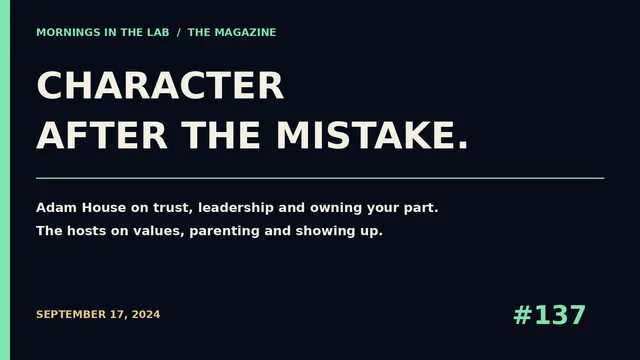
THE MORNING SHOW FOR GENERATION X.We grew up figuring it out. We still are.
THE MAGAZINE · #137
THE COVER STORYCENTER STAGE · ADAM HOUSE
TRUST · ACCOUNTABILITY · WHAT HAPPENS NEXT
Character shows up after the mistake.
For Jon, the revealing moment is what someone does after getting something wrong. Do they take responsibility, or do they reach for an excuse?
Adam House brings the same conversation into business. Trust and reputation take time to earn, he says. A mistake does not end that work, but learning from it matters more than presenting yourself as someone who never gets anything wrong.
His own example is a work call during the pandemic. With his children arguing in the kitchen, he thought he had muted the meeting before losing his temper. He returned to find that the microphone had been live. His point to the hosts is that parents have to own their mistakes too.
The discussion moves between the team, the family and the mirror. Adam describes the support of his wife and his own struggle with never feeling good enough. Jon asks for accountability and an active part in the solution. Neither requires a flawless past.
Adam House discusses earning trust, leading by example and learning from mistakes, including his own experience as a parent. 37:14 Jon asks whether someone takes accountability and helps with the solution after a mistake. 47:14 Keith, Jon, Marty and Kristina debate humor, intent, context and the experience of the person receiving a joke. 23:38 In the gym discussion, Marty and Jon consider the work the arms receive from compound movements and how training routines can change with the person. 1:05:23
Key takeaways
Adam describes trust and reputation as things earned over time, while leaving room for people to learn from mistakes. 37:38
Adam asks leaders to do the work they expect from their teams and recognize when their own role needs to change. 40:32
Jon looks for immediate accountability and an active part in the solution after someone gets something wrong. 47:14
Marty’s example of hiring a coach shows the difference between performing a movement and knowing how to teach it. 53:48
Kristina recommends getting clear on your values before pressure or temptation puts them to the test. 1:28:21
Adam calls self-leadership the starting point. In his example, he asks his team to engage with people on LinkedIn, then has to answer when a colleague checks whether he is doing that work himself.
He also distinguishes the founder doing everything from the leader a growing company needs. Leading by example helps establish the foundation, but he says the role must evolve as the business changes.
Asked what he would tell his nineteen-year-old self, Adam says he would not try to remove every mistake from the journey. He draws a distinction between reading a mindset tip and applying it, while allowing that advisers can help accelerate learning.
Marty offers a concrete example from early in his training career. Being an athlete had not taught him how to explain a movement to somebody else. He hired a coach and learned to cue exercises with familiar actions, such as sitting in a chair.
Adam describes the difficulty of guiding his children while remembering his own mistakes at their age. He wants them to build on what he has learned and still have room to figure things out.
His story about shouting from a supposedly muted work call makes the point personal. He acknowledges losing his temper and says owning those moments is part of what he can model for his children.
Keith opens this conversation by reconsidering jokes he once made and apologizing to friends he may have hurt. Marty distinguishes humor among people who know each other from disrespect and worries about losing room for jokes.
Kristina focuses on context and the person receiving the words. She contrasts language shared comfortably among close friends with the same words coming from someone outside that relationship. Good intent, she says, does not prevent someone from being hurt.
Jon brings both the intention of the speaker and the experience of being targeted into the discussion. The hosts do not arrive at one rule for every situation; the exchange keeps their differences visible.
Marty asks how compound movements fit into arm training, pointing to rows, pull-ups and pressing. Jon adds that a person’s wider program already gives the arms work, which matters when considering more isolated exercises.
Their practical emphasis is on showing up and observing how a routine works for you. Jon says the shorter, more frequent workouts that suit him now differ from what suited him earlier. The conversation offers their training experience rather than one schedule for everybody.
Kristina shares a lesson from her father: get clear on your values before a tempting situation puts them under pressure. In her view, waiting until that moment risks letting the temptation make the decision.
This follows Marty’s advice to a young person leaving home: hold onto the foundation you have been given, even when the people around you have different values. Both bring character back to decisions made before the difficult moment arrives.
Jon describes letting his children pursue what interests them while distinguishing a useful setback from a fall that could seriously change the course of their lives. He says he would step in for the latter.
Kristina recognizes how hard it can be to let a child struggle without immediately fixing the problem. She also talks about her own perfectionism and choosing not to make perfection the standard in her house. The discussion stays with their experiences as parents.
Automatic transcript with source speaker labels. Names and wording may contain transcription errors. Timestamps refer to the full episode.
Read the full transcript
0:00Keith: Hey, I'm just going to sit here quietly for a second. Let you stare at me. Yeah, we're building character. No, we're not talking about the cartoons today. We're talking character. What is in your mirror? When you look in the mirror? Who do you see a guy with character? A guy who's a loser today? Mornings in the lab with Keith, John, Marty, Christina, Flynn, and our guest Adam house.
0:21Keith: Yeah, we're digging into the old conversation of character today. It's a funny word. Yeah. We think big characters like John Anderson and big. I don't Marty fit, but we're not talking about this idea of a cartoon character. No, we're talking real humans. And Hey, by the way, today's an explicit show.
0:47Keith: So if you have children sitting in the vicinity, you might want to put the headphones on, or you might want to turn the music down, or you might want to turn it up and introduce them to the vocabulary that happens here in the business at the performance lab. Hey, I'm your host. I'm Keith Billis across the glass over there is Jimmy.
1:04Keith: Across the glass over there is Tina and across the guy sitting over there. That's John Anderson The guy's lifted a few things in his life And that guy just over there, that's Marty fit at Christopher Martin. He's also picked up a few things in his life as well. He might've dumped a few basketballs in his life today.
1:22Keith: Morning's in the lab. The only morning show to help you guys get your ass to the bed, get moving, get rocking and rolling and get life underway. Good morning team. How are you guys today?
1:31Jon: What's going down? I got a quick vocabulary question. What was the term he used for basketballs?
1:39Jon: It wasn't dunk. It was, what was that shit? Now I'm having a break. Oh
2:02Keith: Hey, Mike Sullivan's joining us this morning. Good morning crew up at the roosters at 4 a. m. Pacific Standard Time. Mike, I'm sorry, Johnny. I got to tell you about Mike Sullivan found us through you. He's a San Diego guy. He's you know what? I found you through John Anderson.
2:16Keith: He goes and because Johnny's on your show. I get my ass every single day out of bed with you guys. And I got to tell you guys, Mike has some he has some challenges. We'll just put that on the table, but he's found us. He's found our energy. He's found the momentum and every single day he gets up to hang out with us.
2:36Keith: So Mike. We're grateful, man, Mike. We appreciate you and anything we can do to help you get your day started. That's why we are here. So Mike Sullivan, thank you, brother. Thanks for hanging out with us this morning.
2:47Jon: And we all got problems for the record. Shit. Ain't not one of us doesn't have some.
2:52Keith: That's exactly it. That's exactly it. Hey, speaking of problems. No, this is not a segue. I know our good friend producer Tina had a sinus challenge. Tina, how's those sinuses today?
3:03Kristina: They're better. I can't complain. I don't know if I'm allowed to say this, but I said to you off screen, Keith, I was like, I never even did cocaine.
3:12Kristina: This feels unfair. I shouldn't have.
3:17Keith: That's awesome. Only in the first four minutes of this show do we talk unpredictable conversation. And we're not talking Coke Zero this morning. No, we're talking sinus infections and lack of cocaine habits. So there you go this morning. Hey, going around the table, I have Oh, yeah, I don't got a black dough rag on.
3:37Keith: I got a black Kangol toucan this morning A little bit cool outside this morning got a black Kangol toucan. I got some brown sunglasses my black Lust or bust t shirt on thinking of john anderson when I threw it on this morning Marty's got his maroon less brunches more crunches shirt on his trademark red headphones Johnny's got the red hat on black glasses, and I think the fuck mental Weakness t shirt, not wellness.
4:00Keith: And Christina's got the old black shirt on this morning as well. Hey guys. So I was reading some news this morning and I have some massive concerns if you're living in Russia.
4:12Jon: And what are these? This would be interesting.
4:15Keith: Massive concerns. If you're living in Russia and tuning into the show this morning, Russians are being urged to have sex during work breaks.
4:23Keith: Amid a massive crunch in, in humans being born. Currently, the fertility rate is less than 1. 5 children per women. It's significantly below the 2. 1 rate. Required to maintain a stable population. So what Putin and government officials are suggesting folks in Russia do nation is that in between coffee breaks, in between protein breaks, in between breaks at work.
4:52Jon: man. Start humping. That's what he's saying.
4:54Keith: It's exactly it. They're like, yeah, but if we're working 12 to 14 hours a day, the humans are saying, they're like no, just go have sex. It's go bang one out. Just go knock it out. Go create some kids. Cause people are dying from the war over there.
5:06Keith: So if you're in Russia, they want you to create kids, but team, here's the contrary point of view. Now, if you're living in Russia and you're a man, pollution is shrinking human penises.
5:31Keith: you're living in Russia in a place with Some pollution and you're not creating kids. Your dick might be small.
5:39Jon: Wow. I don't even know what to say to that one.
5:41Keith: You know what? This might be the first time in the history of mornings in the lab.
5:45Keith: We have John Henderson with nothing to say the whole morning show. The morning loop. Christina has gone off the rails. Good morning, Mike. Good morning, Mike. See you. Sullivan. Good morning. Real deal. Good morning. Good morning. So young. Oh, yes. And real deal. Prime says China birthrate is low yet. They seem to be managing.
6:01Keith: And then yes, the must be the climate. So listen today on the show, we've got the, we've got the morning loop. The first 14 minutes of the show, the part of the show you guys want to tune into unpredictable conversations. If you're living in Russia, you gotta have sex. And we're going to talk to you for a few minutes.
6:14Keith: You're about pollutions, making guys, dick sizes, smaller, come on the 50 minute mark. Get the we got a conversation that I touched on yesterday, Marty and John, and I want to lean into a little further today because that story that I read over the weekend with Will Wheaton referring to just jokes and how we as society, Look at other humans and dehumanizing humans and jokes at the expense of Demarginalized humans and I want to talk about that for a few minutes later on today We've got Adam house joining us to talk about character at the bottom of the hour guys And then at the protein breaker on the 45 minute mark of the show We're gonna lean back into a couple other topics John and Marty nation at nine o'clock Eastern time You guys want a big you guys want to build big arms?
7:02Keith: John and Marty are going to get into a topic around biceps and triceps today. So that's going to come up at the top of the nine o'clock hour. It doesn't want
7:08Jon: bigger arms, man. Who doesn't want bigger arms?
7:13Marty: some of the excuses from the guys that come in my comments and hate what I say.
7:17Marty: Oh dude. Tell me what I want. Big. Why would I want big arms? My wife loves me how I am. It's bro, I never said your wife doesn't love you. This is a fitness page. I'm giving fitness tips, bro. Come on, man. That's it. That's it.
7:37Jon: I love it. Marty's thing. Come on, man. I love it. He's got the invitation to me.
7:41Jon: I got the one coming back. That's good. I like that one.
7:44Marty: I got John Anderson invitation coming later.
7:52Keith: So listen, in 2017, Dr. Shanna H. Swan, a renowned environmental and reproductive epidemiologist, tied the use of industrial chemicals and everyday products to smaller penises, lower sperm counts, and erectile Dysfunction. And as a result, a book was written called countdown. How our modern world is threatening sperm counts.
8:15Jon: Food has got to be a process. Food has got to be a part of this.
8:22Keith: Yes, it's a big part of this. And you know what, Johnny, I found something this morning that I read. I didn't have time to pull it all together, but a study was released in the last 24 hours, John, around the thousands of chemicals that we actually consume throughout the day.
8:37Keith: That we don't think about, but when you add them all up, so I'm gonna get into that hopefully later this week but you're absolutely right. They talk about these PFSAs, right? These forever chemicals that are found in everything that we eat and all this packaging and so forth.
8:53Keith: And essentially what they're doing is. They're making our dicks smaller. Yeah, it's true.
9:03Jon: I think they're doing a lot. They're doing that amongst many other things. This whole it's unbelievable. They're basically killing the human race with all of this terrible food that they're feeding us.
9:15Keith: So Johnny, so are we doomed to see future generations grow up with smaller and smaller schlongs or is there anything we can do? And according to Swan, John, you're going to love this man. Buying single ingredient foods, buying organic protein, using less plastic in our everyday life will help eliminate those chemicals.
9:32Keith: So gentlemen, eat home cooking, try to stay out of, Tupperware. Hey, Tupperware is going bankrupt. A little Beagle MLM company from the years ago, Tupperware is going bankrupt. If you try to stay with single ingredient foods and stay away from environmental. Pollutants.
9:51Jon: I guarantee you this is not just a Russian problem. guaranteed. This is a worldwide problem we're having. This is a worldwide problem. Yes. We're de we're depopulating. This
10:01Keith: is absolutely a worldwide problem. But the problem happened in Russia, Johnny, is that so I linked the two.
10:05Keith: So there are two sh there's two separate stories that have linked them together. So Russia is saying, Hey guys, girls have more kids because we're losing humans in the war, so we need you to make more babies. And then the second story I read was, yeah, but pollution's making dicks smaller on men. And if you happen to be over in that part of the world where there's lots of pollution, you might be actually two things against you.
10:26Keith: You can't make kids and your dick is smaller. Christina you're puzzling. Are we talking
10:30Kristina: sperm or are we talking dick size? Like that to me The dick size, I struggle to understand how pollutants affect that.
10:38Jon: Apparently, let's figure like this. If eating poorly reduces blood flow, which we know it does.
10:44Jon: The shaft uses blood to gain its size. So if blood flow is poor, you're never going to get that thing all the way up to par, which means you're going to be shortchanged when it comes down to just
10:55Kristina: be based on an erection. We're not talking about but like biological, whatever you were gifted with.
11:02Keith: According to Swann's research, Christina, BPA, methylate, parabens, and atrazine are the main culprits behind decreasing libido and fertility. These chemicals are found commonly in plastics, herbicides, toothpaste, and beauty products, and act as endocrine disruptors, which leads to premature birth, lower IQs, obesity, and Gentlemen, and according to swan's research, smaller penis sizes.
11:33Jon: So the question is, which Christina brought up, is it when you're when it's flacid or because it doesn't get all the way primed up
11:46Jon: I was, I know brother, I was searching for a word man. I was like I need a, I need an adjective and I need it quick. And that was all I could come up with. So you
12:18Keith: and girls. A recent study in Melbourne confirmed that chemicals and plastics are leading to genital defects in male babies. Researchers from France's national public health agency found that young boys who lived in polluted regions where coal mining used to take place.
12:35Keith: Marty, we're twice as likely to have one descended testicle and five times likely to have two undescended testicles.
12:44Jon: Check this out. I've got a really interesting thing that I can run up against this. So I'm not going to use any names. I'm going to protect the innocence because this is actually really cool.
12:53Jon: A buddy of mine had a boy, this was years ago, and he decided I'm going to do it the way it should be done. So this little guy has never eaten a processed food. He has slept. He's been literally. Last what I see was two years old. I walked in his house He had a piece of raw tuna like a holding on to it like a Snickers just chewing it down no, I swear to god. He and literally that now at five years old I see pictures of him and he's A full head and a half taller than everyone else because he's been treated the way that the body was designed to be treated to maximize his growth. No, I can't imagine that doesn't happen with the shaft as well.
13:36Keith: Real deal. Prime note to self work over ground correlation.
13:43Marty: I said that was a great correlation. I'm telling
13:45Jon: you right now. I've never seen because. I don't think anybody's ever seen in our current world, a child that's been truly raised on single ingredient, whole foods, never had a processed food in his life.
14:04Keith: Hey, you know what? Speaking of nuts, this is a true story. I went to school with a guy who fell on a fucking fence and lost a testicle. Oh. We called him Racknut.
14:37Keith: Oh man. So yeah he ended up on the nut. So I ended up on the fence and had to go for surgery because it ruptured his testicles and And yeah, one of his nuts got ruptured and his nickname, you know So I guess we're talking jokes later on in the show, but we called him rack nut for a long time
14:54Jon: There would be a lot of good opportunities for a nickname if that happened to somebody I think, you know I was probably one of many, I would imagine.
15:04Keith: Hey, this is the morning loop of the morning loop on the mornings in the lab show, Keith, John and Marty and producer Christina Flynn. The first 50 minutes of the show to get you guys going, the only accountability show to get you guys up, not hit the snooze button and start your day with us.
15:18Keith: I encourage you. And I invite you to like the channel, subscribe to the channel, share it with your friends. We've got a good time joining us here in the fees. We are real deal prime. We've got AJ bumping in with people need to start fasting more tons of health benefits. We're going to have it here in a few weeks here on the show.
15:32Keith: And SWACs just says I just coughed really hard and one of my balls just popped inside of me. Should I be concerned? No, but Tyro fully grown children talking about this. You need help. No, we're having some fun. That's what we do here. Mornings in love. And what we do next is this
15:53Keith: That's it time for a piss, Johnny. And it is time for me to lean into a part of the show we call the accountability check in. It is something that gives you something to think about, to get your day going, to get your day off to start. And here's what we're going to lean into today, Nation.
16:10Keith: They say if you can dream it, you can achieve it. You know what? You know what I know? They're wrong. Because dreaming means nothing without action. You can imagine success all you want, but if you're not moving, you're not progressing. Because here's what actually works. Set an audacious goal. Break it down into simple steps.
16:38Keith: Execute relentlessly, even when it sucks. Because here's what I know. Dreams don't come true. Oh nope. Decisions and actions do. So as you start your day, if you can dream it, You can achieve it, but knowing that they're wrong, if you don't do anything about it, so that's your invite, get your ass to the bed, don't hit the snooze button, get going, hold yourself accountable and go chase the dream.
17:09Keith: Like Seth Koons chasing that one over there, that one over there, Seth, get up and go after a brother. I know you can, that's the accountability check. And every single day around this time, we drop it, give you guys something to think about and get you guys get started. Okay. So we're going to bring back up our.
17:29Keith: My illustrious co hosts, John Anderson. I'm going to bring Tina in for this conversation or bring Johnny up here as well, bring Marty back here. Marty's still doing his toe touches. I think, Oh, I'm sorry. He stretches. Yeah. There's Marty coming back into lap. What's up, Marty? All right. So I, yesterday guys, we started a conversation yesterday.
17:52Keith: This is a new segment in the show. We're calling center stage. It is putting a guest, a topic or an article, something related to the things we talk about here in the lab. We're going to have a discussion around it. It's a new segment we're talking about here in the lab. And we leaned into this yesterday, guys, and I want to pull it back and put it on the table again today.
18:11Keith: So here's where I'm going to start. So Will Wheaton wrote a story on the weekend and it was about, and Will Wheaton's an actor back from the olden days, back when Johnny and I were young little puppets. And Will writes a story about how locker room, the locker rooms that I grew up in, the locker rooms that Johnny grew up in, the locker rooms that Marty grew up in, and the locker rooms that we all told.
18:36Keith: Homophobic jokes, why we might want to revisit them. Now I'm going to embarrassingly admit right now. That was one of those guys
18:51Jon: real quick. This must be a candidate thing because I never made those jokes.
18:55Keith: Oh, interesting. Interesting. So I'm gonna, I'm gonna, I'm gonna lean into this because I was part of those guys in the locker room that was making homophobic jokes and saying the shit that was on Eddie Murphy's Raw and leaning into those movies like Eddie Murphy Raw and all that comedy that was normalizing back in the days that I grew up, normalizing homophobic jokes and normalizing dehumanizing other humans.
19:22Keith: So now as I wake up today and read and look back to some of the things that I laughed at, I'm fucking embarrassed and I'm fucking ashamed of myself actually. And I just want to take an opportunity right now to apologize to my friends in the LGBTQ community over the years that I've offended by some of my behaviors telling homophobic jokes that I thought were funny.
19:48Keith: And when I reflect upon it, I don't know what there is funny about one thing. And here's what it comes down for me, John, Marty, and Christina. And I'm going to invite everybody in Business Athlete Nation to lean into what I'm going to say next. I don't know what is funny about dehumanizing Marginalized groups because I don't know what's funny by me making fun of a D about a marginalized group, which then gives somebody permission who might not have the same awareness I have, or John has, or Marty has, or Christina has to then go do something hatred or hateful or against a D marginalized group.
20:27Keith: So I want to take a quick second to apologize. Let's start the discussion that we have to stop. We have to stop nation leaning into these homophobic jokes that we think are funny because when it comes down to it, we're demarginalizing a human being. And that to me is ultimately wrong. Johnny, I saw you need to go.
20:51Keith: Let's go around the table. This one, John, you first.
20:54Jon: I think first off I was raised in a very liberal setting where, you know, like being very accepting of all races, all preferences. That's just the way I was programmed period end of story. And then the second thing, this is an interesting perspective here is obviously I'm straight, but.
21:14Jon: I was being, I was basically a target of many of those locker room jokes for being a dumb little son of a bitch, so obviously another small school of, easy targets, if you will, and so I understand what it's like to live on both sides of this fence. So it's it's pretty fricking brutal to, to know that you're going to go into a setting and you're going to, you're going to get basically just making your skin get thick because what's coming.
21:46Marty: I gotta counter you on the word dehumanize because I've seen the people dehumanize the people in the gay community. I don't think it's jokes. Now, I think there are jokes that dehumanize them. Absolutely. But if we're going to talk about dehumanizing, I think we got to talk past jokes or jokes.
22:16Marty: And if you want to be equal, I feel like everybody should be able to be joked on. You should be able to make straight jokes. You should be able to make certain jokes. Now there are disrespectful jokes. Now, when I say dehumanize, I've seen parents, their kid chooses that lifestyle and they like, oh, now you got to get in the back seat.
22:31Marty: Don't get in the front seat. That's dehumanizing. Or if let's say and I'm sorry, this isn't anything against women, but let's say I have a disagreement with a woman. I say, no, I don't want to do that. Or, I disagree and they insult me by calling me homo that's dehumanizing and that's disrespectful to the LBGT community.
22:54Marty: I think that's dehumanizing to use an insult, but I think a joke, if it's a, if it's a, if it's an, an acceptable joke, I think that's fine. I don't think we should tell people not to make jokes about it because we come on. We make black jokes. We make white jokes we should have humor and our fear It's the spirit There's a way to do it.
23:14Marty: Yes, there's a spirit. There's a way to do it So I think I don't think all jokes should just be called dehumanizing because then it's like we're not even humans anymore at a certain point Humor is part of our you know, that's part of our nature But I think if we want to talk about dehumanizing there are certain things we should highlight and we should highlight the actual dehumanizing That's just my opinion on it Hey
23:38Kristina: Yeah. I mean there's a number of different things at play here I think there's when you talk about dehumanizing versus joking Context is everything.
23:50Kristina: So it's a matter of, it's your opinion that is not a dehumanizing joke, but somebody on the receiving end of it feel that it is, that's not your call to make.
24:04Kristina: we need to make a consideration of who are we talking to and who are we joking with? The example that I always use is context is everything. If I move my girls, I'll be like, bitch, what are you doing? Blah, blah, blah, blah. Are they going to take offense to it? No, they're not going to take offense to it.
24:19Kristina: But if you walked into the room and said, bitch, what are you doing? They'd be like, who the fuck is this guy? You can't don't call me a bitch. So it's a matter of context. If you are with people that you know, incredibly well, That the jokes are at the person being like, you know We always joke in my family like the lesbians get the parents.
24:38Kristina: Sorry teens like you're fucked. You gotta get my parents That's like among my family. That's among my friends. I know that there's no ill intent there but if i'm in a locker room, which is what will's talking about or if i'm just Dave chappelle and i'm on a show and i'm saying things that are incredibly hurtful incredibly dehumanizing That take a group that already struggles day to day, like the trans community, and I'm putting one more in them, and I have crazy influence to be able to do that, to me, that's completely unacceptable.
25:13Kristina: And like what Will was saying, he's raised in this environment, just like Johnny was socialized that it, there was no environment. Will Wheaton was raised in this environment where it was entirely okay to shit on people. And then he gets into a social context where it's not okay. And he's realizing, Oh damn, like I, I know now the air of my way.
25:33Kristina: I was given permission, but those people had no right to give me permission.
25:39Jon: Johnny. Yeah, no, I, I could I basically had What I was saying when Marty was talking, it's the spirit, is the spirit of the joke intending to be like a giggle with somebody like laughing with them or you firing right at them and laughing at them.
25:57Jon: And now, of course, then Christina brings in a great point. The perception of how the whole thing unfolds, so it's there's no easy way through this, but I think when it comes down to it, if you look at the person is the person that's doing the talking, what is their intention? And I think, if that would be the place to start, not that it makes this whole topic easier, but I think if we look at the person and what they're saying, are they laughing with you or laughing at you?
26:28Keith: Hold on guys. You're hanging out with Keith, John Marty and see Marty fit here at the, but come at the bottom of the hour, we're talking dehumanizing humans. It's an important conversation. If you're leaning in right now, because we think they're joking or are they joking?
26:40Keith: It's all about context. See Marty fit Christopher Martin.
26:43Marty: Yeah. And obviously Christina, yeah. Context is everything. If I, like I have, some gay cousins and we joke around all the time. I'm not going to go up to someone who I don't know and make those, the same jokes and vice versa.
26:57Marty: Absolutely. Context is everything, but my thing is, and and let's be real. It's obvious. I'm black. People say stuff, they make jokes about black people. I see stuff all the time, but at the same time, as a black man, I can't complain every time I see a joke about it or every time I see something, and my fear is that we're going to get to a point where, We can't say anything that maybe, you know and there are times you should be offended, but I feel victim culture is real in America.
27:30Marty: And there are times where it's legit. The you're, yeah, you're a victim. That person shouldn't have done that. And then it's other times where it's All right, come on you gotta let that one slide and anything like dave chapelle and stuff I'm, not saying that they should let that slide because dave chapelle is insane.
27:45Marty: I would never Go up there And say some of that stuff. So at times it's legit, but that's my fear I don't want it to get to a point where we offended at everything, because people are going to disagree with your lifestyle. They're going to disagree with your skin color That's just the reality and as a black man You I've seen it and I don't even like to pull that card.
28:06Marty: Y'all, y'all never going to hear me pull that card, but I'm just pulling it up today because it's, it is unfair. Life is unfair. And there's going to be times where you've got to have tough skin and you're going to have to deal with that. So just moment of transparency right there. No, I feel
28:20Kristina: I feel you. I think it's a matter of. What you're saying, right? Can you intend on not hurting somebody and still hurt somebody? Yes. Like it's the use of the R word. To me, there's a difference between like reclaimed words and words that people use against other groups. So if you look at the R word as the example, my mom does not understand why the LGBTQ community or myself use the word queer to refer to ourselves.
28:48Kristina: She grew up in a world where that was not okay. She's that's, it's a bad word. What are y'all doing? And it's there's this idea of reclaim words to say like that was used against me. And now I'm taking that back and using it as a way to empower myself. I think when it comes to these jokes, I'm with you.
29:04Kristina: I love humor. I love calling things out for what they are. What it always comes down to me is is everyone in the room cool with you making that joke at that person's expense. If they are. That's one thing if they're not you got to cut it and I think casual homophobia is a hard thing because I don't think it's a Lot of it's not something a lot of people are educated on But it's just the idea of are you joking about something being lesser than are you calling each other a pussy?
29:36Kristina: Because you're saying being a woman is weaker Are you saying no homo because you're like, I don't want to be thought of as gay all of these things again It's not easy, but it's just a matter of like you said, I want to be able to joke I'm not offended by everything, but if somebody else in the room is going to be incredibly offended or hurt by something I say, I'm just not going to say it.
29:55Jon: Johnny yeah, I think what in and I have some a little bit of experience on the other side of the fence So I think one of the things I think that needs to be recognized here is that people need to basically Toughen up a little bit. I don't mean not have feelings. I just mean learn to block out the noise You know as a fat little dumb son of a bitch I was picked on a lot and that was one thing that I just by the nature of survival I was pretty good at starting to block out the noise to where when people were talking all that mess It didn't affect me anymore.
30:31Jon: So here's the thing If someone is saying something that offends you, you have the choice to allow that person to actually offend you and change how you feel about the rest of your day. Or you can realize that what that person said doesn't mean enough for you to have a bad rest of your day or a negative set of emotions.
30:53Jon: We choose, we can't control what happens around us, but we have 100 percent control of how we react to it. And if you react properly and you stay focused on you. This problem starts to drift away, but more importantly, you actually benefit from the situation because you're practicing, focusing on yourself, blocking out the noise.
31:15Marty: John C. Marty fit, Marty. Go ahead. Let's go. We'll go one thing real quickly. I know we got to close out, people are going to be ignorant forever. You're not going to change ignorant people. You're not going to stop people from being ignorant. So like Johnny was saying, you do have to have a level of tough skin because There's always going to be ignorance.
31:35Keith: Awesome. This is a great conversation. Clearly we can have more of it, Tina. I think we'll put it on the calendar for future shows because this is a great topic and I want to educate and I want to inform and I want to leave. Everybody listening with this one thing to consider. We saw it yesterday. The influence we have as human beings is powerful.
31:54Keith: If you say something you don't like and somebody's listening, you might inspire them to do something that they don't even know they're going to do. And all we had to do was see it yesterday when somebody sent out a tweet saying, Jeez, I can't believe nobody's trying to kill that person over there.
32:06Keith: Really? They said that we all know what Elon said, love him or hate him. But actually you're going to make that statement on Twitter. You're going to say, yeah, how come nobody's trying to kill that person? So think about that for a second. Think about the influence. Think about when Chappelle goes on stage, love him or hate him.
32:19Keith: And he says, and he demarginalizes a group of people. There's somebody in that audience or somebody listening who may not have the intellect to reason that he's joking. He may, they may not have the intellect to realize that he's just trying to have some humor. And as a result, that human who heard Chappelle might just go down the street, hurt somebody.
32:39Keith: Is that really what we want to perpetuate? So that's what we want to talk about and keep talking about here in the lab is having conversations of importance. But Hey, let's lighten it up. Let's bring an Adam house. But before we do that, Marty, let's do this. Let's kick it off. All right. So we're going to do this.
33:03Marty: All right. We got the fitness tip for today. Let's get to it. We're going to talk about why the V shaped torso matters. And then I'm going to add three body weight movements to help you build that V shaped torso, all right? So this isn't just about an aesthetic. This represents strength, health, and functional fitness, especially as you age, right?
33:24Marty: You're going to have better posture if you get this V shaped torso, slash back, whatever you want to call it, right? This is going to show that you build strength in your back and your shoulders, and this is going to help improve your posture, reducing your back pain and reducing your risk for injury.
33:39Marty: Broad shoulders, narrow waist. It gives you an athletic, strong look, and it's going to be a confidence booster, a performance booster, and it's a symbol of strength. And then as far as functional fitness, the muscles involved are going to be your back, your shoulders and your core. And it's going to be good for everyday movements.
34:00Marty: Like lifting, you're going to lift up kids, you're going to lift up luggage, you're going to carry groceries, you're going to twist these are everyday life movements that are going to benefit you as you get older. Maintaining these muscles is going to become more important, staying active and injury free as you age as well.
34:16Marty: The three bodyweight exercises that are going to help you get started to achieve This look, pull ups, back, shoulders, arms, and a broad upper body. Push ups, chest, shoulders, triceps, while engaging your core. And lastly, planks. Strengthen your core. This is going to be key for supporting your posture and stabilizing your entire body.
34:39Marty: Strive for the V shape. Work towards it. Attain it. That's the fitness tip for today.
34:46Keith: The day see Marty fit, John Anderson. Joining us here in the lab. We got a segment coming up with our friend, Adam house and boys. I got this set up for us here today. Check this one out here. We got this going here. All right, we got a new segment.
35:03Keith: Look at this. Holy. Listen to the music. Let's bring him in. Let's bring this guy into the lab. I got to get them on screen here. Jimmy, I'm having problems with the vertical here. Let's just do this here, man. When the most doesn't work, we're going to build it up. We have the CEO of Adam house, sorry the house of bricks CEO Adam house joining us here today all the way from Adam.
35:45Keith: good? Yeah, how's it going? How's chicago treating you pal?
35:49Keith: We got adam house joining us. Are we good? Yeah, we're good loud and clear brother. Keep going pal. How are you doing today?
36:00Adam: Okay I'm doing great. Thank you. Yeah in the hotel was in chicago yesterday Spotty wi fi it appears, but hopefully you guys can hear me and I got the desk lamp on me for a little better visibility So hope everything's good and wow, whatever the last three minutes of that conversation was Thank you for not having me as a guest on that part of the show.
36:25Keith: We're here to talk character, Adam. We're here to talk character in decision making and leadership. And I found some stats that I think are relatively important for today's show, but 64 percent of consumers cite shared values as the primary reason they maintain a brand relationship. Adam, Can you recall a specific instance when your career where you had to choose between character and short term gain because in today's business world, trust, transparency, they're not optional.
36:54Keith: Frankly, you live in a world of digital brands. They're just non negotiable. Business leaders are scrutinized out of Marty John, not only for results, but for their character and how they handle adversity. Adam, from your experience, how does character shape leadership when the pressure is high? Adam House.
37:14Adam: Man, I will tell you what you and I are both doing right now is the most opportunity I've ever had to sacrifice who I am. Short term gains for, not long term impact. So you have a choice, right? You either. Get out there and spam everybody and try to be someone you're not on social media Or you can build authenticity and trust over time and it takes time.
37:38Adam: You can't buy trust it's earned. You can't buy reputation. It's earned and one thing I do want to say, as we talk about this is Even if you have made a mistake If your intentions are good or you recover and learn from it, you're still heading in the right direction So people beat the crap out of themselves.
37:57Adam: Give yourself a break We're all human. We're all going to make mistakes. And I always lead with trusting a person with that. They had good intentions and their situation may have overcame them for a temporary moment that impacted their decision making.
38:14Keith: Yeah. Hey, Johnny, John, when you think of character in your career, bodybuilding, wrestling, strong man, you've been around a lot of characters, but when you think of character, what does that mean to you?
38:25Jon: You find that it's funny because you they're spotted very quickly and basically like you could in the athletic world, it's going to be like a locker room leader. The guy that's got that really stellar character is going to be the guy that seems to it's not that he keeps peace but he's just the guy that everybody comes to when they need to, when they're at a crossroad, they don't know what to do.
38:51Jon: So the guy with the good character. And, he's gonna he's the cream, he's gonna rise to the top and it real easy to spot in a locker room setting. Obviously in a business world, it's easy to spot as well, but I guess that when you have that good character and you're the guy that owns your word, when you say you're gonna do something, you do it.
39:10Jon: And that's a huge part of who you are. People are attracted to that, whether they know it or not.
39:15Keith: Yeah. Marty, what about you man? What does character mean to you, pal?
39:18Marty: Man, character is everything. And character is, I guess basically what you've been through and who you're in your life and who it made you become and that's going to reveal itself And I guess difficult moments of adversity Obstacles challenges, that's the real you right the way you are when things are going great, business is up Relationship is going good.
39:43Marty: Friendships are going great. Kids are doing well in school That's not the real you. The real you is going to pop out in adversity and a lot of people fold. A lot of people show them true selves. They're going to cuss you out. They're going to be mean. They're going to ignore you. They're going to do a lot of negative things.
39:57Marty: So character is everything and how you react in those tough moments. That's the real you. And that's how I'm going to judge. That's what I'm going to judge you on.
40:08Keith: Adam, you have started several companies. You've been involved in several companies. Is the company culture, Adam, a reflective of your character as the CEO and as the founder?
40:17Keith: Or is character a culmination of all the individual humans that pull together a collective force? Lean into the influence that you as a leader have, Adam, in setting the character of the culture of an organization. Adam House.
40:32Adam: Yep. Best form of leadership is self leadership. So especially in startup mode, everything that I am asking my team to do, engage on LinkedIn, comment 20 times a day.
40:42Adam: I got Michael yelling at me every morning. Hey, I'm looking at your stats. How come you're not commenting and engaging? Listen you got to lead by example. Now that's only sustainable for a certain time in the business, but that's what creates that strong foundation. There has to be a time you evolve as a CEO and every entrepreneur takes what title in the business CEO because they're the only one there and they're under qualified to take that title.
41:11Adam: But they take it because it's available, but there's a huge difference between a solopreneur entrepreneur and then CEO. There's just different ways you have to lead. And that's why a lot of businesses stay under a million dollars in revenue or five million because the entrepreneur founder can't evolve.
41:30Keith: That's interesting. So Adam character can take decades to build and you lean into this and you first brought up here about making a mistake character can take decades to build, but can be shattered in a moment. This is especially true in high stakes business environments where one ethical misstep can derail an entire reputation.
41:52Keith: Johnny, looking at you pal through your career. Have you seen, or have you been involved or been around leaders where one misstep has unraveled absolutely everything and looking back on it? Could you see where they could have made a difference or a change in that? So that it didn't unravel everything, Johnny.
42:11Jon: Yeah. And usually when someone's character gets, compromised, it's cause there's a lot of zeros involved in a decision, money is really weird. About changing someone's character and you can't unring that bell You know the guy that is put in that position To lead the team so to speak, you know lead the locker room, you know he's got that character of a guy that's supposed to be there and he's not supposed to be detoured by some little distraction And again, of course, we all want to make money but money is just one piece of The equation of wealth and success.
42:53Jon: And so I've seen it plenty of times that it's always been involved in some sort of a negotiation or just a transfer of money, currency, whatever you want to call it.
43:03Keith: Yes. Characters are fragile thing. You can lose it all in a quick second. You need to have consistent practices and habits to build it over time, Adam, talk about the fragility of character and that the razor edge of.
43:19Keith: As a high performing business leader, as a high performing athlete pushing, but not going over the edge.
43:29Adam: I'm going to give everybody two things to wrestle with for the rest of their life. Okay, which is number one, a good name is worth more than any amount of money. Your reputation. Yes. And the second, for anyone that is giving someone a hard time for a mistake, whoever hasn't sinned, cast the first stone.
43:46Adam: everyone. Look at yourself before you start tearing down other people. When Tiger Woods came back, I was pulling for him on every single hole. When Kobe Bryant made his comeback, I pulled for him on every single situation. Because, put yourself in those shoes. Millions of dollars. Those guys work, 500 hours a week.
44:06Adam: The temptation, the troubles that they face. I always look, is that something I could have done? Have I done things like that before? So don't sit in a glass house and throw stones, but live to build a reputation.
44:21Keith: Adam, you brought up a couple of good examples there. Kobe Bryant and Tiger Woods, right?
44:27Keith: Men that we grew up with, admiring men that we thought were, we put them on pedestals and then their character came into question because of, The things they did outside of the sports arena. How do we, as men, how do we, as humans reconcile and accept them again as men? Or is it as simply that they're the reputation that they had along the way precedes the mistake or the fuck up they made which made us question character to start with Adam, you first.
45:00Adam: Like I said before, we're all capable of anything. And this is where the power of accountability, community, so I like to surround myself with like minded people, because we're all human, we're all men, and we're all dumb as you know what. So it's just, we're all capable of anything. So get around the right people, show me your five friends, I'll show you who you are.
45:23Adam: Get in a community and I've talked about this before mentor someone else if you're holding them accountable, it will hold you accountable you'll grow and But listen any mistake you've made the past only exists in our mind. That's the only place the past exists So learn from it move forward and keep building
45:42Keith: Yes, we're talking character with the CEO of House of Bricks, the ultimate entrepreneurial advisory services.
45:48Keith: I invite you to go check out Adam House and House of Bricks on the LinkedIn community and all over the internet. Marty, when you hear, when we're talking about Bryant, we're talking about Woods, we're talking about character. How do you as a young man reconcile with those mistakes they made? And how do you lean back into those guys to admire them again and put them back on a pedestal, Christopher?
46:08Marty: Yeah I honestly, they I'm not happy to see those mistakes, I don't want to see anybody lose money, potentially lose their family, but it shows me that, hey, these guys are human, they make mistakes too, and, like you said, we put these guys on a pedestal, and, especially as a kid, seeing these guys, you look at them like they're perfect.
46:31Marty: And so as a kid, I made tons of mistakes, right? So whether that's sports or outside of sports, so that made me realize that it's okay, and you can bounce back from a situation. I've dealt with tons of adversity at 31, a lot of things. I've shared some of it on here, I know looking at those guys and how successful they've become, I can always bounce back.
46:55Marty: And then when you do bounce back, guess what? People forget about it Like I guarantee when kobe bounced back and won them two championships after all that crap Nobody was thinking about that. You know when tiger bounced back. Nobody was thinking about that I'm sure that the golf ratings were going back up.
47:14Jon: And you know what I want to see when someone makes a mistake forget whatever they're whoever they are, Number one are they taking accountability? Right away, because good character is going to say, oh shit, that was a mistake, you know For whatever reason accountability is going to be there immediately There's not going to be an excuse the reason doesn't matter and then the second thing Is that person going to be actively part of the solution rather than the problem and you know You find the person that takes accountability he wants to double back and he wants to help the situation in any way he can The guy that doesn't take accountability, he makes excuses and usually will continue to be part of that problem.
47:54Jon: And it's a pretty clear line to see someone's character at that point of what are they going to do when they made that mistake?
48:01Keith: We've recently seen some recent news. We're talking character Dave. The last 10 days or so has come out and held and kept himself accountable for something he has done, having.
48:11Keith: Another child at a wedlock. So you talk about character. Dave Grohl himself is going through a character test right now in the media and in life and with his family, as he's acknowledging what's been going on in his life, we're talking character with Keith, John, Marty, and Adam house. And we're going to move our attention in the show to the John Anderson lifestyle segment, and then we're going to come back and we're going to continue the conversation with Adam.
48:31Keith: And we're going to talk about growth through imperfect, imperfection, owning our younger selves. We're going to lean into that talk for a couple of minutes, but Johnny, my friend, Guess what? It is time for you to do this.
48:46Jon: You're up, pal. All right, here we go. Another lifestyle actionable tip. Here's the thing. We want all these tips to be something that you can understand and apply to your life. So here's a thought it hear me out. I know when I say this is going to sound a little weird. The quality of your thoughts are going to dictate the quality of your life.
49:11Jon: So keep in mind the way that the human brain was designed, it was designed to pick out all of the threats and the challenges. So the human brain is programmed to basically have stressful thoughts. You got to remember most of the things you're stressing out about. never actually turn into reality, live in your mind.
49:31Jon: So what this lifestyle tip is about is to understand that your brain is going to basically find things to stress out about. And those thoughts are going to degrade the quality of your day, your life, whatever you want to call it, all the above. So when you start to practice catching yourself, having those stressful thoughts, boom, stop it.
49:53Jon: Think about something that made you happy. Think about something that made you smile. You can start to literally have a big difference in what you think about, which will then in turn make a huge difference in how you feel, how you behave, your success. Because when we're thinking about things that make us happy, that thinking about things that inspire us.
50:16Jon: We're focused on what we want to do. We make more progress and that's what it's all about. When you're thinking about the shit that stresses you out, quality of life is poor and your forward progression is going to reflect that. So that being said, just remember the quality of your thoughts will dictate the quality of your life.
50:38Keith: So dictate the quality of your life. That's the lifestyle tip today with John Anderson coming to you here. Mornings in the lab with Keith, John, Marty. Producer Christina Flynn. We've got our special guests here today. Adam house and boys, 70 percent of people, 78 percent of people believe that they could have handled past business decisions better if they had the mindset and experience that they had today, Adam, we all look back on past business decisions and realize we could have done things differently, whether it was about integrity or simply a decision based on fear.
51:12Keith: This is something almost every entrepreneur or leader can relate to. Adam, talk about some times in your careers where looking back have made you cringe. And yes, I saw that picture you dressed up as Vanilla Ice. Are there some career moments, Mr. House, that you have looked back and you're going, oh man, this is a cringeworthy discussion or a cringeworthy decision.
51:37Keith: Adam, you first, pal. Keep it real, Adam. Yeah.
51:57Jon: I don't think we've got him in the horizontal either.
51:59Keith: Yeah. Oh, Adam's fully muted here. So while we're going to, while we're unmuting Adam Johnny, have you looked back on past business decisions?
52:09Jon: Yeah. Yeah. In terms of this question it's interesting because when we look back, we can connect the dots.
52:18Jon: We understand that. And here's the thing. Yeah. The things that happen when you look back and they're cringeworthy, you got to remember that something happened in that cringeworthy moment that changed your trajectory and the change of your trajectory. If you responded properly to that cringeworthy moment would actually be something you look back at and be happy about.
52:38Keith: Yes. Adam, you want to unmute yourself and we'll put you up here as well. There we go.
52:45Adam: I'm not on, can you guys hear me now? Or We got you now bro. I can hear you. Okay. Sorry. It's the hotel wi fi. So that's okay I don't know what you heard, but Lean into the talking Moment of your life adam yeah, so People ask this question.
53:03Adam: Won't you tell your 19 year old self and I say nothing Because you learn through the process any tip can give you on mindset. You have to do it to own It's not reading it in a book. You got to apply it. So Telling my 19 year old self isn't going to do a lot. Now there are ways to accelerate the process through advisors that have gone through things that you have gone through.
53:27Adam: But when I look back, I've made a thousand mistakes, different ways I could have led people. But I don't live in the past. And all of those mistakes led to where I am today.
53:40Marty: Yeah, man I've made a lot of cringe worthy moments, but I would say first thing Run to the cringeworthy moment.
53:48Marty: Like the quicker I can get to it, the quicker I can get past it, the quicker I can get better. And, specifically as a young trainer, had people doing things with the wrong form maybe, but I didn't know how to communicate and cue them. I didn't know how to, I didn't know how to do that.
54:05Marty: Cause I play sports. I was an athlete my whole life, so I just picked up on things, but I had to hire a coach. And I, and he had to teach me how to cue people like, okay, use real life movements. Imagine you're sitting on the desk chair, imagine you're sitting on the toilet, stuff of that nature.
54:22Marty: Imagine you picking up the baby on the deadlift. When I learned how to do that, it got better, but people would be hammering my videos of clients because they'd be doing stuff wrong. So it's just part of the game.
54:33Keith: Adam, I'm struck by something you said that you're saying to yourself that if I was to speak to my 19 year old self, I wouldn't tell them anything different.
54:40Keith: What you're actually saying is, embrace the mistakes you're going to make. Embrace the obstacles you're going to face. Embrace all the learnings along the way because if I'm telling you all those things that are going to happen You're not going to have a chance to learn from them so essentially Adam what you're saying is that Cringe is part of the journey and I know you in the house of bricks and us here in the business athlete performance lab Embrace the journey Because it's all about the journey and it's not the end in game.
55:08Keith: But Adam, what you're really saying is that if you're going to talk to your younger self, you want to encourage the younger self to walk towards those cringeworthy moments, aren't you, Adam?
55:17Adam: 100 percent and fail fast, fail often. Why do we go to the gym? To fail, break down our muscles so they get stronger every day.
55:26Adam: Waking up with the why not mentality, why not do whatever it is you've been putting off for the last one day, one month, one year, whatever. The more you fail, the more you grow.
55:36Keith: Yeah. How do we forgive ourselves? Like John, you look back and maybe some of your private moments or Marty, your Adam, like, how do you, man, I have made some pretty big fuck ups in my life, big ones.
55:50Keith: And I have had to spend lots of money going to head doctors in my own mirror to get over my shame or get over my own, My own mistakes. How do you guys reconcile with some of the cringe or some of the mistakes you have made in your lifetime? John, you first pal.
56:08Jon: Yeah. Goodness, the first chunk of my life was filled with this stuff, and it was like, I guess it's just.
56:16Jon: Looking back, you can connect the dots. So how do I deal with it? I look back and realize, holy shit, if I didn't have that problem, I wouldn't have developed the skill. Holy shit. If I didn't go through that terrible experience, I wouldn't have developed the thick skin, learn how to block out the noise. So every one of those things that, that college is embarrassing, cringeworthy, what do we call it?
56:38Jon: They all serve the purpose. And without those, I'm not me. And I am absolutely thankful, blessed, so happy that I went through all that shit. Because without it, I wouldn't be the developed version of me.
56:53Marty: Yes, yeah. Marty? I'm big on time, man. And, if I'm 31 I'll say that, say I'm going through a shitty moment right now, right?
57:06Marty: I'll say something to myself like all I'll be 34 one day. Will I still be going through this shitty moment? Yes, the answer is no right then I'm gonna be 41 day that I'm gonna be 50 and when I get to 50 am I still gonna be thinking about the shitty Moment that I went through at 31. So it's embrace it, right?
57:22Marty: You made a mistake. Don't make the fucking mistake again get through it and move on, but it's gonna happen. It's part of being a man's part of being a woman. And like I said, I just run towards it, embrace it and I'm open about it. Like johnny says, pull your what down johnny,
57:43Keith: Have you found yourself in moments in your career or life? If you found yourself adam beating yourself up like in your private moments where maybe you've haven't had the courage to speak to your wife or your friends, where you've just, you've had days or weeks where you just beat yourself up, where you've had to come to terms with, okay, this is how it's going to be.
58:02Keith: Adam, and I know your amount of faith. So when you look into your amount of faith and I know your amount of strong values, How do you not beat yourself up with some of the mistakes you've made in your life, Adam?
58:14Adam: You mentioned my wife. She's seen all of them and has stayed true to me and my biggest cheerleader of all time.
58:23Adam: Any, the best I could ever ask for. I wouldn't be where I am without her today, but I was shaking my head when you were talking about looking in the mirror. I do that every day, every high performer is going to beat themselves up. It's just what you do with those. Feelings, you know for me you mentioned i'm a faith guy.
58:42Adam: So I pray in the morning. Hey god, you made me so help me get through this, try to get better one percent every day, but you're gonna fail Every day and it's a constant struggle. That's probably you know, I love to own my weaknesses as well it's a big weakness for me. I never Feel good enough.
59:02Adam: I could always do more. Who could I inspire? Who can I impact? How can I be a better father? So it's not an easy thing. And we talk about it, but it's challenging, especially for high performers like us.
59:14Keith: And Adam, how do I know you're a father of three amazing boys, how do you talk to your boys about, Oh, four, sorry.
59:21Keith: Yes. How do you talk to the boys about character? And how do you talk to the boys about embracing some of the mistakes, they're going to make along the way? Reflecting upon your past, Adam.
59:34Adam: It's the hardest thing to balance knowing that my 18 year old is 18. And where was I when I was 18?
59:40Adam: Certainly not where he is in his faith and character and integrity. So part of it is let him figure it out and then the other part, you're trying to make your ceiling as a father, their floor. So how does he build from what I've created? But I own my mistakes, a couple times. Hey, dad drank a little too much last night, not recently, but there's been times, where I just, Fly off the handle, we all do it lose your shit during COVID, I remember walking out, I was on Zoom with the CEO of Rocket, and all my kids are home, and they're fighting in the kitchen, okay, and this is a 30 billion dollar company, and I thought I put Zoom on mute.
1:00:25Adam: And so I say, hang on a second guys, I go out in the kitchen, and I'm like, I'm trying in here to, pay our bills, and I walk back in, and everyone's looking at me like, Adam, you didn't press mute. I was like, sorry guys, this is after six months of 12 hours of Zoom. We all gotta own it, we're all gonna screw up, and that's the best thing you can do for your kids is own your mistakes.
1:00:50Keith: awesome story, Adam, because that's real life, right? And what I like about that, though, Adam, when you share that story, is that those that didn't know you, but would know of your character, would know that you were just being a good father at that time. And you're just saying, listen, boy. Get your shit together.
1:01:08Keith: I'm trying to pay the bills because everybody listening on that phone at that time is going, Oh yeah, he's doing what I want to do. The point is that had they not, had you not had a good character about you, people would have been questioning who the fuck is Adam guy. You know what I'm getting at there, right?
1:01:25Keith: So the reputation preceded you gave you the permission not to hit mute and not to have anybody beat up on you after that moment.
1:01:35Jon: I still wish I would have pushed it. I still wish I would have pushed
1:01:41Jon: exactly it. That's exactly it. Hey, we're hanging out with Adam
1:01:54Keith: House here, the CEO of House of Bricks.
1:02:00Keith: It's the ultimate entrepreneurial advisory business on the internet on LinkedIn. You can find Adam over on LinkedIn. Adam's hanging out with us in Chicago today. Mornings in the lab with Keith, John C. Marty fit John Anderson. We're going to get into the in the gym with Marty and John here. Just a quick second.
1:02:16Keith: We're Adam, we're going to let you go, man. Great conversations on character. I love the conversation on character today because it's such a foundational point and you guys talk about the foundation of bricks. Adam, some final words for you today, pal, before we say goodbye today, buddy.
1:02:28Adam: I just want to, first of all, thank you guys for having me on this show.
1:02:31Adam: I love it. It's I'm in Chicago figuring out a way to get online. I'm muting six browsers and Paul's in Minnesota, not helping me. This is the most confusing radio show I get on, but I can figure it out. Final takeaways is listen, wherever you are own your mistakes, find accountability continue to turn obstacles into stepping stone and building your life and business brick by brick.
1:03:00Adam: Get around the right people, the people on this show. It's great advice every day from mindset Physical health to business ways to build your business and grow. So really appreciate what you guys are doing and glad to be a part of this global movement. We're going global guys. So
1:03:19Keith: All right, Adam, thanks for joining us today. You have safe travels there in Chicago, and we look forward to welcoming you back into the show next week. Adam House, the CEO of House of Bricks, the ultimate advisor service. If you are an entrepreneur who's looking to build your business, go knock on Adam's door.
1:03:32Keith: He'll help you get started. Appreciate you, Adam.
1:03:36Keith: See you later, pal. There goes Adam. He's out of the lab here today. He's making his way back through Chicago. And at this point in the show, guys, where I got some new music for you guys. Check this out.
1:03:52Keith: Oh, but Hey, our friend Seth Kuhn. What's shaking Seth. He gave me a sound effects last night that I just didn't have time to pull together, but I got a sound effect for you guys. That's going to surprise you motherfuckers. One day you guys are going to love it. I can't wait. Seth dropped it on my door last night.
1:04:08Keith: And I was like, Oh yes. He's Marty and John are not going to expect this. I'm like, I know. Cause he was laughing at my walking in the snowshoes discussion. He was like no, I got something better for you. And Seth's going to join us on the show in a couple of weeks. So Seth, we look, so maybe we'll do is when Seth joins, I'm going to have the sound effect for you boys.
1:04:25Keith: But listen, let's do this. You guys are going to do in the gym with Marty and John. We are going to talk about arms. John and Marty are going to lean into a big discussion about biceps and triceps and help you guys build those big ass arms to wrap those arms around that lovely partner of yours. So boys, I'm going to get out of here, grab a cup of coffee, and I'll see you guys in about 10 minutes or so.
1:04:47Jon: I think the first thing that people got to understand, if you want to develop your arms, and we talked about this with, I can't remember which segment it was, but the body wants to be balanced. So you're going to have. much better luck if you're trying to get your arms to grow.
1:05:02Jon: If you're training the other areas of your body, we talked about why the body wants to be balanced. It's a survival mechanism. So not to say that you can't lead with your arms, but you need to give the rest of your body some attention to grow also so that you can Ultimately, so you can get what you want from your arms.
1:05:19Jon: This is the body will only get so far out of balance.
1:05:23Marty: I got to ask you a question, Johnny. I'm gonna give my opinion first, but then I'm gonna ask you a question. So when it comes to arms, people don't realize that you can't just isolate arms. You have to get some compound movements in there, right? So if you want to build triceps, you do have to do bench press.
1:05:43Marty: You do have to do shoulder press, military press, whatever it is. If you want to build a biceps, you do have to do some pulling. You got to do some pull ups. You got to do some rows. A lot of people don't realize that. And I've had a lot of times with the fellas, but I I want bigger biceps. And I'm like, yeah, let's focus on increasing your row.
1:06:00Marty: Let's focus on increasing your seated row bent over row. Let's increase, add some weight on the pull ups. And then we'll get to the biceps. Then we'll work about, we'll worry about hitting the different heads on the bicep or tricep and let's go from there. So how do you feel about compound movements being the foundation for building bigger arms?
1:06:18Jon: 100 percent because here's the thing you're going to have your arm training. But then you're going to have a lot of other indirect training, pull ups for the biceps, different types of pressing moves for the triceps. So 100%, when it comes down to it, and that's something that you have to account for, because if you're trying to Basically get your arms to grow, but you're over training them.
1:06:41Jon: That's small muscle gets over trained really quickly. So to your point, people tend to not understand that if they have a complete program, they are getting a lot of secondary work. Then the arm training itself needs to be shorter. And more for a little more frequent, or it needs to be a little longer, but less.
1:07:01Jon: So there's a balance that has to be put in here. And here's the thing, everybody's different. So you got to remember, so many people looking for that silver bullet of like, how what is the best way to do it? The best way to do it is your body's going to reveal that for you. Now, granted, you can start off in a couple different directions and get some feedback from the body, but.
1:07:22Jon: I agree with you 100 percent that the compound limits are something that, you're, and you're actually going to get the, the bicep is going to get a lot out of doing a pull up. So don't think that, there was a period where in my strength career, I didn't do bicep curls for probably five years and my arms were broken.
1:07:40Jon: Yo, I was doing tons of pull ups. I was lifting up Atlas stones. You lifted up an Atlas stone. That bicep is a big part of the equation. It's, there's so many other indirect ways to get to work on the arm for sure.
1:07:55Marty: I know I'm right there with you. How do you structure an arm workout and our shoulders consider part of arms?
1:08:04Marty: Cause I know a lot of people. They do arm day. Some people focus on just buys and tries for arms. Some people, depending if you're a bodybuilder, but some people will focus on shoulders as well. So would you throw shoulders and shoulder isolation movements into your arm day?
1:08:21Jon: I think the shoulder is actually a bigger, many people think that the shoulder is not a big undertaking with a workout. There's a lot to the shoulder, so I, my, myself if you're going to thread some arm training into the shoulder, you number one, you got to remember you're getting a, if you're pressing, you already got the tricep under fire.
1:08:44Jon: So you got to remember that. But I think when it comes down to it, how your body responds with arm training is going to be really unique to you, meaning how hard you train, how often you train, even your genetics play a role in this. Man, you've seen guys that just have these.
1:09:02Jon: Really nice peak biceps, I was never one of those guys. I, took me years to get a peak to my bicep. But I think what, obviously we're trying to give you some really good simple takeaways. I think the thing to think about with the arm training is try different stuff.
1:09:18Jon: Try doing. Shorter workouts, maybe two or even three a week. When I say short, we're talking five, six sets of a bicep and five, six sets of triceps. See how that works. And then you can go to the flip side where you do it once a week. And you're going to start to see where you're getting the most benefit.
1:09:37Jon: And I think that's what people miss. They just want to answer, do this. Do this and register what type of. signal you're getting from the body, then do something else, register those signals. And then you're going to, it's a process of elimination to find out what's going to be best for you.
1:09:54Marty: Yeah. I'm big on do what works for you, trial, error, try things, do what works for you.
1:10:00Marty: So for me, and I want your opinion on this as well, if I'm doing a pull day, if I'm doing back, I'll throw some biceps in there, but there are people who do maybe a push day and they'll do biceps and on a pull day, they'll do triceps. They'll do the antagonist pretty much of the, on for their arm.
1:10:19Marty: How do you feel about that? Do you feel like one is more effective than the other, or do you feel like it's just just do what you do, what you want?
1:10:25Jon: I think the most effective thing in all of what we're talking about. Is making sure you get the work in, if we could talk about every possible variation of doing this, but if you don't have the habit of showing up, none of what we're talking about makes a difference.
1:10:45Jon: And if you're showing up and you're putting in some work, you're going to get some benefit. Now, if you've got that handled and you're, you've got the showing up part nailed down. Now, okay, let's talk about some tweaks, because in keep in mind, the tweaks are going to change. As I got in my fifties, I realized that, holy Toledo, my arms respond so much better with short, frequent workouts.
1:11:08Jon: Five years ago, that wasn't quite the same in five years before that it was different yet again. So you just got to remember this whole thing is a moving target. And if you think you're going to figure out a way that works. Forever. You're off your rocker
1:11:24Marty: now. I'm with you there, man. It goes back to the mental part.
1:11:27Marty: Just show up, be consistent, be disciplined. And another thing with the mental, I feel like fellas don't go in the gym with the mindset of, I want big arms. Yeah, yes. You want big arms. We know that of course, but it's not just focusing on arms, like we mentioned earlier, so don't go in there with the mindset, just trying to spot and target your arms, it's a lot bigger than that
1:11:56Jon: And the thing about, we got to remember the arms take a lot, they, They get a lot of attention because, whether people admit it or not, down deep, they, if somebody is in the gym, they're going to want some big arms, if they're that's usually it's going to be arms and chest is what they're going to want, and so you just got to remember if you're one of these guys that's getting in there trying to get the job done.
1:12:21Jon: It almost doesn't make a difference what you're doing, and then here's the flip side. I know, but it wants to hear this, but if you're putting into work and you got the show and not part figured out, your diet is going to completely dictate if you're getting what you want from your time spending there.
1:12:38Jon: And if your diet's not on point, you're going to have a really hard time figuring out what's best for you because you're not. Recovering all the way, which means you're not getting the full signal from the body. So as unsexy as it sounds, we're just to remember that if your nutrition is really poor, then much of what we're talking about, it almost doesn't matter.
1:12:59Marty: How do you feel about doing the same movements every week? I, I. I get bored. I keep it boring on purpose, I get bored with my workouts. I, tricep extension with the rope, I'll do skull crushers. I, I keep it simple with my arm movement.
1:13:18Marty: Same with biceps curls, hammer curls, seven, seven, sevens, whatever you want to call it. How do you feel about that? Or do you think people should try different things and challenge themselves in different ways?
1:13:27Jon: There's no question. Everybody has their pet blips, pet events, pet exercises, pet machines, meaning the ones they love to go to.
1:13:36Jon: And by all means, you should enjoy those machines. Now, a way that you can keep those machines fresh. One day you're going in and you're doing sets of 15. The next time you train it, you're doing sets of five. Maybe the next time you train it, doing sets of 20. So if you're bouncing back and forth drastically with rep range, that's going to be the change of stimulus that you're going to need.
1:13:59Jon: So you can stay on that machine for a longer period of time. If you're on that same machine and you're doing the same rep range. Over and over the body will adapt so quickly. You're wasting your time. This goes back to the joke about international bench day. Everybody's going on Monday, doing five sets of five.
1:14:16Jon: The body knows exactly what's coming. It saw it last week. It saw the week before it has no reason to adapt. So a simple change of a rep range. On the exercises you like, as long as they're drastic. And every week we'll keep you moving in the right direction.
1:14:32Marty: Yeah. I like to mix it up, focus on volume, focus on progressive overload.
1:14:37Marty: I definitely mix it up. You still gotta change your body. So when I find out. When I feel like the progressive overload is getting easy, we're going to volume, we're going to work on that muscle endurance. So just, you can go back and forth with their training. And like I said, it could get boring.
1:14:53Marty: So you could mix it up a little bit in
1:14:55Keith: the gym with Marty and John, the two beasts to get you guys fit talking big arms today, big biceps, big triceps. Just wondering guys. I'm not going to wonder that out loud. I guess I'll just keep that thought to myself.
1:15:10Marty: You got an arm question, Keith. What's up, man?
1:15:15Marty: Are you about to say something wild? Weren't you?
1:15:17Keith: I was thinking about saying something. We started the show about, shrinking penises. I knew we were
1:15:23Jon: going back there. I knew it. Let's hear it out, baby. You can't stop it.
1:15:28Keith: Can we get good arm workouts with just pulling the old putt?
1:15:31Keith: Is that part of the old practice, too, boys?
1:15:36Marty: Maybe that's the arm workout for you, Keith.
1:15:38Keith: That's the arm workout for Uncle Keith. That's
1:15:42Keith: That's the morning. That's the morning. So we used to use it on the basement. When Johnny wasn't training arms for years, Marty, we knew what he was training along the way, though.
1:15:56Keith: No, I said, no, Johnny was training the skin flute. He's a good musician. He's a good musician. Hey, so we're coming up to Asian. We're coming up to 960 in Eastern time here. Mornings in the Lab with Keith. See Marty fit, AKA Christopher Martin. We've been talking character.
1:16:13Keith: We've been talking homophobic jokes and so forth. I just have no place in, have no place in today's society anymore, from my point of view. And we're working towards the last segment of the show here. And it's a new, A new segment, we're calling the deep dive part two, which kind of revisiting the two earlier segments in the show.
1:16:32Keith: And guys, I want to I want to keep our conversation going around character. 53 percent of entrepreneurs, Johnny site, personal integrity as the top trait necessary for long term success. Business success, John Anderson, looking at you, pal, when you decided to make some decisions of moving into wrestling or bodybuilding or the strong man associations, there were men that were leading those organizations.
1:17:01Keith: Did they all have strong integrity that you aligned with to go there? Or was it chasing money, chasing fame, chasing opportunity, but talk about that trait. Of, of personal integrity of the men you worked with and worked for and how important that was to you, John?
1:17:19Jon: When it comes down to it you see both sides of the fence happening at all times, and the guy that has the character the pillar, I call it a pillar of that unique society.
1:17:34Jon: That's the guy that, One way or the next will rise to the top because the guy that doesn't have that character the guy that you know is always trying to work the system to get what he wants and compromising his character along the way you know eventually everybody You know, catches on to the company catches on and they don't want those people around when it comes down to it, especially in wrestling.
1:17:59Jon: Goodness gracious. If you have a guy, keep in mind it's a dance. You're going out there to dance with someone. That person is not on the same page. You get your neck broken. And so if someone's integrity is that compromised in the wrestling world, they're going to end up getting pushed to the side.
1:18:17Keith: Hey, Marty, can you share an example of a time when things were tough in, in, in business for you or as you're going through your athletic career where it taught you to go back and look into your own mirror based on somebody you were working with, where you questioned their character, their integrity.
1:18:36Keith: Which then as a result made you question yours because you were hanging out with those people or you were working with that person or part of that team.
1:18:45Marty: Oh, yeah, definitely, man. I've had and I hate to say this, man. I've had teammates doing all types of things. And, it could influence me, especially as my freshman year.
1:18:57Marty: Yes. I had some wild teammates and luckily enough, I was raised well enough to not be influenced by some of those things they were doing. I don't want to get too specific, but yeah, definitely. And it made me feel like how did I even, how did I even end up here? Am I a low quality player?
1:19:15Marty: My low quality person that I spent all these years working hard and ended up here. So I had to do some self reflecting and I had to really convince myself that you don't have to stoop down to this level and it doesn't mean you belong here. Part of the reason I've, I've made some moves transferring to college, but that's another story for another day.
1:19:36Marty: It's a piggyback off of what john said. I've seen coaches. I hate to keep shitting on coaches the bitter retired basketball player. But it's the truth. But I've seen coaches who necessarily didn't treat players correctly. They didn't treat me well. They didn't have integrity.
1:19:55Marty: They didn't have respect for the players or the parents. And I've seen what's happened to them as I've gotten older and I've become a man and I've gotten to the age that they were. And have some integrity because it's going to catch up to you at some point, even if it's 10 years down the road. I've seen coaches I've seen them get fired.
1:20:13Marty: I've seen some scandals with coaches. I want to bring it up, but I don't, but it's like what you do in the dark comes to light. Yes. Yeah. Yeah. So it's integrity and character is everything. I'll just leave it there.
1:20:27Keith: Boys, I got a question for both John and Marty.
1:20:30Jon: Hold on. Are we real quick? I'm sorry. Normal are at the Creator spotlight. Now I'm about ready to piss in my pants, so you gotta give me a quick Jake brother ahead.
1:20:40Keith: Man I got a question for Marty. Johnny, you Yes. Yeah, you go brother. So Marty, talk to me. Let's talk to Carter right now. You've met Carter.
1:20:46Keith: My, you've met my 18-year-old son, Carter and his buddies, my guy. Yeah. And then he's in the dressing room. He's on his way through hockey and on his way to college. He's spending time with his buddies. He's now about building character. He's now about being around guys with character and integrity.
1:21:04Keith: With some advice, you're saying a cart. Hey buddy, when you're going to the dressing room and you're going through the next, your next five years of your life, 18 to 23, 24. What are some, what's some advice techniques or tips or things you'd get Carter to be thinking about when it comes to character and the people he should surround himself with and, knowing, me, but outside of me, Marty, what are some things you would you'd offer to it, to an 18, 19 year old boy?
1:21:29Marty: No, I'd tell him, especially if they come from a great foundation like myself and Carter, that's credit to you and my parents keep that foundation, the foundation, don't change because maybe, you're away from home now. You have, you don't have the influence of your father, your mother, and even Lauren, you don't have them maybe in your corner.
1:21:50Marty: I don't know if he's, going away to college or what his next plan is, but, as he gets older, he's going to be away from you more. Keep the foundation, everything you learn. I guess all of the morals and the values that were instilled in you keep those because it's going to be easy to fall into something and that's whether you and the hood, whether you're in the suburbs, that don't matter where you are, there's going to be bad influences.
1:22:13Marty: Regardless. Keep the foundation and just always move with integrity. Yeah, and that's,
1:22:22Keith: it's easy to get pulled in many directions, isn't it, Marty? If you don't have that foundation in place, right? And that, you get around people that have different values of yours, you're gonna get pulled in different directions.
1:22:32Keith: And next thing you're going down a path of perhaps no return.
1:22:35Marty: And, there's a time, and you got to become your own man. Yes. There's a time where, I say what my mom doing the situation? How would my dad react to this situation and that or how would they feel if I reacted this way in a situation and that has helped me not make a lot of decisions.
1:22:53Marty: I've still done some knucklehead stuff. Don't get it twisted. I ain't nothing. I ain't perfect. Don't get it twisted. That has helped me, be in a good position today at 31. One. Yeah.
1:23:05Keith: Johnny, what about you, man? You haven't met Carter. You haven't met my son. What would submit?
1:23:09Keith: What advice would you, and you have three lovely girls. What advice would you give to a young man? 18, 19 years old, just making his way to college team sports. Lot of influence around him. What kind of advice would you give that young man who's just getting started? Johnny? With being pulled in so many directions as we're talking about character and as we're talking about integrity, John Anderson,
1:23:32Jon: That's that self discovery part of life.
1:23:35Jon: That's difficult. We're, we ask our kids at that age to make a decision on what do you want to do for the rest of your life? And that's not fair to them. They don't know. And then we say, okay, go to four years of college and you can figure it out then, so at that age, what I would suggest, which is what I told my girls is look, you got to find.
1:23:55Jon: What makes what really inspires you makes you happy? What is it that you want to do? What is it that you'll get up and keep you excited? You're waking up excited to do what you're going to do find that thing and when you find that thing Your life will be different granted. You're going to you'll be in pursuit of that thing You're going to be happy and you're going to be in a position where You know it's easy to, easier to have good character when you're constantly doing something you want to do versus when you're showing up to a job, you don't, it's a play, you're uninspired, you don't want to be there, you went through 90 minutes of traffic, we're filled with these people who have become walking zombies and their character almost becomes second, second seat.
1:24:40Jon: Because there's no reason for their character. They're just mindlessly doing nothing through their lives. And so I think when it comes down to it, I'm going a little bit of a tangent here, but I think that the advice that I would give to the youngsters is find what you really want to do.
1:24:57Jon: Don't, choose your life. Don't let life choose you. And when you choose your life, you're going to have a much better experience and your character will be. It's going to be a huge part of you moving forward through your life and it's going to be easier to have that really high standard of a good character because you're doing what you want.
1:25:17Jon: You're inspired, you're motivated and. That's where I would leave it for the, that age bracket.
1:25:24Keith: What scares me, John and Marty is as a dad and Johnny, I'm sure you can relate to some of the things I'm going to say and Marty, I'm going to just give you some advice so you can listen as you become a dad one day and go, okay, I'm going to try to get away from this is knowing that our kids need to make mistakes to build character.
1:25:43Keith: Knowing they need to fall on their back, knowing they're going to hurt themselves, knowing that they're going to have to go through some really tough moments in life, John, like you have had, and again, I refer to some of the mistakes that I've made, those mistakes that I've made. Don't put me here in front of you guys today.
1:25:58Keith: Those mistakes that I've made do put me in front of here with you guys. And I've contrasted myself because it's the truth. If I don't make that mistake, I'm not here. If I do make the mistake, I'm here. Present, so it's, and then it's us just, and Marty said himself, it's learning to be a man.
1:26:13Keith: So it's sitting back and watching Carter and watching Piper and watching Brooklyn. I'm going to bring Christina here in a second. When she has some young kids is. Embracing them, walking towards that failure and accepting their failure, knowing that it's only going to help them as they get older in life.
1:26:31Keith: And fuck John, as a dad, Marty, as a dad, one day, man, that's scary. It's, it makes me scared. Sometimes Johnny, I see you, you see you nodding there, pal.
1:26:41Jon: Yeah. What I told my kids was, look, I want you to be in pursuit of what makes you happy and go for it. And what I'm going to do is I'm going to let you.
1:26:51Jon: I'm going to identify what type of fall you're having, and if I identify that the fall you're having is going to change the trajectory of your life because it was too impactful in a negative way, I will be there. I will sneak between you and the ground to pad that fall to make sure that we're not going to change the trajectory of your life.
1:27:11Jon: All the other ones, you need those bumps. You need to take your lumps because those are the ones that are teaching you What to do, what not to do. And so I think it's, promoting them to go forward, promoting them to do what is not the status quo, promoting them to do the things that are scared and constantly program with the idea that they have to pick their life before life picks them because if life picks them, they're not going to be happy.
1:27:37Keith: Yeah. Tina, we have not had the privilege of you being part of our conversation around character and integrity and as a mom with two awesome kids that are still young and working their way into life. What are some of the things you heard Adam say, myself, Johnny, Marty, say that resonate for you or as a mother of children, what are you thinking about when it comes to character, Christina?
1:27:58Keith: And then second part of that question, not only for your kids, but just you as a human working with others, what has stood out for you around the idea of character, Christina Flynn?
1:28:08Kristina: So I've been really lucky to be raised by two parents that are. Incredibly big on values very strong values. And my dad has always been a mentor of mine in the business sense.
1:28:21Kristina: One thing he taught me that has always been clear to me is get clear on your values before they're ever questioned. And to me, that's a matter of kind of what Marty was saying, set the foundations now because they will come into question. It's a guarantee. And if you take that moment when they're coming into question on setting those values.
1:28:42Kristina: You're gonna be biased by what that temptation is or what that thing is in front of you. You can't trust yourself in those moments. So that's always been something I've been really clear on. I think raising kids, it's gotta be the hardest thing ever to sit there and be like, I see you're doing something.
1:29:03Kristina: it's going to be okay. And I just got to sit here and let you have it, not jump in and not try to make everything better. We, my generation is blessed with the opportunity to watch. The helicopters and the eighth place trophies and all that kind of stuff happened before I ever had kids.
1:29:24Kristina: And so you don't necessarily know what you want to do or how you're going to do it, but you know what you're not going to do. And that's typically learning from other people. For me, I'm going to have to let them fall. And I love John. I love your perspective on like to a point. If this thing is going to take you in a different direction, where I know there's no coming back from that, where I can step in, if it's not and it's going to hurt and it's going to suck, I'm still going to be there for you, but it's, I'm going to let you take it and you're going to be okay for it.
1:29:59Jon: And on that level, one thing I should have shared, which I didn't was, on those, The trips, the falls, the failures, I reacted with a celebration. I embraced that with, Hey, that's awesome. Look what you did. Look how far you got. Yeah. You crashed, but it's further than last time it's versus the parent that runs it.
1:30:19Jon: Oh my God. Are you okay? The kid is reacting to what they're getting. So when they get, when they feel the support from trying and failing, they feel like they feel, but they made it a little bit further. No, You didn't fail. You made it that much further than last time. Great job. Let's do it again.
1:30:37Jon: They're so malleable in terms of how they download their basically what's all around them. And if you program them with the idea that every time, they trip and fall that the end of the world is coming. That's how they're going to live their lives.
1:30:54Keith: I got to tell you, Marty, since we've been hanging out with Johnny, I don't know if the fellow.
1:31:01Keith: Embraces anything negative in his life. And I'm saying there's lots of love, John, because anytime I hear something difficult happening within your circle or your family or friends, you talk to you always find always, Oh, you fell on your head, but you didn't crack your skull. Oh, you gotta be, Oh, you gotta be, but you didn't get a C from last time.
1:31:23Keith: Like John, that is, I gotta tell you, man, you can always talk about not teaching old dogs, new tricks. And I'm just going to blow smoke up your ass, but I'm being sincere. I learned something every single day. From this, from you and the show, because it's just a good reminder, how easy it is to lean into, Oh, you fell and you hurt yourself.
1:31:41Keith: No, actually. Oh, you did better than you did last time. And that's a great learning for us as parents, because we're so quick to coddle coddle, instead of in embrace and encourage. I love that mindset, John Anderson and Christina. I see you nodding too. It's a refreshing mindset, isn't it? Christina?
1:31:59Kristina: And it's going against everything that I feel inside. And then I'm fighting as a fighting perfectionism. I'm fighting this mentality and that didn't necessarily come from my parents. My parents were great and they were supportive, but they weren't all about perfectionism. They knew no one was going to be harder on me than me.
1:32:18Kristina: And so they didn't make things even harder, but. And this is probably for another day, Marty, like I grew up with coaches that were like, nah, you had a bad game. You're a bad person. Get the fuck out of my face. And all that that was the different kind of mentality that was working against me that now John's talking about, I need to rewire out of my brain.
1:32:38Kristina: And we don't use the word perfect in my house. Even though that's
1:32:42Kristina: a word that i've loved for a very long time. We don't use that word So it's just trying to I think it's taking it outside of yourself That's the difficult part to say this isn't actually me repeating me This is me learning from the mistakes or learning from the experiences i've had And trying to give them a better outcome and a better way of looking at things than I had myself.
1:33:05Jon: It's all software. We got to think like this. Our brains are like this super computer and that the hardware is there, but we get to program. We have the option. We have the ability to program how we look at things. It's our software. We also have the ability to do that with our kids up to a certain point.
1:33:24Jon: And it's the most, I think when people realize that they have this type of. Control or influence is a better word. It's really game changing for someone's life, because when it comes down to it, we all want to be happy. We want to move forward. We all want to have everybody's definition of success is different, making progress is going to be a part of that definition somehow, some way, and no matter what lands in your lap, if you can find a way to take a small step forward from it, Then every day you're going to get a little bit better no matter what gets put in your lap.
1:33:58Jon: So Again, I always make the joke, I got yes, I got kicked in the nuts I'm on my hands and knees gasping for air. But guess what? I'm on my fours. I got a perspective around me I didn't have before I got kicked in the nuts. So what am I supposed to see down here?
1:34:15Kristina: How do you make beauty out of that statement?
1:34:24Jon: Yeah, it's and it's because, when you think about getting kicked in the nuts, there's usually not anything positive coming from it. So I thought that's the perfect place to make this example, maybe I should say kicked in the crotch.
1:34:42Jon: I don't think she was asking that, John. I
1:34:45Kristina: don't know. You don't have to be included.
1:34:48Jon: I wasn't really, I mean granted, of course you're a female, but I was just talking about making my Johnism go more widespread to males and females.
1:34:57Marty: John makes everything beautiful. He makes everything beautiful. Oh man, my Johnism. You're
1:35:04Kristina: getting kicked in the nuts too. A thing of beauty.
1:35:07Keith: I love that. I love that. Oh, where'd it go? Hold on a second here.
1:35:11Marty: Where's my sound effects? You gotta love Johnny, man.
1:35:21Kristina: That's it. And be on all fours. Alright!
1:35:28Keith: Alright team, listen. 9. 36 Eastern Time, Keith, John, Marty, producer Christina Flynn. Guys, we're going to get, we're going to spend some time next couple of weeks getting to know Flinner here. She is the personal branding expert. Big dog. She's the big dog. I got a rant for a second guys.
1:35:45Keith: And it's a positive rant. I've spent spending time on the old LinkedIn platform. Looking at all Marty, all these branding experts and branding coaches and personal branding. Exactly. We got the fucking expert in the lab. We got the ultimate personal branding expert here in the lab, and we're going to be elevating this human being in the next couple of weeks.
1:36:06Keith: So y'all can do some work with her. So if you're like waking up one day going, ah, I need to get my shit sorted. You're wait you're some 40 year old dude, 50 year old dude. You're like, ah, my resume is distorted. My wife's not having sex with me. I'm feeling shitty about myself in the mirror. I don't know how to eat.
1:36:22Keith: Wow. We've got something for you. Come hang out. You can do that. Okay. Keep kicked in the nuts. Yeah. Christina's going to create a personal brand for you to make it look like a superstar. Johnny's going to put some good habits into your life. Marty's going to get you fit. I might teach a couple things along the way, but Hey, listen, we're going to spend some time on the next couple of weeks getting to know Flinner and the stuff she's all about.
1:36:42Keith: So I invite you to keep tuning into the show, but Hey, right now, guys, we're going to do the last segment here. We got a segment here, the community, the creator spotlight. And there's somebody we're going to pull on the stage here. And I know we're going to get some good humor from John and Marty Christina with this one, because Melissa put something on our feed this morning about this human who is celebrating and he, so listen, here's why we're going to do this today's creator spotlight.
1:37:09Keith: I'm just going to get right to the chase here. Creator spotlight. Jimmy is somebody who helps you cleanse your body, transform your health. And upgrade your life, a holistic health and detoxification coach author. But Marty, she doesn't say she's a two time. She doesn't say she's a best selling author. So she's an author, two time author, advisor, creator, investor.
1:37:32Keith: She's a Canadian native Cornell university graduate working for a venture backed hypergrowth tech startup in both San Fran and New York city. She is a, but she found an article that she put out into the out onto LinkedIn that got me thinking, got me laughing and I'm thinking, oh yeah, this is.
1:37:48Keith: Perfect for today's show. So today's creator spotlight for mornings in the lab for Tuesday is somebody who is calling attention to something that is crazy. And we're going to pull it up here. Yeah. The drum polies is today's Chris Paul. It is Megan Swindler, Megan Swindler, no end. Sorry, Megan, you're not Mike McQuinlan.
1:38:11Keith: You're Megan Swindler. Megan is from Los Angeles, California. She helped cleanse your body. But here's something that really struck me and guys, you're going to love this one. So she pulls an article about yesterday, which is i'm pretty sure this should be illegal. It's 2024 Is this really the ultimate lunch experience?
1:38:30Keith: Check this out. John and marty and all these parents out here When close to 50 of american children are overweight or obese When 30 percent of American teens have pre diabetes or type two diabetes, when outer, when one out of every 36 children is on the autism spectrum, let's be real. Now we have Mr.
1:38:50Keith: Beast offering the ultimate lunch experience, chocolate. Pizza, turkey snackums, fiesta nachos. You'll never have a boring lunch again. If you engage in the Mr. Beast ultimate lunch experience and yes, nation, they're offering this in 2024. To parents around America, John Marty. I am curious to know your thoughts on this whole experience of this is what we are feeding kids, because this is what Megan's pulling attention to.
1:39:26Keith: So if you're looking to cleanse your body, upgrade your life and engage with a creator or investor that clearly has her shit together, I'd invite you to check out Megan Swidler over on LinkedIn, Tina. You had some time to look at Megan thoughts on Megan, Christina Flint.
1:39:47Kristina: Yeah in general, before we get into the incredibly interesting, I think that's one of the reasons why Megan.
1:39:55Kristina: It's so appealing because she's saying the things that other people Doing that in her content in a number of different ways, obviously bias. She's canadian. Gotta love that But really what I do you know I take the way I take the good Still on your own. What I love Is that and I want to I megan's story even more this idea of detoxification We talked about it in a number of different ways today And I don't think a lot of people know about the toxicity in our foods and our environment and the impact that's having so I like the fact that megan is taking an educational approach to that in her content And just being really real we talk about the importance of authenticity all the time And she's calling things what they are I again, I want to dig in more and further to learn more from her But we need more profiles like this on linkedin that are saying real shit You That are calling attention to real issues and are being humans at the same time.
1:41:01Keith: Yes. Megan Swindler, come hang out with us. Come hang out with us some time mornings in the lab. Let's talk about detoxification. Let's talk about that article that I found here. It's just literally showed up here in the last 24 hours across the media channels around all of the plastic. That we as human beings are consuming over the years, John, I thought about you and I was reading it and I didn't have enough time to really pull it together, but I want to put it on the table because I think it's going to blow us away as human beings.
1:41:27Keith: All of the chemicals we have consumed in all of the food that we eat. And I know John, that's a passion point for you because you always talk about one ingredient foods and so forth. Megan, congratulations on being named creative spotlight today here in the lab. We're going to get you here on the show here coming up.
1:41:42Keith: But what a great show. It's What do we got here? We got to a cosmic vision has been, I've been working on waking up, brushing my teeth treadmill, and then waits. Thanks for the advice guys. Awesome. Cosmic. I thank you for joining the show. And if you haven't already, I invite you to subscribe to our channel, like it, comment it, and share it with our friends, but a team we're wrapping up today's show.
1:42:04Keith: Christina thoughts on the show today.
1:42:09Kristina: Great show. I think the character is an interesting one. Not a lot of people are talking about it. And I think to be able to break it down into what the fuck does that even mean? No, just something actionable. I also really love the, in the gym today. I think there were really practical tips and immediately go actually make some benefits and their tries and buys if that's what they're trying to do today.
1:42:32Marty: Awesome. Marty, what's set up for you today? Show pal. Man. Great show. I think characters overlook. I think we need to address it. We need to talk about it. We need to highlight bad character and how people can improve it. So that, that whole situation was great. I like how Adam opened up, share some real life examples and the and the gym with Johnny and even a fitness tip for it's just keeps getting better and better.
1:42:59Jon: Johnny, it was a great show and there's so many great tidbits, so to speak, if you will. Goodness gracious. I think when it comes down to, your character has a lot, you hear me say that, I say this all the time, you can't control what happens around you, but you can control how you react to it.
1:43:19Jon: And when you really own that statement. It's your character that helps you own that statement. When someone does something poorly to you, are you going to have the character to find the positive and walk away with something, or are you going to not have the character respond negatively with them?
1:43:39Jon: So I think that's a lot to think about for today's show.
1:43:43Keith: Yeah. To all of you that tuned in today. I thank you for joining us here. Thomas and Jonas from Africa. I love you, man. Thanks for joining us here today. I'm getting back to see you soon. My friend, if you're looking for the greatest safari expert in Africa, you've got to go hang out with Thomas.
1:43:56Keith: I can help you with that. The dying hope, David Rogers, cosmic vision. Who else we got here? Marty Paul, join us here. Paul Reidner, Adam house, real deal. Prime Anthony joined us. AJ joined us. Jack Dugan. Hey, good morning, Jack. I didn't see their pal. Good to have you here on the show this morning as well.
1:44:12Keith: And they listen, just a quick reminder. If you need some help getting your day started, I invite you to subscribe to our channel, comment on it, like us get into the feeds with us. We start this show every single day, eight o'clock Eastern time. We go Monday to Friday with one purpose, one mission. Only to help you guys get your day started, not hit the snooze button to help you achieve the biggest, most audacious goals in your life.
1:44:35Keith: Christina, who do we got tomorrow on the table? Tomorrow's Wednesday. Do we have somebody coming tomorrow? Rich
1:44:40Keith: We do have Rich Ingram. Yes, we do. And we are excited. I've been talking with Rich and Rich, actually, Rich is listening to the show today. We're shaking, Richie. Rich just sent me a note here.
1:44:50Keith: He has a potential guest for us. Christina, a psychologist for the Toronto Maple Leafs might be a certain guest to have on the show here. So Richie Rich is going to join us tomorrow. Those of you that don't know Rich, if you have you have, if you're looking for inspiration, you come join tomorrow's show, Rich will make you believe, trust me tomorrow, mornings in the lab, eight o'clock Eastern time.
1:45:14Keith: Rich Ingram, Keith Bellis, John Anderson, C Marty fit. And of course, Christina Flynn. We'll see you guys tomorrow.
Questions this episode answers
How does Adam House connect character with trust?
Adam says trust and reputation have to be earned over time. He contrasts that work with presenting yourself as someone you are not on social media, and says people can still move in the right direction by learning from a mistake.
Adam gives the example of asking his team to engage on LinkedIn and then being held accountable for doing that work himself. He says leading by example builds a foundation, while a founder also has to evolve into the role the growing business needs.
What does Jon look for after someone makes a mistake?
Jon looks for accountability without excuses, followed by an active effort to help with the solution. He contrasts that with avoiding responsibility and continuing to contribute to the problem.
Marty says his background as an athlete did not automatically teach him how to explain movements to clients. He hired a coach and learned to use familiar actions, such as sitting in a chair, to make his cues clearer.
Why does Kristina set values before they are challenged?
Kristina shares her father’s advice to get clear on values before a tempting situation arises. She says deciding them under pressure risks letting the temptation in front of you influence the choice.